HOW TO HELP STUDENTS OVERCOME TEST ANXIETY IN A PANDEMIC
THE MOST SUCCESSFUL WAYS TO ADDRESS NURSING STUDENT STRESS
AND EASE ANXIOUS TEST-TAKERS
The coronavirus pandemic has required educators and students to adapt teaching and learning techniques in nursing schools nationwide. As of March, lecture classes have gone virtual, providers canceled clinicals, and tests have become remotely proctored. Students are having to balance a full course load and work while trying to maintain connectedness with family and friends. The stresses of everyday life are heightened when students also experience test anxiety and uncertainty about the outcome of their academic future.
HELPFUL STRATEGIES FOR LESSENING NURSING STUDENT STRESS
Needless to say, it’s difficult being a nursing student right now. Many had to suddenly uproot their collegiate lives last spring and take on an entirely different learning environment. This fall looks just as uncertain. For the nontraditional students — of which nursing students are many — worries about unemployment continue, as do finding new resources to pay bills and tuition. No matter what a student’s situation is, it is overwhelming and stressful.
In a February article published in "The Lancet," multiple studies found that individuals can suffer multiple effects from prolonged isolation, including post-traumatic stress symptoms, confusion, and anger. “Stressors included longer quarantine duration, fears of infection, frustration and boredom, inadequate supplies, inadequate information, financial loss, and stigma,” the article noted.
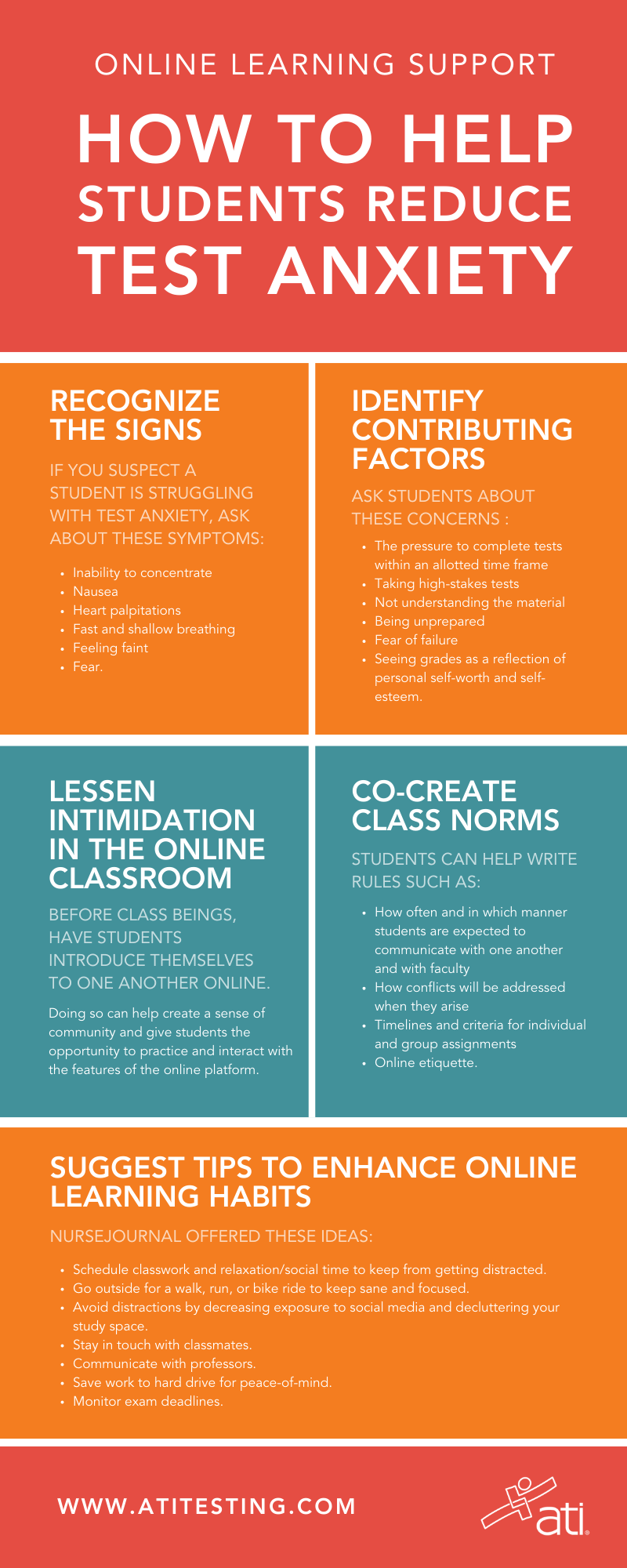
DOWNLOAD THE INFOGRAPHIC AT RIGHT AS A HANDY REFERENCE
Nursing student stress can present itself in recurring headaches, insomnia, and decreased productivity that can lead to depression and anxiety. Not only that, but it can also contribute to serious health problems, such as high blood pressure, heart disease, obesity and diabetes, according to the Mayo Clinic.
It’s vital to keep students’ (and your own) mental health a top priority. Stress management is key. To help students reduce stress, recommend that they:
- Get 7 to 9 hours of sleep per night
- Stay hydrated
- Eat healthy, well-balanced meals
- Exercise regularly
- Keep in contact with family and friends (such as via Google Hangouts, Zoom, or Netflix Party).
Also, remind students of on-campus and virtual resources that your college’s health center provides. Another option is Active Minds, the nation’s premier nonprofit organization supporting mental health awareness and education for students. It has more than 550 campus chapters and offers free access to the multichannel communication forum, Slack. Students can ask questions, start conversations, provide their successes, and engage in direct message (DM) chats.
REDUCING NURSING STUDENT STRESS DUE TO REMOTE-PROCTORED TESTS
“Creepy” is one of the favorite adjectives students use to describe remote-proctored tests. Many have said they felt the use of live, one-to-one webcam surveillance was intrusive — likening the process to being watched by a stranger in a private place. (We’ve researched concerns about remote proctoring to help allay such apprehensions.) This type of pressure can produce or exacerbate test anxiety, but you can offer solutions.
First, fully explain the testing requirements and process so students will be mentally prepared and won’t face any surprises on test day. Do so at the beginning of the semester and reiterate the same information before the test. Also, if possible, administer a practice test.
Some of the most common remote-proctoring security measures you can share are:
- Students should have access to a desktop or laptop computer with an internal or external microphone, webcam, and high-speed internet.
- Before the test, students will need to provide a photo ID, webcam photo, and e-signature verification.
- Once the test starts, the virtual proctor software gets to work. Students’ screens will lock, so they won’t able to open other windows. They will also be monitored by webcam, microphone, and screen recording.
- The software will automatically flag any abnormalities during the assessment, which a security team will then review.
When it comes to studying, no one way is best to prepare for a remote test. Consider recommending these strategies outlined by Stanford University:
- Be aware of course policies.
- Care for yourself by writing a simple schedule.
- Review test strategies (multiple-choice, short-answer essay, etc.).
- Practice by emulating the testing situation (same time of day, same time limitation, same resources available).
- Learn to reduce test anxiety.
RECOGNIZING THE SIGNS OF TEST ANXIETY
 Cynthia Clark, PhD, RN, ANEF, FAAN, specialized in adolescent mental health as a clinician before focusing her efforts on the study of incivility, a topic on which she is now considered among the world’s leading experts. “Experiencing mild levels of anxiety related to taking a test or completing a complicated assignment can sometimes be motivating and give students an edge,” explained Dr. Clark, now Strategic Nursing Advisor at ATI. “However, if stress levels become heightened and prolonged, the result may be full-blown test anxiety, which can affect performance, grades, and potentially the trajectory of one’s career.”
The symptoms of test anxiety may differ from person to person ranging from an inability to concentrate, nausea, heart palpitations, fast and shallow breathing, feeling faint, and fear.
“There are several contributing factors to test anxiety including the pressure to complete tests within an allotted timeframe, taking high stakes tests such as preparing for the nursing licensure exam (NCLEX), not understanding the material, being unprepared, fearful of failure, or seeing grades as a reflection of personal self-worth and self-esteem,” Dr. Clark explained.
“Educators can encourage students to complete study logs to document time spent for upcoming exams, assign required readings in small amounts, and reinforce successful test-taking strategies,” she added. “Practice tests or low stakes (e.g., nongraded) quizzes can be helpful.”
HELPING STUDENTS SUCCEED AT DISTANCE LEARNING & OVERCOME TEST ANXIETY
Distance and remote learning used to be a student’s choice. In the current climate, of course, few have that luxury. Online learning is now a necessity for most students — one that requires the willingness and patience of everyone in education, from deans and directors to faculty and students.
“Before class begins, having students introduce themselves to one another online can help create a sense of community and gives students an opportunity to practice and interact with the features of the online platform,” Dr. Clark suggested.
"NurseJournal" provided its own tips for students adjusting to an online school format:
- Schedule classwork and relaxation/social time to keep from getting distracted. (Apps, such as TickTick and Todoist, can help students organize both aspects of their lives by creating to-do lists.)
- Go outside for a walk, run, or bike ride to keep sane and focused.
- Avoid distractions by decreasing exposure to social media and decluttering your study space. (Apps like Flipd and Moment set daily limits and can even lock you out for specific times.)
- Stay in touch with classmates. (Project management apps like Trello and G Suite allow for real-time collaboration on team projects. Other tools, like Doodle, are helpful for scheduling meeting times with multiple people.)
- Communicate with professors.
- Save work to hard drive for peace-of-mind.
- Monitor exam deadlines.
Dr. Clark offered some final thoughts. “It is also important to co-create class and clinical norms (ground rules or social contracts) so that each student (and faculty member) knows about and agrees to abide by class and course expectations,” she said.
“Some examples of norms include how often and in which manner students are expected to communicate with one another and with faculty, how conflicts will be addressed when they arise, timelines and criteria for individual and group assignments, and online etiquette.”
And, of course, Dr. Clark would remind us all to be empathetic of others’ situations and be civil — both now and when the new normal becomes more familiar.
|
Looking for other ways to support your students? Refer them to the ATI blog for nursing students. They’ll find a wide range of topics to help them navigate their nursing curriculum — both today and in a nonpandemic world. |