KNOW THESE 7 SYMPTOMS OF SOCIAL ANXIETY IN YOUR GEN Z LEARNERS
PUT THESE 9 STRATEGIES INTO ACTION TO HELP DISPEL GEN Z’S CONCERNS
BY JOY WELLER, MSN ED, RN
 No one would blame you if you admitted to having some anxiety about the fall semester. The situation with the pandemic is ever-changing, and many educators are having to deal with new policies this year on masks, distancing, and hybrid learning.
It’s likely no surprise, then, that your students are experiencing similar trepidation. Your youngest students — Generation Z, young people born between 1995 and 2010 — are particularly vulnerable to worries that can impact their learning.
LEARN MORE ABOUT GENERATION Z STUDENTS
Generation Z is reported to be the most anxious generation, and the ongoing pandemic has further contributed to this group’s unease. Specifically, 46% of Gen Z adults report that their mental health is worse now than it was prior to the pandemic. They also report a higher stress level than the average adult.
Other statistics show that 57% of Gen Z adults report symptoms of anxiety and depression, an increase of 8% from the prior 6 months. That anxiety has intensified with the ever-changing condition and unknowns related to COVID-19. (American Psychological Association, 2021)
THE IMPACT OF GEN Z’S WORRIES ON EDUCATION
Declining mental health in Gen Z may be related to numerous issues:
- Politics
- Economics
- job stability
- Concerns regarding chosen major/career path
- Vaccine safety, efficacy, and mandates being implemented at college campuses.
More specifically for educators, Gen Z students report that their education itself is a significant source of stress. Making matters worse, social isolation and loneliness are contributing to increased symptoms of anxiety and depression during the pandemic. (Annie E. Casey Foundation, 2021)
DOWNLOAD THE INFOGRAPHIC AT RIGHT AS A HANDY REFERENCE
THE GROWING TREND OF SOCIAL ANXIETY IN GEN Z
As things begin to open across the country and students return to campuses this fall, social anxiety is also increasing among Gen Z learners. The National Institute of Mental Health defines social anxiety as the “intense, persistent fear of being watched and judged by others.” The innate characteristics of Gen Z learners may increase their likelihood of experiencing social anxiety. In addition to monitoring for symptoms of generalized anxiety and depression, faculty should also strive to recognize and understand symptoms of social anxiety so they can best support students and promote their academic success.
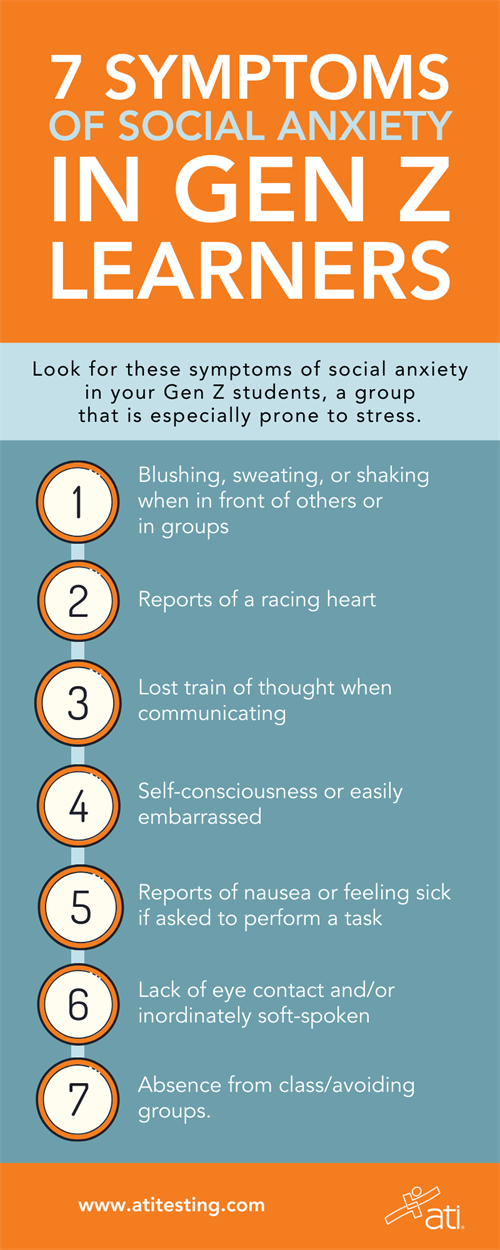
Symptoms of social anxiety include:
- Blushing, sweating, or shaking when in front of others or in groups
- Reports of a racing heart
- Lost train of thought when communicating
- Self-consciousness or easily embarrassed
- Reports of nausea or feeling sick if asked to perform a task
- Lack of eye contact and/or inordinately soft-spoken
- Absence from class/avoiding groups.
STRATEGIES THAT CAN EASE THE APPREHENSIONS OF GEN Z LEARNERS
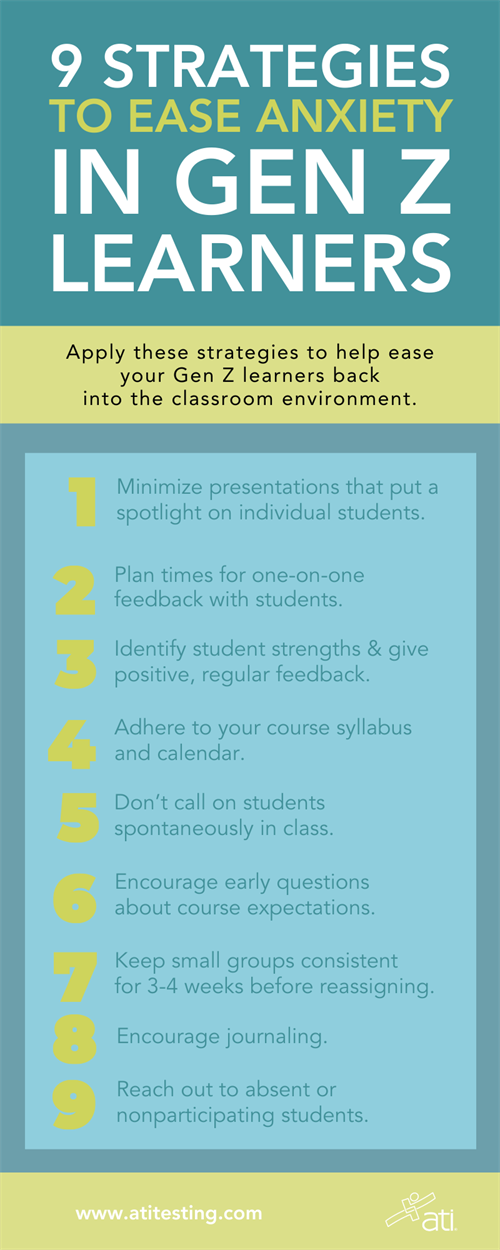 It’s important to keep the characteristics of Gen Z learners in mind and apply strategies that support this group as they transition back to the classroom environment. Some strategies to consider include:
- Minimize presentations that require students to be in front of the class. Reserve necessary presentations for later in the term when students are feeling more confident among their peers and faculty.
- Plan times for one-on-one feedback with students. Secure a safe, distraction-free environment to support focused and clear communication.
- Identify student strengths and provide positive and regular feedback. Feedback should include both planned and unplanned comments to fulfill students’ need to know they are doing well and to support strong faculty/student relationships.
- Adhere to your course syllabus and calendar. Doing so gives students time to plan and prepare for assigned tasks. Gen Z students need to plan and know what is expected.
- Don’t call on students spontaneously in class. The fear of answering something incorrectly in front of their peers increases anxiety in Gen Z learners.
- Encourage students to submit questions or concerns related to course expectations at the beginning of the course. Doing so will assist in eliminating a fear of the unknown (and its resulting anxiety) and supports students’ desire to please faculty.
- When assigning group work, keep groups consistent for 3-4 weeks before reassigning. Consistent groups promote the development of peer relationships and support. They may also promote student confidence.
- Encourage students to journal. They should maintain a journal as they progress through your course, prepare tasks, complete projects, etc. Journaling allows for student self-expression and reflection.
- Reach out to students if they are absent or don’t participate in group assignments. Practice active listening to promote honest communication.
DOWNLOAD THE INFOGRAPHIC AT RIGHT AS A HANDY REFERENCE
PROVIDE HOPE FOR GENERATION Z
A recent survey indicated that 79% of Gen Z adults felt they needed more emotional support than they received the prior year. (American Psychological Association, 2021) If possible, put some extra effort toward providing social and emotional support to students this year and focus on providing strong educational opportunities with clearly defined expectations. Gen Z students need to know that they are supported and cared for and that there is hope for the future.
Your extra efforts will, hopefully, pay off with more successful students who are confident in their knowledge and skills. The world, after all, needs all the nurses for the future that you can help train today.
 Author: Joy Weller, MSN Ed, RN, is the Manager of Post-Grad Solutions — Complete and Global accounts for ATI Nursing. She began with ATI in 2014 and is part of a dynamic team that delivers high quality NCLEX reviews for PN and RN graduates, as well as supporting global nurses as they transition to healthcare in the United States. Weller has more than 19 years of experience in nursing education and combines her expertise in leadership, classroom/online teaching, curriculum development, and faculty mentorship in her current position. Weller has presented on the topics of positive self-talk, finding hope, no shame, and anxiety. She earned her nursing degrees at Fort Hays State University and Indiana Wesleyan University.
REFERENCES
American Psychological Association (2021). Stress in America 2021: One year later, a new wave of pandemic health concerns. Retrieved 8/20/2021. https://www.apa.org/news/press/releases/stress/2021/sia-pandemic-report.pdf
Annie E. Casey Foundation (2021 May 22). Generation Z and mental health. Retrieved 8/19/2021. https://www.aecf.org/blog/generation-z-and-mental-health
National Institute of Mental Health: Social anxiety disorder: More than just shyness. Retrieved 8/16/2021. https://www.nimh.nih.gov/health/publications/social-anxiety-disorder-more-than-just-shyness#part_6255