What's Actually Happening With ATI 'Leaked' Tests for Sale?
3 proof points that ATI takes test security — and cheating — very seriously
ATI takes test security concerns very seriously and promptly addresses any suspected test misconduct. ATI also regularly monitors the internet and public-facing websites for unauthorized sharing of ATI test content.
When the company finds sites that purport to share ATI-test material, the company contacts the website owners and demands that they remove those postings. Often, sites will remove the content within hours of ATI contacting them, and some even proactively remove postings on their own.
Much of the content that you see labeled as current 2019 proctored tests is actually outdated assessments or practice tests. More often, you’ll see content that is not ATI test materials but is misleading postings attempting to drive traffic to their site.
ATI monitors the web daily for unauthorized postings of ATI test content, taking swift action for removal. ATI urges anyone with test-security questions to contact the company so it can take timely action.
1) MAKING TEST SECURITY A NO. 1 PRIORITY
ATI differentiates test security as either test-fraud “cheaters” or test-theft “stealers.”
Test-fraud cheaters are those whose goal is to increase a test score beyond what someone would normally earn.
Test-theft stealers have a different objective: to steal, capture, or otherwise obtain test content illegally for personal gain.
Because both of these test-security concerns are so important, ATI uses 2 primary prevention measures to secure our tests from unscrupulous individuals. The company focuses on:
- Eliminating vulnerabilities and opportunity
- Enforcing consequences.
To demonstrate its commitment to fulfilling these objectives, ATI has an entire team dedicated to maintaining the integrity and security of its test materials. ATI established its Test Security Team in 2012. That was a decade ago, yet this industry is still so new that ATI is one of the few companies with a department dedicated to test security.
The Test Security Team is an example of how ATI invests in the security and integrity of its assessments. Similarly, ATI is continually implementing processes and technology designed to detect whether someone has attempted to compromise its content.
2) CONTINUOUSLY MONITORING TO ENSURE TEST INTEGRITY
To enhance the efforts of its Test Security Team, ATI created a “Test security & exam content-protection program.” The role of this program is threefold:
- Ensure test security. The program focuses on control processes to ensure the validity of results for all exams and assessments that ATI administers.
- Escalate to Legal. ATI consults with its attorneys and, where appropriate, takes legal action designed to stop illegal selling, posting, and unauthorized sharing of ATI’s copyrighted assessment content.
- Manage and report on security incidents. The program tracks all security incidents and escalates each to ATI’s senior management team.
This program has 3 goals related to clients:
- Protect exam content from test fraud and test theft through proactive measures to enable the delivery of scores that clients can trust with valid and reliable results.
- Support and educate clients in the best administration and use of ATI exams to maintain accurate student knowledge assessment.
- Safeguard the integrity of ATI assets and the significant investment of time, energy, and resources required to create them.
Clients have a role in the security of exam content, too. As a partner with ATI, nursing program deans, nurse educators, and adjunct/clinical faculty should:
- Be responsible for setting the tone for exam security with strong academic integrity policies and honor codes within their institutions.
- Ensure students understand the importance of these policies and establish clear disciplinary action for violations.
- Enforce consequences of policy violations when the institution identifies cheating and other forms of test misconduct.
Additionally, ATI employs a variety of technical controls and test designs, including:
- Embedded controls. Built within proctored assessments, these preventive measures alert the proctor if a candidate attempts to navigate away from the assessment, which could indicate exam misconduct or compromise of exam items.
- Application-security reviews. Web-application security reviews identify any potential security risks associated with high-severity vulnerabilities in ATI’s environment. These reviews include using data forensics to compare times and scores for anomalies.
- Enhanced assessment distribution. Since 2014, ATI has randomly distributed sets of items nationwide to decrease item exposure and lessen predictability.
3) COUNTERING MISINFORMATION ON WHAT IS ACTUAL ATI CONTENT
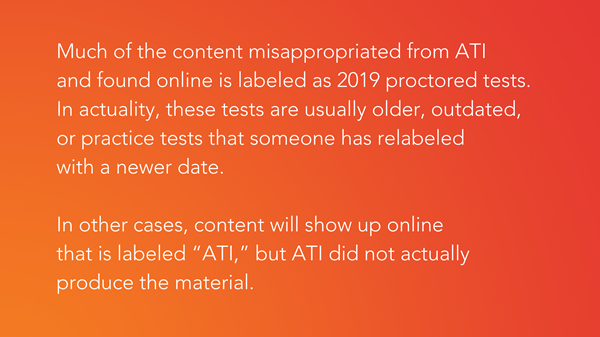
Much of the content misappropriated from ATI and found online is labeled as 2019 proctored tests. In actuality, these tests are usually older, outdated, or practice tests that someone has relabeled with a newer date. In other cases, content will show up online that is labeled “ATI,” but ATI did not actually produce the material. In those situations, ATI’s Test Security Team takes steps to identify whether an authentic instance of infringement is occurring. Where necessary, ATI demands that the site owner remove the material.
For all incidents, ATI conducts investigations into alleged security breaches and runs statistical analysis on every single test attempt each day.
If you are concerned about any specific sites you think are providing ATI test assessments, please relay that information to [email protected] for investigation. ATI also urges clients to continue to raise questions so it can respond in a timely manner. ATI encourages you to employ robust policies around academic integrity and make sure to take disciplinary action when your school confirms test misconduct has occurred.
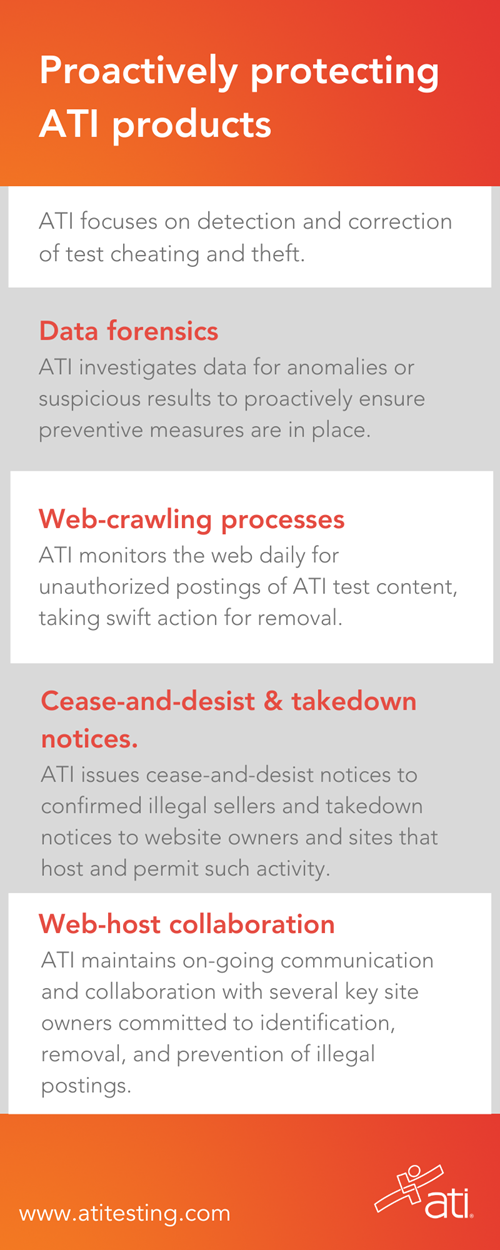
PROACTIVELY PROTECTING ATI PRODUCTS
ATI focuses on detection and correction of test cheating and theft.
- Data forensics. ATI investigates data for anomalies or suspicious results to proactively ensure preventive measures are in place.
- Web-crawling processes. ATI monitors the web daily for unauthorized postings of ATI test content, taking swift action for removal.
- Analysis and investigation. ATI analyzes each reported incident of unauthorized use and misappropriation of its test materials. It also searches and investigates web postings that state ATI test content is for sale.
- Cease-and-desist and takedown notices. ATI issues cease-and-desist notices to confirmed illegal sellers and takedown notices to website owners and sites that host and permit such activity.
- Web-host collaboration. ATI maintains on-going communication and collaboration with several key site owners committed to identification, removal, and prevention of illegal postings.
HOW DOES YOUR PROGRAM ENSURE TEST SECURITY? SHARE IN THE COMMENTS BELOW.