Have a Nursing Education Need? Solve it by Getting a Grant
Writing Grants for Nursing Education Projects (AKA How to Ask Perfect Strangers for Money)
 By Barbara S. Turner, PhD, RN, FAAN
How do you secure funding to support the various challenges facing your nursing program — or nursing education in general? Get a grant! Honestly, it’s much easier than you probably think. Here, I’ve broken it down for you into just a few easy steps.
Identify Your Why in Helping Nursing Education
It may seem obvious, but you need to get specific about what your grant will be used for. Take a look at the big picture and write down how the grant will address it. This info will be useful throughout your grant-writing process as it helps establish a case for support of nursing education.
Find Organizations That Offer Grants
 Many organizations fund projects; you just have to know how to find them. My tip? Do a search of the major nursing education journals. Look for articles on topics that are similar to your grant request. As you review each, refer to the end of the article for acknowledgments of any agency that funded the project. You now know to whom you can apply!
Similarly, do a web search of professional organizations, along with state and local government websites. Look for a section identified as “grants” or something similar. Most will clearly detail what type of projects they are interested in funding, the amount of funding available for any one project, and the maximum length of time for the project.
And keep an eye on your email for notifications about opportunities.
Keep a running list of all the funding agencies you come across whose key area of interest aligns with your grant project.
Become Friends With the Grant Contact
Okay, maybe you won’t become friends, but it certainly is helpful to get in touch with the individual identified as the primary grant contact to request more information. Simply send that person a paragraph or two about what you plan to do and ask if your project is one they would be interested in funding. Your initial project isn’t likely to be an exact match to their interests. But, once you know more specifics about what they find important, you can adjust your plans to fit that funding opportunity.
Download the infographic at right as a handy reference
Read the Instructions (Then Read Them Again)
Once you’ve found an opportunity, the real work begins. And the first step: Pay attention to the instructions; they are not suggestions. See them as rules. If they say a grant should be 70 pages, and you submit 70.5 pages, your grant may be returned. If the instructions state no more than $100,000 is allowed for a grantee’s budget, and you submit a grant with a budget of $100,010, your grant may be returned. The same holds true for formatting your actual application, including font, size of font, and margins.
After you’ve read the instructions once, read them again. And, on the second read-through, highlight the grant’s required elements. Then, as you write your grant, you can cross through each element as you address it.
Also, look carefully for any criteria against which your grant will be reviewed. I call these the “test questions.” After I’ve written my grant, I always check to make sure I’ve answered each and every “test question” in my application.
If you are unsure of any aspect of a funder’s criteria, contact the agency to ask for clarity. I typically send an email so I can get the answer in writing.
Pay Attention to the Details
When I first started writing grants, a wise person told me, “Pretend you do not deserve the grant and write with that mindset.” Those words helped me rather than discouraged me because they made me justify and explain every detail of my request.
Along these lines, then, take care not to assume what people do and do not know. One example is acronyms. They mean different things to different people, so always spell them out on first use. Similarly, be specific on every detail. I have been on multiple grant-review panels where a proposal stated something like, “This project will take place in XXX county and serve that county’s residents.” In that simple sentence, the grant writer implies that we — the grant readers — already know the county, what state it is in, and something about that county’s population. The problem is that we do not! This is particularly important if your application is to a national agency, as opposed to a local one. To provide context, I will often add a state map to my grant application and mark where my organization is located and the counties that will be involved.
These steps are simple, but they help the review panel — and you want to do everything you can to help the individuals on that panel understand your application.
Consider the Format
As mentioned previously, you may have strict instructions on the font, font size, and margins of your grant document. But you should also consider the overall design of your application. After reading through lots of grant proposals, members of review panels get tired; all the grants can start to run together in their minds. The solution: Make your grant stand out. One way: Use plenty of ”white space” as a visual relief from text-dense pages. (Hint: I tend to read grant applications with lots of white space first and save the text-dense grant applications for last. You don’t want your grant to be among those I’m reading when I’m least alert.)
Another suggestion: For visual relief, add spaces between paragraphs, tables to explain details, and — as mentioned previously — a map if necessary. I have tried including cartoons, hoping to give reviewers a laugh. That didn’t go over well, so I don’t recommend that technique. Even so, on two different grants, I altered well-known song lyrics to fit the grants. Both times, those grants got funded! On one of my efforts, I slightly changed the lyrics to, “Trouble! We’ve got trouble! Right here in River City. Oh, yes, we got trouble, trouble, trouble! With a capital T and that rhymes with P and that stands for people.” I then went on to talk about the nursing shortage. Who knows if my song reference made a difference, but I know people later referred to my application as “The Music Man” grant. So, you never know what can make a difference.
Don’t be afraid to make the effort to apply for a grant. You can do it!
About the author: Barbara S. Turner, PhD, RN, FAAN, is the Elizabeth P. Hanes Distinguished Professor at the Duke University School of Nursing.
10 TIPS FOR GRANT-WRITING SUCCESS
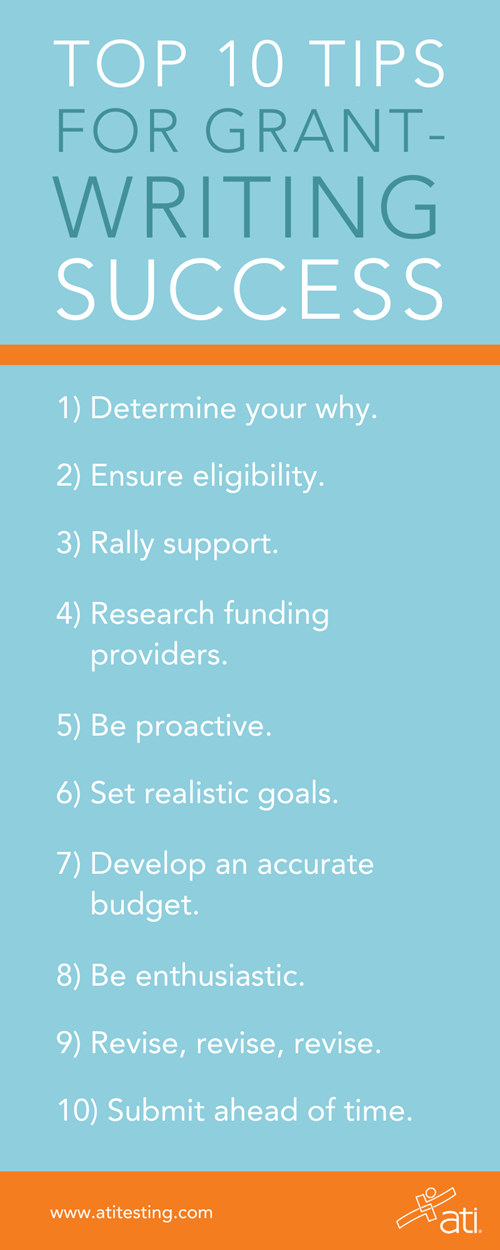
- Determine your why. Decide for what purpose your grant will be used. Doing so helps you look at the bigger picture and can provide guide rails as you’re writing your grant.
- Ensure eligibility. Before you go to the effort of writing a grant, make sure your organization is eligible by researching the grant guidelines. If you are still unsure after reviewing the application details, contact the grant organizer with questions.
- Rally support. Especially if you are in a small community, share details about how your project will benefit the community and then ask for support. The value of your application may increase when you can include community support and related statistics as evidence. Also, consider any organizations with similar interests to your cause, and ask for their support as well.
- Research funding providers. Competition for grants can be intense, so do some research into the funding providers and previous recipients. This step can help identify which grants were previously awarded. Understanding the driving force behind a funding body can influence your case for support.
- Be proactive. The longer you have to prepare for, organize, and write the application, the higher quality your submission will be. Ensure that you set realistic time frames for each requirement and gather information ahead of time. Pro tip: Create a calendar to map out a timeline for writing your grant.
- Set realistic goals. Make sure you define the goals of your project and that they are achievable. Read the grant guidelines and ensure you are a good fit for the funding opportunity. Then make a compelling case as to why your project should be funded.
- Develop an accurate budget. The budget is a way to demonstrate that your project or idea is well-planned, well-conceived, cost-effective, and feasible. A well-developed budget can highlight how achievable your goals are and where you will apply the funding income. Make sure your budget is detailed and — like the previously mentioned advice — highlight how the funding benefits the community if possible.
- Be enthusiastic. Put yourself in the shoes of a grant reviewer whom you can realistically assume is assessing many applications. Be clear and concise in yours, including up-to-date data with clear language. Follow any complex points with a summary of the big picture. Convince the reviewer that your project is exciting and worthy of funding.
- Revise, revise, revise. Ensure no spelling errors, incorrect grammar, or vague ideas will hinder your application. A fresh set of eyes on your application is always a good idea, and don’t be afraid to rewrite as necessary.
- Submit ahead of time. Don’t wait until the last minute to develop your grant. You may encounter unexpected glitches, and you need time to deal with them.
For more tips on writing grants, visit https://www.thegrantshub.com.au/blog/articles/top-10-tips-for-successful-grant-writing.
Don't Miss These 2 Grant Opportunities
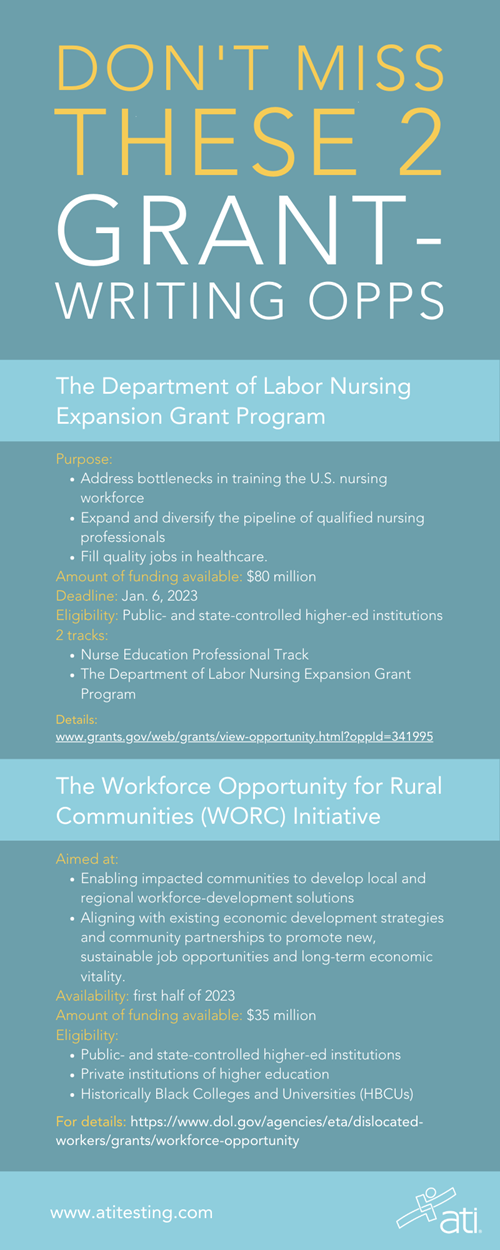
The Department of Labor Nursing Expansion Grant Program
Purpose
- Address bottlenecks in training the U.S. nursing workforce
- Expand and diversify the pipeline of qualified nursing professionals
- Fill quality jobs in healthcare.
Amount of funding available: $80 million
Deadline: Jan. 6, 2023
Eligibility:
- Public and State controlled institutions of higher education [as well as Native American tribal governments and nonprofits that do not have a 501(c)(3) status with the IRS]
Options:
Nurse Education Professional Track:
Aimed at increasing the number of nursing instructors and educators (for classroom and vocational/clinical instruction)
Applicants will propose strategies to improve nurse educator
- recruitment
- preparation
- development
- training
- retention.
Nursing Career Pathways Track:
Aimed at training frontline healthcare professionals, paraprofessionals, and direct-care workers
Applicants will advance their career pathway and attain postsecondary credentials needed for nursing occupations
- Middle-skilled occupations
- require some significant education and training beyond high school (but less than a bachelor’s degree)
- High-skilled occupations
- require a bachelor’s degree or higher.
For details: www.grants.gov/web/grants/view-opportunity.html?oppId=341995
The Workforce Opportunity for Rural Communities (WORC) Initiative
Aimed at:
- Enabling impacted communities to develop local and regional workforce-development solutions
- Aligning with existing economic development strategies and community partnerships to promote new, sustainable job opportunities and long-term economic vitality.
Availability: first half of 2023
Amount of funding available: $35 million
Eligibility
- Public/State controlled institution of higher education
- Private institution of higher education
- Historically Black Colleges and Universities
- Delta and Appalachian regions
- State/county/city government
- Regional organizations
- Independent school districts
- Indian/Native American Tribal Governments
For details: https://www.dol.gov/agencies/eta/dislocated-workers/grants/workforce-opportunity