Why Nursing School Exam Practice and Remediation Matter
The Connection Between Nursing School Exam Practice and Student Success
 Nursing school exam practice questions — typically referred to as assessment questions — and standardized testing are key to tracking and remediating students’ learning to ensure their success in becoming practice-ready nurses.
With the advent of the Next Generation NCLEX (NGN), many educators believed that if they understood the new item types and gave students plenty of practice with them, then their job was done. The task, however, is not quite so easy.
Learn about the research behind ATI’s standardized tests
 For students to be prepared for the new version of the NCLEX that launched in April 2023, they must develop the clinical judgment skills to be safe, competent nurses. Ada Woo, PhD, ATI/Ascend Learning Vice President of Innovative Learning Sciences, says success in developing those skills is tied more closely to assessments than how to answer, say, a “multiple-response — select ‘N’ item type.”
Nursing School Exam Practice's Connection to Remediation
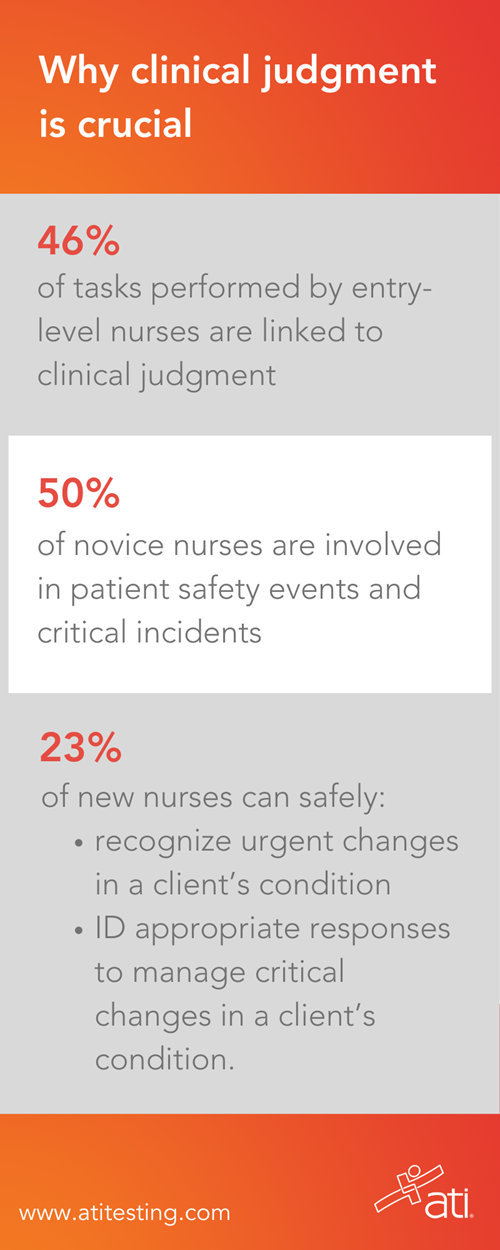
But before you can connect the dots between assessments and clinical judgment, it’s helpful to understand why clinical judgment is important. (See boxed information at right.) Founded in that knowledge, you can more easily trace the connections: assessing ➔ remediating ➔ learning clinical judgment ➔ assessing ➔ remediating, etc.
ATI has offered standardized assessments for nursing education for more than a decade. Now, with the recent changes to the NCLEX, ATI has updated its nursing school exam practice questions to align with the new exam and underscore the importance of delivering safe care. Similarly, ATI has amped up resources to help teach clinical judgment.
Read on to see a list of some of these evidence-based resources. You can also gain a better understanding of the importance of standardized assessments in nursing education and ATI’s stance on high-stakes testing.
Why Clinical Judgment Is Crucial
- 46% of tasks performed by entry-level nurses are linked to clinical judgment.
- 50% of novice nurses are involved in patient safety events and critical incidents.
- Only 23% of new nurses can safely:
- recognize urgent changes in a client’s condition
- ID appropriate responses to manage critical changes in a client’s condition.
Rely on Evidence-Based Tools for Nursing School Exam Practice
Not all assessments are created equal. Look for research-based nursing school exam practice tests such as:
- Test of Essential Academic Skills (TEAS).
- Proven to predict early nursing school performance.
- The most widely used standardized test for nursing program eligibility.
- Comprehensive Predictor (CP).
- A research-based tool with objective details about NCLEX preparedness.
- Helps predict a student’s probability of passing the NCLEX.
- Custom Assessment Builder (CAB).
An expansive item bank for quick, easy creation of nursing school exam practice questions plus the option to create custom items. Helps prep for the NGN:- Add NGN item types to assessments
- Create standalone (bow-tie and trend) or case study items
- Access instructions for creating NGN items directly in the tool
- Apply enhanced scoring options (0/1, +/-, rationale) per NCSBN guidance.
- Content Mastery Series (CMS).
- Provides test data showing students' mastery of NCLEX-specific concepts.
- Updates include RN/PN NGN item types.
The Importance of Standardized Assessments & Nursing School Exam Practice in Nursing Education
Standardized assessments aid in:
• Developing practice-ready nurses.
To graduate competent, safe-practicing professionals, “Standardized exit exams … should be embraced as evidence-based, academically rigorous evaluation tools.”
• Remediating to develop crucial knowledge and skills.
“These tests can identify weak areas.” Research shows remediating — practicing “active retrieval of knowledge” — improves students’ “long-term meaningful learning.”
• Ensuring use of the highest-quality test items.
Experts with “the necessary resources to develop high-quality, rigorous test items similar to the NCLEX-RN” are responsible for today’s standardized tests.
• Preparing for the Next Generation NCLEX.
The NGN is more cognitively complex than the previous version of the exam. Its multiple interacting elements require “a great deal of computational power in working memory. If test-takers have not encoded that information for easy retrieval and use, their ability to answer … [is] severely diminished.”
STANDARDIZED TESTS, NURSING SCHOOL EXAM PRACTICE, & HIGH-STAKES TESTING
The Accreditation Commission for Education in Nursing (ACEN) says the use of standardized tests for high-stakes testing is “not a best educational practice and is strongly discouraged.” (Many state boards suggest limiting high-stakes tests to 10 percent or less of a student’s grade.) Similarly, ATI does not design — nor recommend — its tests for high-stakes purposes. Instead, use ATI nursing school exam practice assessments to:
• Better understand student comprehension of key concepts
• Predict students’ probability of success in high-stakes situations
• Follow up with focused remediation to strengthen knowledge.