Building a Respectful Learning Environment: 5 Strategies to Squelch Incivility in Your Classroom
Incivility among nursing students is creating toxic environments in which faculty experience increased stress, burnout, and job dissatisfaction. The impact of these behaviors is far reaching. Research shows that the presence of incivility can negatively affect student learning and the preparedness of new nurses entering the workforce (Clark et al, 2021; Fontenot et al, 2024).
What behaviors are common expressions of incivility?
The term incivility refers to a range of subtle or overt behaviors that demonstrate a lack of respect for other people. And although these behaviors are not unique to academic nursing programs, their high incidence there is striking.
Common incivility behaviors cited by nurse educators include:
- rudeness
- bullying
- harassment
- disruption of the classroom
- making belittling comments
- refusing to participate in group work.
Faculty members usually bear the brunt of student incivility, but they are not the only people affected. Fellow nursing students can also be the targets of rudeness, bullying or harassment.
Why is incivility among nursing students so prevalent today?
The rise of incivility among nursing students is a topic of discussion and study. A panel of nurse education experts and faculty explored this issue during an “Ask ATI” webinar in May 2024. Janet McMahon, DNP, MSN, RN, ANEF, a Client Success Nurse Educator Strategist at ATI, facilitated an interactive forum in which ATI experts and faculty participants shared their experiences with incivility and offered practical strategies to foster greater civility in nursing programs. (Find future Ask ATI events on the Nurse Educator Event Calendar.)
 During the webinar, faculty attendees reported encountering student behaviors including bullying, flip attitudes (e.g., eye rolling during conversation), entitlement, disengagement, power struggles, blatant violation of rules, and outward hostility.
As they cited these examples, they acknowledged that addressing the behaviors requires an understanding of why students exhibit them in the first place.
Multiple faculty members shared their thoughts on causative factors. They included:
- stress (financial, academic, etc.) associated with being a nursing student
- changing demographics in today’s nursing student population
- difficulty balancing life responsibilities with coursework
- cultural and/or generational differences that lead to conflict.
The webinar participants agreed that addressing incivility requires faculty to establish and communicate clear behavioral expectations. Another strategy they recommended is to develop a code of conduct that outlines expected behaviors and the consequences for incivility.
What resources are available to help faculty curb incivility?
Research shows that by implementing civility training, nursing programs can reduce problem behaviors and graduate new nurses who are less likely to engage in incivility once in the workforce. Training can include:
- workshops on conflict resolution, communication skills, and stress management
- faculty-led cognitive rehearsal to prepare students for challenging interactions
- simulation modules that teach students to recognize and respond to incivility.
A study by Mahalia G. Barrow, EdD, RN, and Melondie R. Carter, PhD, RN (Barrow & Melondie, 2024) found that the use of simulation modules to teach students about incivility improved their self-efficacy on this issue. They determined that by providing a safe environment to observe and learn about identifying and addressing incivility, students learn ways to cope with the effects of the behaviors and develop increased resilience.
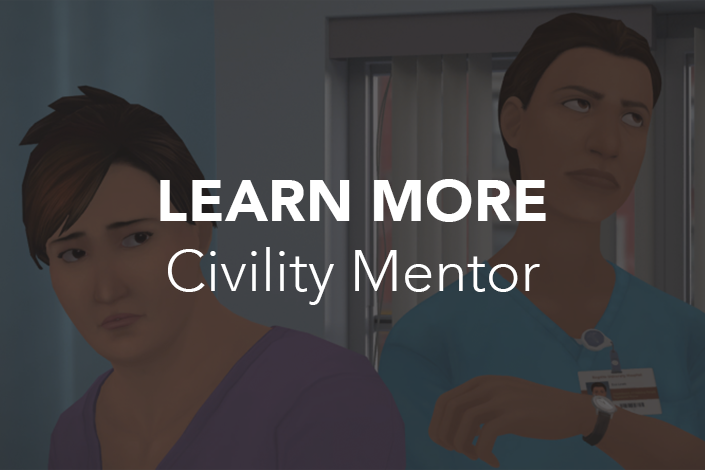
 The teaching strategy used in the study is Civility Mentor, a series of four simulation modules developed by ATI to teach students not only how to recognize and respond to incivility, but also how to foster civility.
In an interview, Dr. Barrow explained that her interest in civility stems from her experience as a bedside nurse and educator in a cardiac ICU, where she observed the toll of incivility firsthand. One year she oriented 35 new nurses who took positions in the ICU, but 12 months later, only five of them still worked on the unit.
“Most of them left because of how they were being treated by other members of the staff. It was incivility, but I didn’t know the word for it then,” said Dr. Barrow, who is now a Clinical Assistant Professor at the University of Alabama Capstone College of Nursing. “I knew that wasn’t how it should be, so I wanted to dig a bit deeper and find out what we could do to help keep our nurses working in nursing.”
She selected incivility as the focus of her doctoral thesis in 2022 and sought a way to empower nursing students to recognize, name, and navigate these behaviors effectively. She learned that Civility Mentor is included in the ATI solutions available to University of Alabama students, and quickly recognized that it provided the preventive strategy she was seeking. Dr. Barrow incorporated Civility Mentor as an optional activity at the end of a clinical medical-surgical unit, and the majority of students completed the modules.
“First and foremost, Civility Mentor boosted the students’ confidence in their ability to recognize and respond to incivility,” she said. “They loved the vicarious aspect of the learning, as well as the virtual coach so that they could receive immediate feedback while in a safe place. They felt that their ability to address conflict improved.”
Dr. Barrow’s commitment to integrating civility education into nursing curricula is growing. She presented on this topic at the 2024 National Nurse Educator Summit, where she connected with attendees who now are partnering with her to perform further research involving Civility Mentor.
Civility Mentor provides 4 simulations focused on the key aspects of civility
In Civility Mentor, students build their capacity to empathize with and advocate for clients as they learn, practice and apply techniques in effective communication, conflict negotiation, stress management, self-reflection, professional conduct and more. The four detailed simulations present conflicts in peer-to-peer interactions, student-to-preceptor relationships and other commonly experienced situations.
- Simulation 1 focuses on the foundations of professionalism and civility and educates students in perspective, empathy, and the importance of norm-setting to support safe patient care.
- Simulation 2 covers professionalism and civility in the academic environment and focuses on the stress associated with pursuing a nursing degree. It provides techniques to balance work, life, and school responsibilities and to cope with stress in healthy ways.
- Simulation 3 focuses on civility and patient safety in the clinical environment and shows how incivility negatively affects teamwork, quality care, and most importantly, patient safety. The module emphasizes every nurse’s ethical and professional obligation to foster civility, to address conflict, and to communicate respectfully to protect patient safety.
- Simulation 4 covers professionalism and civility in nursing practice and shares the negative impact of incivility on colleagues, patients and the healthcare team. Students learn the importance of effective communication and conflict negotiation, and how to use evidence-based approaches to respond to uncivil encounters in order to protect patient safety and promote teamwork and collaboration.
5 faculty strategies to foster civility and professional behavior in students
In addition to curriculum and program strategies, actions by faculty are essential to cultivating student civility. Based on suggestions made during the ATI webinar and their expertise in nursing education, Dr. McMahon and ATI Nursing Content Strategist Kelly Simmons, DNP, RN, identified five strategies to achieve that goal:
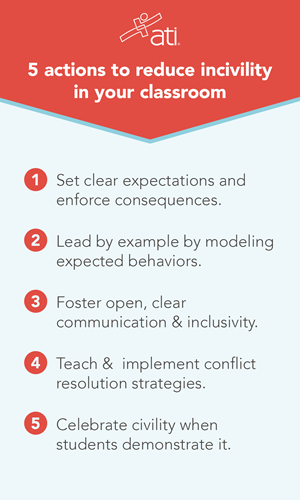
1. Set clear expectations and enforce consequences: Create norms that clearly state expected and acceptable behavior by students and faculty. When incivility occurs, it's important to address it immediately and consistently. Consequences should be fair, appropriate, and known to all students to deter future incidents. Consider creating a Civility Committee.
2. Lead by example: Model expected and acceptable behavior in all learning environments, demonstrating integrity, respect, and kindness in every interaction.
3. Foster open communication while cultivating an inclusive environment: Encourage students to express their thoughts and concerns respectfully, and provide opportunities for all students to be heard.
4. Implement conflict resolution strategies: Teach students effective conflict resolution skills. Provide role-playing scenarios and discuss potential conflicts to prepare students to handle disagreements in a professional manner.
5. Celebrate civility: Recognize and reward examples of civility among students. Highlighting positive behavior reinforces the importance of maintaining a respectful and professional learning environment.
By role modeling civility and addressing incivility with directness, nurse educators can create a positive learning atmosphere that not only benefits students but also sets the stage for their future roles as safe, compassionate nurses.
References
Barrow, M. G., Carter, M. R. (2024). The effects of an incivility-based virtual simulation on nursing students perceived self-efficacy. Teaching and Learning in Nursing, 19 (2), 170-174. https://doi.org/10.1016/j.teln.2024.02.021
Clark, C. M., Landis, T. T., Barbosa-Leiker, C. (2021). National study on faculty and administrators’ perceptions of civility and incivility in nursing education. Nurse Educator, 46 (5), 276-283. DOI: 10.1097/NNE.0000000000000948
Fontenot, J., Hebert, M., Morris, D. (2024). Systemic antecedents of academic incivility in nursing: an integrative review. Teaching and Learning in Nursing, 19 (2), 192-201. https://doi.org/10.1016/j.teln.2024.01.015