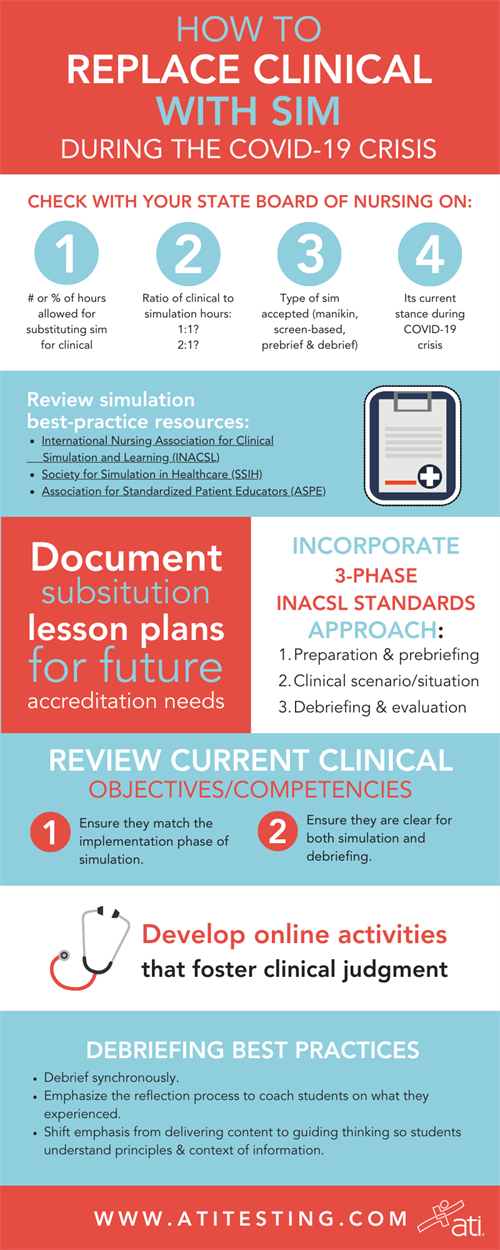
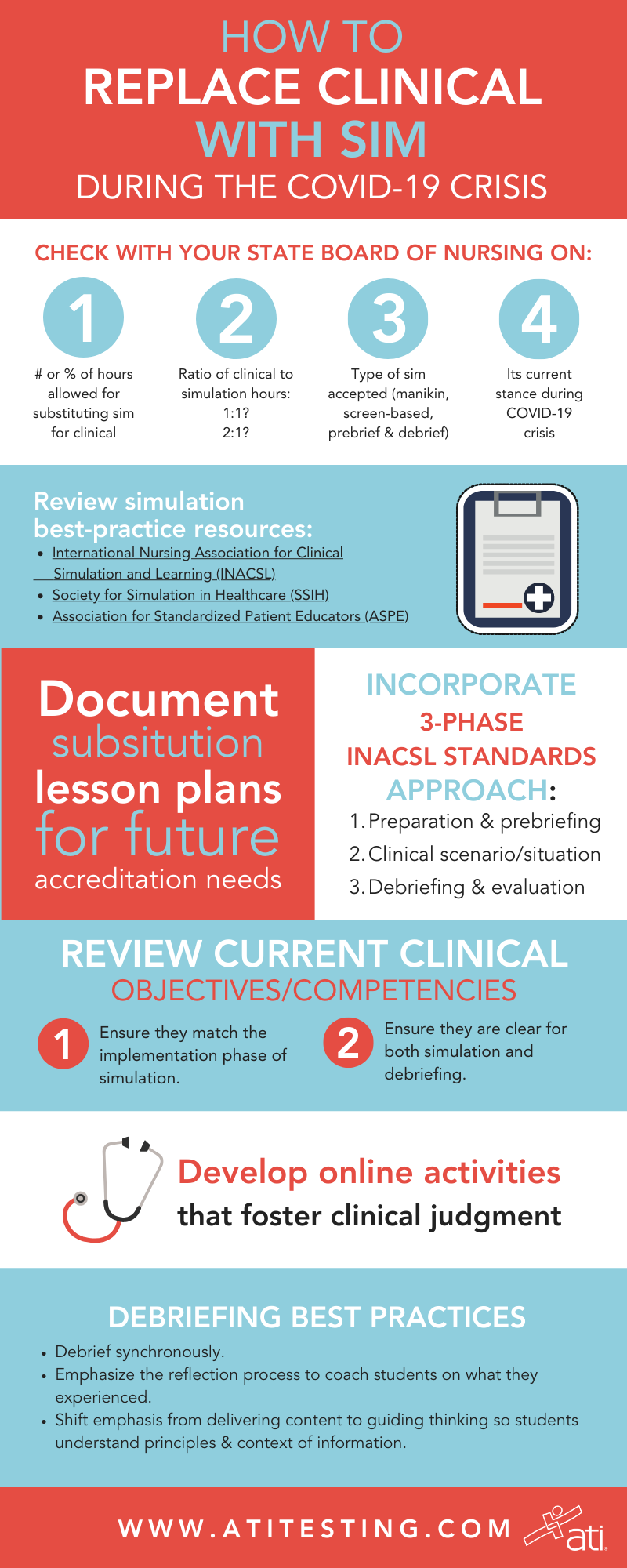
HOW TO REPLACE CLINICAL WITH SIM DURING THE COVID-19 CRISIS
DOWNLOAD THE INFOGRAPHIC AS A HANDY REFERENCE.
 Check with your State Board of Nursing.
Requirements regarding the substitution of simulation for clinical hours are different state to state. And, right now, those requirements are changing day to day during the pandemic crisis. Thus, it’s crucial for you to check with your specific state to review your board’s decisions on:
- the number or percentage of simulation hours that can be substituted for clinical hours
- the ratio of clinical hours to simulation hours
- the type of simulation deemed acceptable (manikin-based, screen-based, prebrief and debrief)
- Its current stance during the COVID-19 crisis.
Also check with the National Council of State Boards of Nursing for regularly updated information.
Review simulation best-practice resources.
Take advantage of information offered by the major organizations that work specifically in the area of clinical simulation:
- INACSL: International Nursing Association for Clinical Simulation and Learning
- SSIH: Society for Simulation in Healthcare
- ASPE: Association for Standardized Patient Educators.
Document your lesson plans for substitution for future accreditation needs.
Individual Boards of Nursing may currently be relaxing guidelines and regulations during the COVID-19 crisis. Nevertheless, they will still require documentation of your lesson plans and their implementation if you have an accreditation visit in the near future or if you plan on continuing to use screen-based simulation after the crisis. Take steps now to save time in the future.
Incorporate the 3-phase INACSL Standards approach.
INACSL divides the simulation experience into 3 phases. Each is crucial to ensuring the experiences are as meaningful and effective as possible. Incorporating each of them into your lesson plans ensures you are following best practices:
- Preparation and prebriefing
- Clinical scenario/situation
- Debriefing and evaluation
Review current clinical objectives/competencies.
Take a hard look at the clinical objectives/competencies that your program and faculty are currently using. Then:
1. Ensure they match the implementation phase of simulation.
2. Ensure your simulation’s objectives and debriefing are similarly clear.
Develop online activities that foster clinical judgment.
Take advantage of the fact that simulations assist students at the application level of learning. Make sure each activity helps them practice decision-making and problem-solving.
Debriefing best practices
- Debrief synchronously.
- Emphasize the reflection process to coach students on what they experienced during the simulation.
- Shift the emphasis of the debriefing from delivering content to a focus on guiding the process of thinking. Think less about telling students how to perform and more about helping them understand the principles and context of information they’re learning.
Remember, too: The situation during this pandemic may be the first time that students have interacted in a true online environment for instruction. Because of their variety of learning styles, the comfort level of transitioning to online may be more challenging for some learners — and faculty. Be patient with yourself and your students. You don’t have to be perfect. Just be willing to try.
Sources:
- Foronda, et al, 2020; Gordon, 2017
- Sullivan et al. (2019)
- Billings and Halstead, 2020