What are students' options for nursing clinical experience?
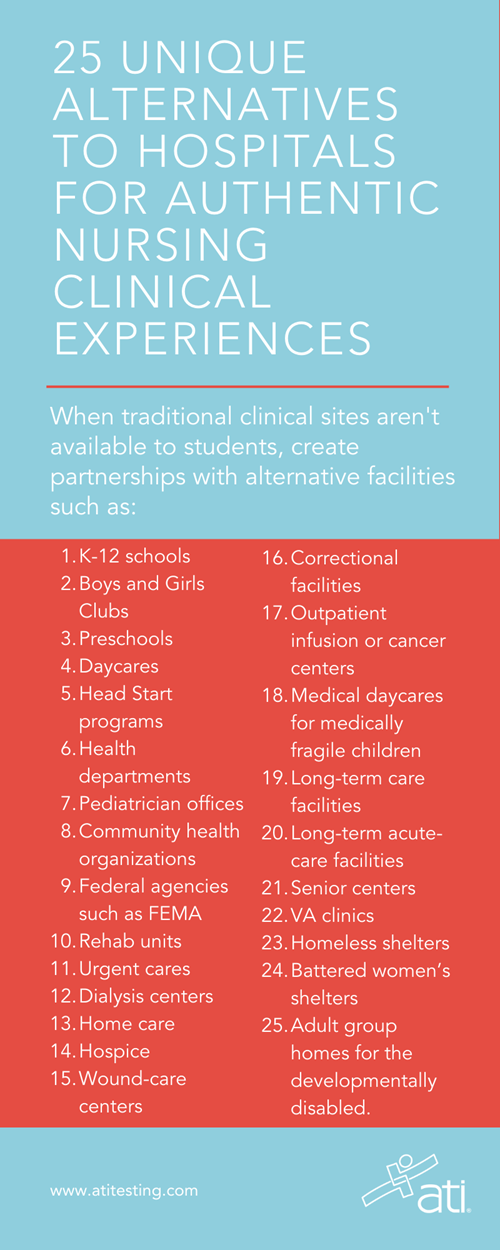
25 unique alternatives to hospitals for authentic nursing clinical experience
 Delivering real-life nursing clinical experience to students is a crucial aspect of their education. But, in the last few years, the pandemic limited opportunities at clinical sites, particularly hospitals. Many providers didn’t want the liability of exposing students to COVID-19, while others laid off staff to moderate financial losses after being forced to discontinue elective procedures. And, with fewer staff, those providers had fewer preceptors available to oversee student nurses.
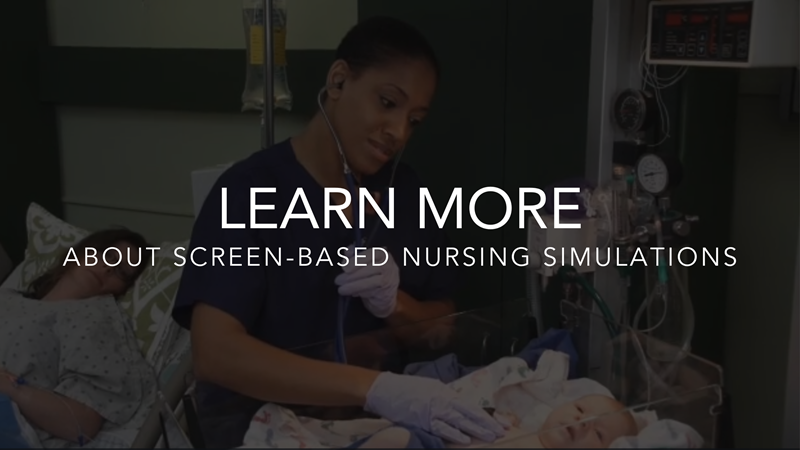
LEARN MORE ABOUT SCREEN-BASED NURSING SIMULATIONS
EXACERBATING THE SCARCITY OF NURSING CLINICAL EXPERIENCES
Most recently, just before the 2022 winter holidays, the existing number of clinical sites only got smaller; hospitals began experiencing a new wave of overcrowded facilities and staff shortages due to the triple whammy of COVID-19, the flu, and RSV. The result: Many facilities had to — once again — forego preceptorships.
IDENTIFYING CREATIVE OPTIONS FOR NURSING CLINICAL EXPERIENCES
Luckily, last summer, some educators began anticipating the possibility of a continuing scarcity of clinical sites. These forward-thinking faculty began exploring other options to replace the traditional hospital experience. In August 2022, for example, NurseJournal published an article on the topic: “Alternative clinical experiences for registered nurses.” In it, the author offered a host of opportunities for nursing programs to consider.
In particular, the article suggested that faculty consider facilities that weren’t as likely to be overwhelmed with COVID-19 patients.
“Some alternative locations for live interaction with various types of patients include nursing homes or long-term care, urgent-care centers, dialysis centers, psychiatric facilities, behavioral health facilities, acute-care drug-rehab facilities, community care centers, home care, hospice centers, and military or VA facilities,” the article stated.
EXPLORING HOW TO USE ALTERNATIVE NURSING CLINICAL EXPERIENCES
In researching this topic, we saw a question about clinical alternatives posed in an online forum of nurse educators. Faculty responded to the query with an abundance of advice on clinical options.
Here, we offer some of educators’ top suggestions. We’ve also included their advice on how you to best take advantage of these facilities for the most beneficial real-life experience.
ANOTHER ALTERNATIVE FOR NURSING CLINICAL EXPERIENCE
Don’t forget that you can also supplement up to 50% of clinical experience with simulation, according to research by the National Council of State Boards of Nursing. The 2014 National Council of State Boards of Nursing (NCSBN) National Simulation Study stated that simulation could replace up to 50% of traditional clinical time “without any effect on clinical competency, comprehensive nursing knowledge assessments, NCLEX pass rates, or overall clinical competency after six months of post-licensure practice.”
Christine Heid, PhD, RN, CNE, an ATI Consulting Nurse Educator who is a Certified Healthcare Simulation Educator (CHSE) and 2017 member of the International Nursing Association for Clinical Simulation Learning (INACSL - CAE Healthcare) Fellowship Program, also suggested reviewing the March 2020 position statement released by INACSL and the Society for Simulation in Healthcare (SSH). Those organizations said they “support the use of virtual simulation as a replacement for clinical hours for students currently enrolled in health sciences professions (i.e., nursing students, medical students) during the current public health crisis caused by COVID-19.”
Their statement continued:
“We can attest that virtual simulation has been used for over a decade successfully. Further, research has repeatedly demonstrated that use of virtual simulation — simulated healthcare experiences on one’s computer — is an effective teaching method that results in improved student learning outcomes.”
A BROAD LIST OF ALTERNATIVES FOR NURSING CLINICAL EXPERIENCES
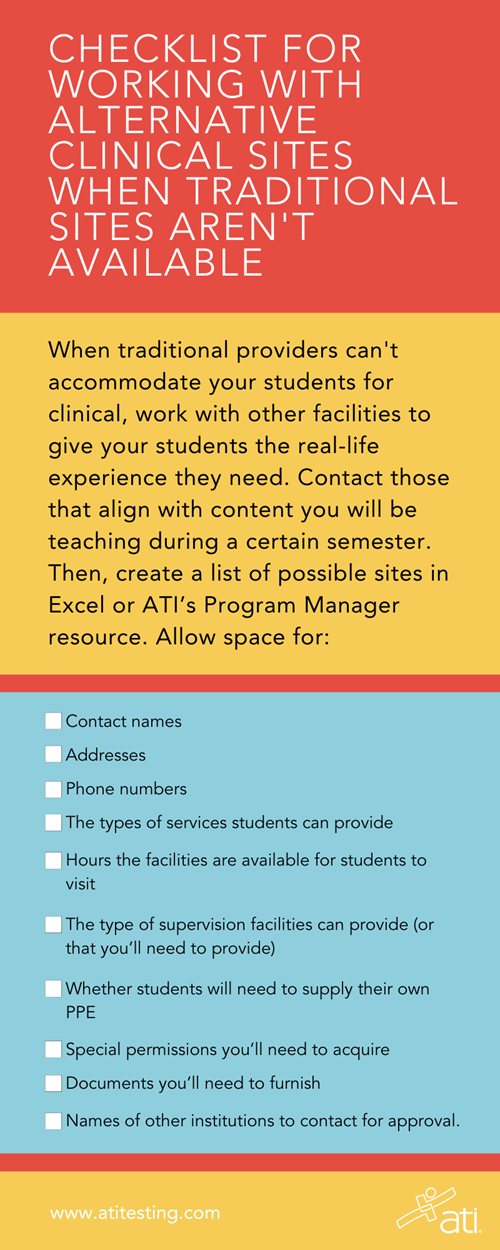
You may be surprised at how willing facilities within your community are to provide opportunities for your students. Contact those that align with content you will be teaching during a certain semester. Create a list of possible sites, such as in an Excel sheet or using ATI’s Program Manager resource.
Allow space for:
- contact names
- addresses
- phone numbers
- the types of services students can provide
- hours the facilities are available for students to visit
- the type of supervision facilities can provide (or that you’ll need to provide)
- whether students will need to supply their own PPE
- special permissions you’ll need to acquire
- documents you’ll need to furnish
- names of other institutions to contact for approval.
For facilities that are unsure or think nursing students will be a burden, explain how the experience would work. Describe the services and support your students can provide, as well as how valuable the experience will be to your community’s future healthcare needs. Setting up these relationships may take time initially, but the long-term result will be the experiences that your students would never receive in a typical bedside situation.
Following are facilities to consider as alternative nursing clinical experience locales:
- K-12 schools
- Boys and Girls Clubs
At facilities with young children, your nursing students can help educate kids on topics such as car and bike safety, diet and exercise, and even how to cope with stress. They can also distribute meals to at-risk children or perform sports assessments.
- Preschools
- Daycares
- Head Start programs
- Health departments
- Pediatrician offices
In more formal environments in which children are treated, such as the previous 5 suggestions, your students can aid in checking development milestones, giving immunizations, performing eye exams, measuring height/weight, screening blood pressure and pulse, and teaching hand-washing or teeth brushing. Professional settings also provide opportunities for students to shadow the practice’s nurses.
- Community health organizations
Cities and counties often provide services to homeless people via shelters or call on the elderly in their homes. Suggest ways that your nursing students can aid these organizations.
-
Federal agencies such as FEMA
During an actual disaster, it’s easy to identify opportunities for nursing students to get real-life experience. But students can also help with preparations for future emergencies.
- Rehab units
- Urgent cares
- Dialysis centers
- Home care
- Hospice
- Wound-care centers
- Correctional facilities
In locations such as those above, where patients may be more fragile care or require immediate oversight by healthcare staff, students can offer support in less-direct ways. For example, they can conduct telehealth interviews, aid with in-person assessments, and shadow the professional nursing staff.
- Outpatient infusion or cancer centers
If these types of facilities don’t allow a student to provide hands-on support, they can gain a lot of knowledge by observing nurse navigators, pharmacists, and clinic nurses in action.
- Medical daycares for medically fragile children
Student nurses can gain a variety of experiences in these facilities, from simply interacting with children to supporting PT/OT/speech services and aiding with assessments.
- Long-term care facilities
- Long-term acute-care facilities
- Senior centers
- VA clinics
Facilities in which clients live full-time or for long stretches can give student nurses the option to deliver hands-on services. But these sites also allow nursing students to learn empathy as they care for and deliver attention to clients who are often without visitors or family.
- Homeless shelters
- Battered women’s shelters
- Adult group homes for the developmentally disabled.
The options for real-life experiences are abundant at facilities such as the previously 3 listed, especially those aimed at women’s health. One especially innovative idea suggested by an educator in a Facebook group was for students to set up health fairs with “booths” to educate clients on nutrition, STDs, meds compliance, COPD, and how to stop smoking.
HAVE YOU IDENTIFIED UNIQUE ALTERNATIVES FOR YOUR STUDENTS’ NURSING CLINICAL EXPERIENCES? SHARE THEM IN THE COMMENTS BELOW.