Teach Nursing Students How to Recognize Cues Using the Engage®️ Series
How to Develop Cue Recognition and Help Students Build Clinical Judgment Skills
Evidence shows that a high percentage of college students do not read assigned textbook materials.1,2 Reasons cited in the literature include inadequate motivation, poor reading or comprehension skills, time limitations, and perhaps most importantly, perception that the assigned textbook reading is not important.
This problem is not new. But it is one that can be addressed by delivering necessary educational information in a way that will thoroughly engage students.3 ATI has developed an evidence-based digital solution as a replacement for nursing textbooks, called The Engage Series. This interactive nursing education resource can effectively prepare students for the NCLEX and for practice. (Read more about the transition from textbook to interactive learning in ATI’s special report, The Learning Shift.)
For information on The Engage Series, click here.
This article is the first in a series that explores how Engage can improve student understanding of core curriculum and ensure the development of clinical judgment in specific ways. This segment focuses on how Engage Fundamentals, one of several solutions in the Engage series, teaches students how to recognize cues in order to make appropriate patient care decisions.
 Amanda Jamison, Lead Product Training Specialist for ATI Nursing Education, explained in a recent webinar that the unique, appealing features built into Engage “help students connect what they learn with real-life practice experiences.” This allows students to “strengthen their knowledge of clinical judgment in order to prepare for NCLEX and beyond,” Jamison said. View the recording of this webinar here.
The Importance of Developing Clinical Judgment in Nursing Students
NCLEX test plan changes that took effect in April 2023 require licensure candidates to clearly demonstrate clinical judgment when answering NCLEX questions. The National Council of State Boards of Nursing (NCSBN) developed the NCSBN Clinical Judgment Measurement Model (CJMM) as a framework for measuring clinical judgment and decision making, and the CJMM supports the NCSBN’s development, classification and scoring of test items.
The ATI Guide for Clinical Judgment is based on the CJMM and was created to assist nurse educators in the development and implementation of learning materials to promote clinical judgment throughout students’ nursing education experience and transition into practice. It focuses on three major areas of nursing practice:
- factors to consider
- clinical judgment functions
- expected responses and behaviors.
Faculty can use the ATI Guide for Clinical Judgment as a framework for creating learning activities such as:
- scenarios for simulation
- writing unfolding case studies
- developing test items.
The image below is a representation of the core concepts in the ATI Guide for Clinical Judgment. It depicts the relationship of approaches that foster this essential skill: Tanner’s Clinical Judgment Model, the nursing process, and the Clinical Judgment Action Model (CJAM).
At the center of this diagram, the 6 clinical judgment functions are listed; these form the foundation of building clinical judgment.
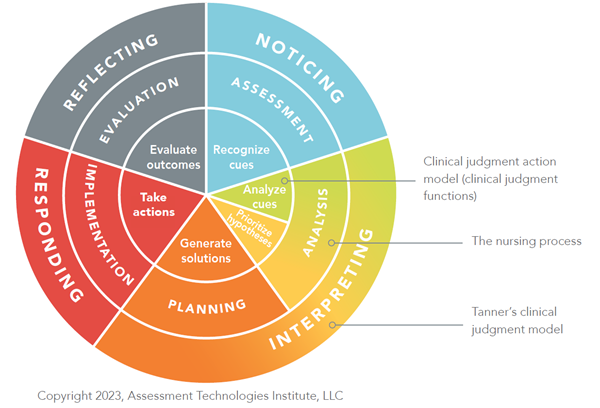
Teaching clinical judgment functions to nursing students
The 6 clinical judgment functions identified by the NCSBN are:
- recognizing cues
- analyzing cues
- prioritizing hypotheses
- generating solutions
- taking actions
- evaluating outcomes.
The recognition of cues is in direct alignment with the assessment phase of the nursing process and the noticing phase of Tanner’s Clinical Judgment model.
“Here at ATI, we have detailed definitions for each of the 6 clinical judgment functions as well as expected responses and behaviors,” Jamison said. “This helps us to ensure that nursing students know what recognizing cues involves, that they know how we assess this recognition, and that we can help students strengthen their abilities.”
Jamison said that Engage helps faculty determine whether nursing students recognize cues by determining the following about their review of a client health history:
- Can the student recognize what is relevant related to a particular disease or disorder?
- Can the student read a provider note and understand what is of concern?
- Can the student read a provider note and determine what is expected next in terms of nursing care and the management of the client?
Developing Cue Recognition in Nursing Students
Using the Engage Fundamentals module on hygiene, Jamison highlighted a few examples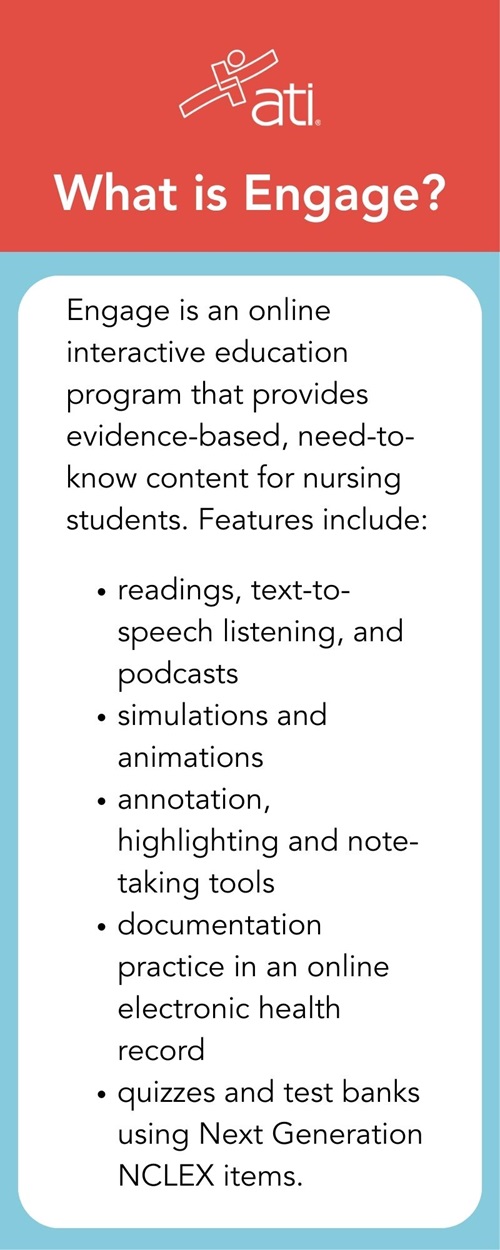 that help students learn to recognize cues and how faculty can use the resource to reinforce what was learned. During this module, students learn about hygiene needs that are common in clients. In the section that focuses on bathing and foot care, students are prompted to look for cues while completing a hygiene check. Faculty can reinforce this education during class. In the hygiene module, Jamison explained that faculty could follow up to determine whether students:
- noticed the color and temperature of the client’s lower extremity
- recognized the edema present in one of the client’s feet
- observed the sock line on the client's lower calf.
“A single image contains multiple cues for nursing students to recognize,” Jamison said. During the virtual applications/simulations, students are provided with many decision points, starting with the recognition of cues. All their decisions are tracked throughout the simulation. At the conclusion of each module, students can review how they did, where they made the correct decisions, and where they made incorrect decisions. This feedback enhances and solidifies each student’s learning.
Jamison also referenced the nutrition module within Engage Fundamentals as another illustration of teaching the use of cues. In this module, students learn about the important components of a balanced diet and the effects of a poorly balanced diet. Then, Engage uses simulated client interactions to present opportunities to recognize cues that indicate poor nutrition. For example,
- Does the student note client report of weight gain or loss, or of hunger?
- Does the student recognize poor dentition as a cue for poor nutrition status?
- Does the student notice anything about the client’s clarity of thinking that could indicate a nutrition deficit?
- Does the student know what lab results point to inadequate nutrition?
“Recognizing cues while learning how to assess clients is absolutely fundamental to all that nurses do,” Jamison said. Engage Fundamentals contains 40 lessons that build the recognition of cues, plus the 5 other clinical judgment functions.
Transitioning to Interactive Learning Materials to Develop Clinical Judgment
Wondering what it feels like to move away from traditional textbooks in favor of impactful, interactive digital learning with Engage? A university in the Southeast was an early adopter of Engage. The nursing program’s director told ATI Nursing Education that her faculty members had long remarked that students weren’t reading their assigned books. “Students really, truly do not read the textbook,” she said. “So, I said, ‘Let's give them something that appeals to them.’”
The director and her team organized the curriculum in their usual manner as they implemented Engage. “I divided the semesters into weeks, and then I identified the content for each week,” she said. “Using a modular format, I placed the Engage Fundamentals content at the top, and I told students to go through that content first. Then, if they needed supplemental material, they could use their textbook as a reference guide. So, we used the book, but differently than what they were used to.”
One technique the director employed was to “encourage students to go back through the Engage lessons over and over again.” At the end of the semester, faculty asked the students which resources they used most, and the majority answered that they relied on Engage Fundamentals.
Read more about how this nursing program successfully transitioned from 100% textbook teaching to hybrid interactive learning on the ATI Educator blog.

References
- Anning, R. (2019). Are textbooks becoming obsolete? https://elearningindustry.com/textbooks-becoming-obsolete
- Zeivots, S. 2021. Up to 80% of uni students don’t read their assigned readings. Here are 6 helpful tips for teachers. The Conversation. https://theconversation.com/up-to-80- of-uni-students-dont-read-their-assigned-readings-here-are-6- helpful-tips-for-teachers-165952
- Phillips, B.C., Johnson, J., Khalid, N., Zapparrata, N., Albright, G. (2023). Benefits of an online interactive educational program over traditional textbooks. Nurse Educator. DOI: 10.1097/NNE.0000000000001398