Why Interactive Learning Solutions Are Better Than Textbooks in Nursing Education
Interactive Learning in Nursing Education is Becoming the New Best Practice
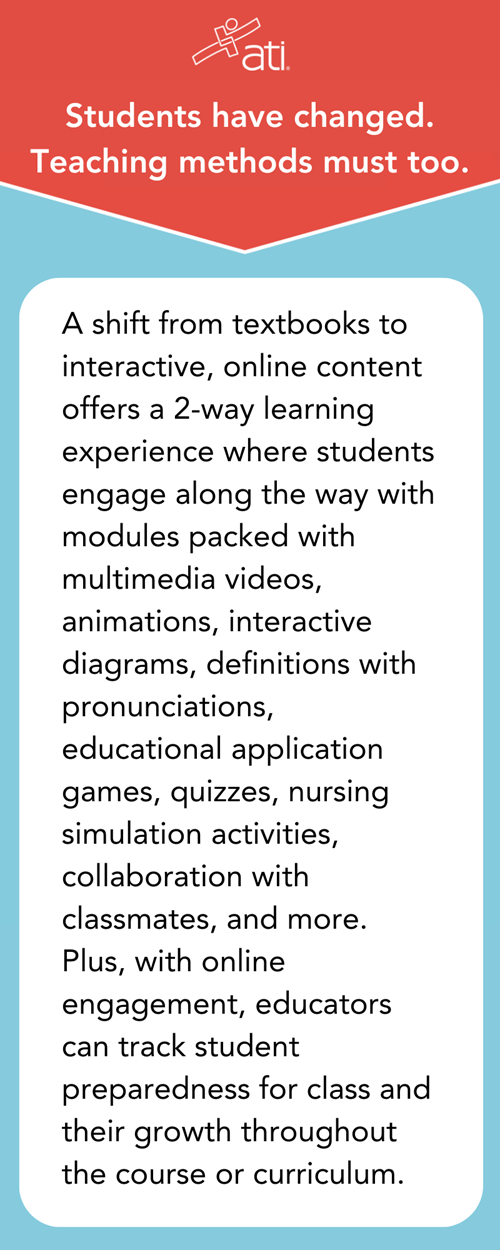 Textbooks have been a tradition in education for decades. But, with the advent of technology, online nursing interactive learning has emerged as more effective, engaging, and dynamic. Research has proven the advantages of these programs over textbooks in numerous areas.
Read on for evidence-based benefits of using digital solutions that include nursing simulation activities in lieu of textbooks. These benefits include:
- More profound engagement
- Enhanced accessibility and mobility
- Intensified learning
- Strengthened student involvement
- Bonus benefits.
LEARN MORE ABOUT THE ENGAGE SERIES
More Profound Engagement With Interactive Learning
Nursing students today are different than those of past generations. That means they need different methods of teaching to ensure they learn and understand the complex content of nursing school. With the advent of more options available for interactive learning in nursing education, it’s becoming much easier to meet these students’ needs.
Today, nursing schools that employ the most cutting-edge techniques — recognized as the most effective — include nursing simulation activities, which typically includes interactive screen-based content. Just like the other tech products with which students are familiar (and enjoy using), these high-tech solutions are designed to enhance students’ engagement.
Features and benefits of them include:
- Improved motivation, communication, collaboration, and research. Teachers and students are optimistic about the use and influence of mobile devices in all these areas1.
- Fun with gamification. Gamification — such as points, badges, feedback, levels, rewards, and challenges — encourages students’ motivation, user interaction, and social effects2. Students are also more satisfied and engaged when study content includes technology3,4.
- Facilitated teaching. Information and communication technologies (ICT) and e-learning materials allow students to learn more effectively, which can facilitate the teaching process5. Professors recognize the potential of this technology and its positive effect on learning and development6.
- Self-reliant studying. Mobile devices enable students to search for answers to questions asked in class or other settings. Students also say that these devices make them feel more confident during discussions7.
- Enhanced learning. In providing opportunities for interactive and multimedia-rich content — embedded videos, animations, quizzes, and interactive nursing simulation activities — digital solutions improve student motivation, engagement, and knowledge retention8.
- Online as the preferred option. In one survey, 84% of students preferred digital course materials, with 79% citing they preferred online quizzes, adaptive learning, and e-textbooks9.
- Highly satisfied nursing students. Nursing students using online interactive educational programs have higher satisfaction rates and greater engagement with the material than those using traditional textbooks10.
- Reluctant readers. Up to 80% of college students don’t read the assigned materials, especially Gen Z students. They have grown up with technology and online learning — not physical textbooks — as a fundamental part of their daily lives11,12. Growing up with computers has made today’s students technologically savvy and interested in more innovative ways of learning, such as participating in nursing simulation activities13.
- Textbook refusers. While faculty have often reported that students don’t read all the assigned pages14, some students never even purchase the required textbooks15.
Interactive Learning Offers Enhanced Accessibility & Mobility
 No generation has faced schooling without some level of challenge. But today’s students face issues that often were not previously acknowledged. Today, more aspects of society have become inclusive in understanding the differences among students and how best to help them overcome obstacles.
With today’s enhanced teaching techniques and high-tech offerings, educators have an easier job with these issues by taking advantage of the benefits offered by interactive learning options for nursing students, which offer:
- Accessibility and inclusivity. Digital solutions offer enhanced accessibility and inclusivity compared to traditional textbooks because they can incorporate features like text-to-speech, adjustable font sizes, and color-contrast settings. Also, students can access digital resources from any location with an internet connection, ensuring that learners who can’t physically visit libraries or bookstores still have access to educational materials.
- Up-to-date and customizable content. Creators can quickly and easily update digital resources, allowing for more current and relevant content. In addition, digital platforms often enable customization options, allowing instructors to adapt the content to meet specific learning objectives and cater to diverse student needs.
- Portability and convenience. With digital solutions, students can access course materials from various devices, such as laptops, tablets, or smartphones, providing them with greater flexibility and convenience, without having to carry heavy textbooks. Mobile devices allow on-the-go studying, maximizing productivity and use of study time, and improve independent, autonomous learning. Plus, students can adopt more active approaches toward course materials and facilitate the learning process via repeated learning opportunities when they are able to participate in nursing simulation activities and similar learning techniques7.
Intensified Learning Is a Major Benefit of Nursing Interactive Learning
A major concern for students in the healthcare field is that they don’t simply try to memorize facts. To do their jobs successfully — and not endanger future clients — they must truly understand the concepts behind why the techniques they are learning work. That means their understanding can’t simply skim the surface. It must go deep, and educators must employ intensified techniques to make that happen. Interactive nursing education activities — such as those that include simulation — are key to this.
Consider these major benefits of nursing interactive learning:
- Different ways to learn. Healthcare students using mobile learning tools experience different, diverse learning methods, including accidental learning, group learning, trial and error, just-in-time learning, and blended learning7.
- Better class preparation. Question-embedded videos enforce more productive feedback-driven problem-solving behaviors than textbook readings, leading to substantial gains in performance and metacognitive monitoring. The result is better prepared students for in-class instruction16. Online modules are also an effective preparation for face-to-face meetings for postgraduate health professionals17.
- High academic performance. Digital technologies expand the boundaries of “self-directed learning,” developing leadership in the pedagogical environment, creating conditions for the formation of individual educational trajectories of students, modernizing tools for assessing student knowledge, and differentiating forms and methods for teaching18.
- Faster problem-solving. Healthcare students using mobile phones facilitate and accelerate their learning, allowing them to solve workouts and problems much faster, thus improving the learning process7.
- Impressive potential. Emerging technologies such as augmented reality (AR) have the potential to radically transform education by making challenging concepts visible and accessible to novices19.
- True emotional and empathetic experiences. Among the many high-tech interactive nursing resources available today, screen-based simulation has proven to be highly effective in helping students become engaged.
 Beth Phillips, PHD, RN, CNE, CHSE, ATI Strategic Nursing Advisor, has done a great deal of research into this area. She’s talked to educators who believe that screen-based simulations don’t give students the same emotional experience that a real-life clinical setting delivers. But her experience has taught her just the opposite. She’s seen students have visceral reactions to the virtual simulation just like they would in real life.
“I know students can gain deep learning in a simulated environment,” Dr. Phillips said.
How Interactive Learning in Nursing Education is Leading to Strengthened Student Involvement
Students also are benefiting from the new world of teaching by becoming more involved in understanding how they learn best. They are recognizing that they must put themselves at the center of their learning and not simply sit in a chair hoping to passively soak up knowledge. As a result, all of today’s interactive learning options — from onscreen simulation to mobile technology — are putting the power into students’ hands with aspects that include:
- Student-centered learning. Mobile technologies place the student at the center of the teaching-learning process. This results in the teacher being the mediator between content and knowledge. This technology also allows the inclusion of multiple learning models, thus managing to involve students in the construction of their own learning20.
- Augmented education. The key benefits of using augmented reality in e-learning include support of kinesthetic (tactile) learning, collaborative learning, distance/remote learning, learner-centered learning, and creative learning. Studies also report that AR enhances students’ engagement, motivation, attention/focus, interactivity, verbal participation, concentration, knowledge retention, and spatial abilities, as well as information accessibility21.
- Motivating modules. A majority (81%) of students say e-learning provides scientific material in an interesting way. Similarly, 80% say e-learning increases the possibility of contact between students and between students and teachers22.
Bonus Benefits of Interactive Learning in Nursing Education
Some of the aspects of interactive learning within nursing education don’t fall into the categories previously noted. They are, nevertheless, critically important to many students. These aspects include:
- Cost-effectiveness. A primary advantage of digital solutions is their potential to reduce costs for students — an important aspect for financially insecure students having trouble paying for their textbooks23:
- 25% needed to work extra hours.
- 19% decided which classes to take based on the cost of course materials.
- 11% said they skipped meals due to the cost of materials.
- Environmental sustainability. The digitalization of textbooks contributes to environmental sustainability by reducing paper consumption and the associated carbon footprint. Using e-textbooks for one year can save up to 700 pounds of CO2 emissions, equivalent to driving a car for 785 miles24.
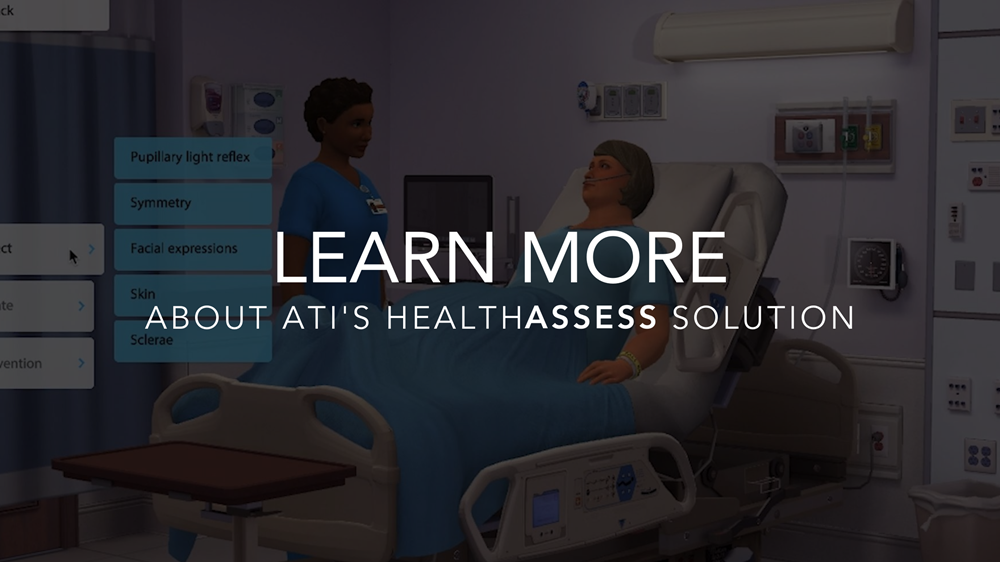
Visit atitesting.com to learn more about ATI’s first-of-their-kind interactive learning tutorials: The Engage Series and HealthAssess.

REFERENCES
1Dias, L., & Victor, A. (2022, January-June). Teaching and learning with mobile devices in the 21st century digital world: Benefits and challenges. European Journal of Multidisciplinary Studies, 7(1), 26-34. Retrieved from https://revistia.com/index.php/ejms/article/view/5837
2Saleem, A. N., Noori, N. M., & Ozdamli, F. (2022, March). Gamification applications in e-learning: A literature review. Technology, Knowledge and Learning, 27, 139-159. Retrieved from https://link.springer.com/article/10.1007/s10758-020-09487-x
3Ortega R, Akhtar-Khavari V, Barash P, Sharar S, Stock MC. An innovative textbook: Design and implementation. Clinical Teaching 2017;14(6):407–411. doi:10.1111/tct.12587
4Chan SL, Lin CC, Chau PH, Takemura N, Fung JTC. Evaluating online learning engagement of nursing students. Nurse Educator Today. 2021;104:104985. doi:10.1016/j.nedt.2021.104985
5Asad, M. M., Hussain, N., Wadho, M., Khand, Z. H., & Churi, P. P. (2020, July 25). Integration of e-learning technologies for interactive teaching and learning process: An empirical study on higher education institutes of Pakistan. Journal of Applied Research in Higher Education, 13(3).
6Liesa-Orus, M., Latorre-Cosculluela, C., VazquezToledo, S., & Sierra-Sanchez, V. (2020, June 1). The technological challenge facing higher education professors: Perceptions of ICT tools for developing 21st century skills. Sustainability, 12(13). Retrieved from https://www.mdpi.com/2071-1050/12/13/5339
8Kuppuraj, V. (n.d.). Role of multimedia on motivation and knowledge retention. The International Journal of Analytical and Experimental Modal Analysis, XII(IV).
9Harman, M. (2023, May 7). eTextbooks: Reasons students prefer digital reading experience. Retrieved from Kitaboo: https://kitaboo.com/etextbooks-digitalreading-experience/
10Phillips, B. C., Johnson, J., Khalid, N., Zapparrata, N., & Albright, G. (2023, March 7). Benefits of an online interactive educational program over traditional textbooks. Nurse Educator. DOI: 10.1097/ NNE.0000000000001398
11Zeivots S. Up to 80% of Uni students don’t read their assigned readings. Here are 6 helpful tips for teachers. The Conversation. Accessed August 27, 2022. https://theconversation.com/up-to-80-of-uni-students-dont-read-their-assigned-readings-here-are-6-helpful-tips-for-teachers-165952
12Anning R. Are textbooks becoming obsolete? May 2, 2019. Accessed July 22, 2022. https://elearningindustry.com/textbooks-becoming-obsolete
13Culha I. Active learning methods used in nursing education. Journal of Pedagogical Research. 2019;3(2):74–86. doi:10.33902/jpr.2019254174
14Smale M. “It’s a lot to take in” — Undergraduate experiences with assigned reading. Impact. 2020;9(1). Accessed July 22, 2022. https://academicworks.cuny.edu/ny_pubs/316/
15Kim Y. Study: 65% of college students skip textbook purchases during pandemic. The Cap Times. March 3, 2021. Accessed July 22, 2022. https://captimes.com/%20news/local/education/study-65-of-college-studentsskip-textbook-purchases-during-pandemic/article_%20ad40bb22-058b-5b6f-8e85-7a7681245128.html
16Pulukuri, S., & Abrams, B. (2021, June 9). Improving learning outcomes and metacognitive monitoring: Replacing traditional textbook readings with question-embedded videos. Chemical Education Research, 2156-2166. Retrieved from https://pubs.acs.org/doi/10.1021/acs.jchemed.1c00237
17Westerlaken, M., Christiaans-Dingelhoff, I., Filius, R. M., de Vries, B., de Brujine, M., & van Dam, M. (2019, July 30). Blended learning for postgraduates; An interactive experience. BMC Medical Education. Retrieved from https://bmcmededuc.biomedcentral.com/articles/10.1186/s12909-019-1717-5
18Frolova, E. V., & Ryabova, T. M. (2020). Digitalization of education in modern scientific discourse: New trends and risks analysis. European Journal of Contemporary Education, 9(2), 313-336. Retrieved from https://eric.ed.gov/?id=EJ1262557
19Radu, J., & Schneider, B. (2019, May). What can we learn from augmented reality (AR)?: Benefits and drawbacks of AR for inquiry-based learning of physics. CHI ‘19: Proceedings of the 2019 CHI Conference on Human Factors in Computing Systems, (pp. 1-12). Retrieved from https://dl.acm.org/doi/10.1145/3290605.3300774
20Criollo-C, S., Guerrero-Arias, A., Jaramillo-Alcazar, A., & Lujan-Mora, S. (2021, March 26). Mobile learning technologies for education: Benefits and pending issues. Applied Sciences, 4111. Retrieved from https://www.mdpi.com/2076-3417/11/9/4111
21Alzahrani, N. M. (2020). Augmented reality: A systematic review of its benefits and challenges in e-learning contexts. Applied Sciences, 10(16), 5660. Retrieved from https://www.mdpi.com/2076-3417/10/16/5660
22Al Rawashdeh, A. Z., Mohammed, E. Y., Al Arab, A. R., Alara, M., & Al-Rawashdeh, B. (2021, May 17). Advantages and disadvantages of using e-learning in university education: Analyzing students’ perspectives. 19(3). Retrieved from https://academic-publishing.org/index.php/ejel/article/view/2168
23Welding, L. (2023, March 27). Average cost of college textbooks: Full statistics. Retrieved from BestColleges: https://www.bestcolleges.com/research/average-cost-of-college-textbooks-statistics/
24Paper vs. digital. (n.d.). Retrieved from Environmental Paper Network: https://environmentalpaper.org/paper-vs-digital/