How Different Is the New (Next Gen) NCLEX From the 'Old' NCLEX?
NCSBN Experts Detail the Changes From the Previous NCLEX to the Current Version
 The new version of the NCLEX (referred to as the Next Generation NCLEX [NGN]) launched on April 1, 2023 — a very different exam from the one graduates have taken for decades. But just how different is the new version of the NCLEX from the previous one.
In discussions with nurse educators who participated in multiple "ATI Talk” online sessions, we compiled questions about the new version of the NCLEX. Here, we present answers from "ATI Talk" guest speakers from the National Council of State Boards of Nursing (NCSBN): Phil Dickison, PhD, RN, CEO, and Jason Schwartz, Director of Outreach.
What Didn't Change From the Previous Version of the NCLEX?
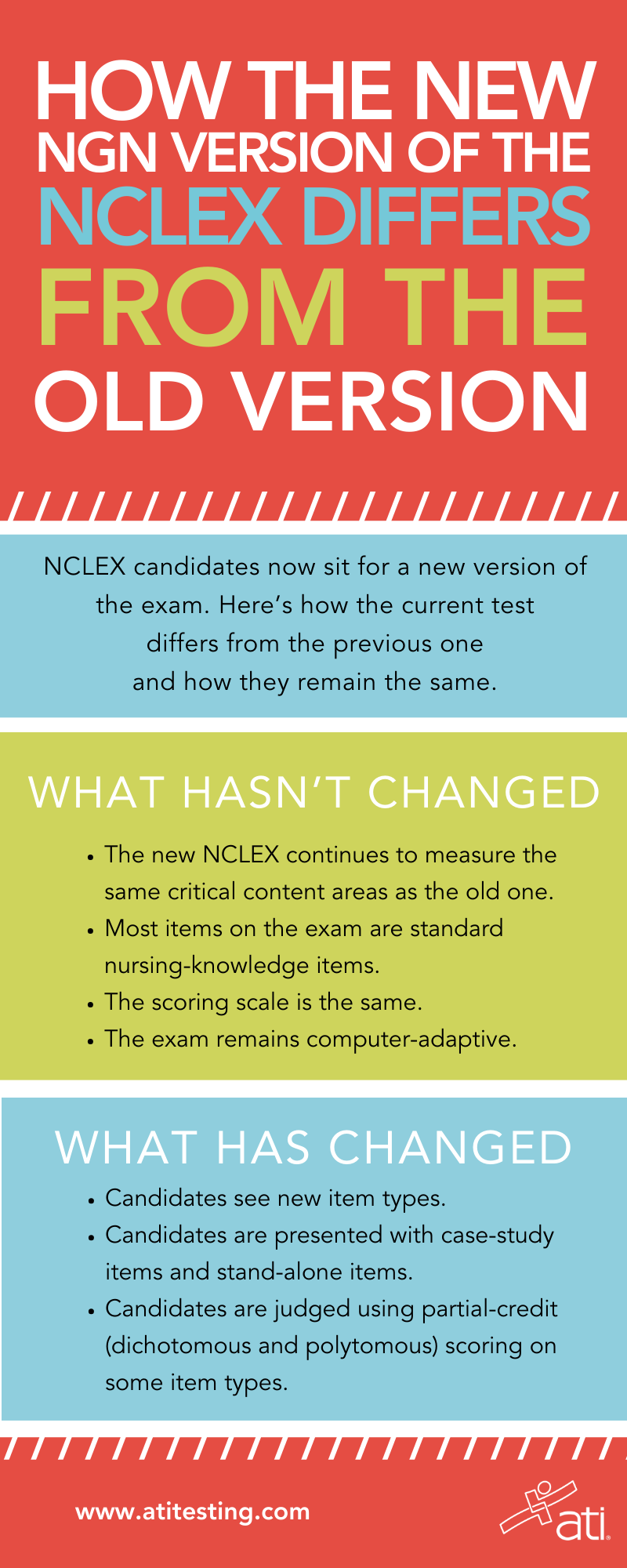
- The exam measures the same critical content areas.
- Most items on the minimum-length exam are standard NCLEX items.
- The scoring scale has not changed.
- The exam remains computer-adaptive.
Content areas covered. The reason the NCSBN decided to change the NCLEX was to include the assessment of clinical judgment. But the exam’s focus hasn't changed in terms of its overall content.
Dr. Dickison said, “Just because we’re measuring clinical judgment doesn’t mean all the other stuff that we’ve been measuring is not important; it’s still important.” Most of the exam, he added, is what candidates saw on the previous version of the NCLEX.
Schwartz did add that the percentage of content on the RN exam changed for 3 categories:
- Management of care. Decreased by 2% (changing from 17%-23% of the exam to 15%-21% of the exam).
- Safety and infection control. Increased by 1% (changing from 9%-15% to 10%-16%).
- Physiological adaptation. Increased by 1% (from 11%-17% to 12%-18%).
Majority of item types. While many educators were initially concerned that the revised exam would focus exclusively on new NGN-style item types, Dr. Dickison explained that did not happen. “The majority of items on a minimum-length exam [are] the standard NCLEX item types,” he said.
Same scoring scale. "We’ve kept that scale stable for 20 years,” Dr. Dickison said, adding that the organization had no plans to change it. The new version of the exam continues to offer longitudinal comparisons of nurse ability, and scores continue to be comparable from past results.
DOWNLOAD THE INFOGRAPHIC ABOVE AS A HANDY REFERENCE
What Changed From the Previous NCLEX?
- Each candidate sees a set number of case studies.
- The test uses partial-credit scoring.
- Students may receive single, standalone, clinical judgment item types called bowties.
Case studies. Case studies are now included on the new version of the NCLEX, and they are beneficial because they allow an accurate assessment of clinical judgment because each question builds on the next. Case study items reflect the kind of real-world decisions nurses make in healthcare settings. (Schwartz provides tips for writing a case study in easy-to-understand terms.)
Partial-credit scoring. Some new item types on the NGN aren't scored as simply right or wrong. Instead, candidates receive full, partial, or no credit for an answer based on their selected response.
Bowtie items. Resembling a bowtie onscreen, this item type offers 2 antecedents on one side and 2 outcomes on the other. Test-takers are asked a question that requires them to pull the antecedent to the outcome based on a pathophysiology or some nursing-care characteristic. All candidates may see one of these standalone item types focused on clinical judgment, Dr. Dickison said. But candidates that reach the minimum-length exam may receive as much as 10% of these items on the rest of their exam.