5 Reasons to Integrate Active Learning in Your Academic Nursing Program
Build Clinical Judgment & Graduate Practice-Ready Nurses
Nursing students must acquire comprehensive knowledge, master clinical judgment, and develop strong communication and hands-on skills. Active learning can meet these goals — which is why many education experts recommend making it part of every nursing curriculum.
Chief among the list of reasons to incorporate active learning is that traditional lectures and textbooks often fail to engage students deeply enough to embed understanding and knowledge application. Research shows:
- Up to 80% of students don’t complete textbook assignments.1
- Lectures promote passive listening, which limits retention and application.2
- Digital active learning environments provider deeper understanding and connect content to real-world practice.3
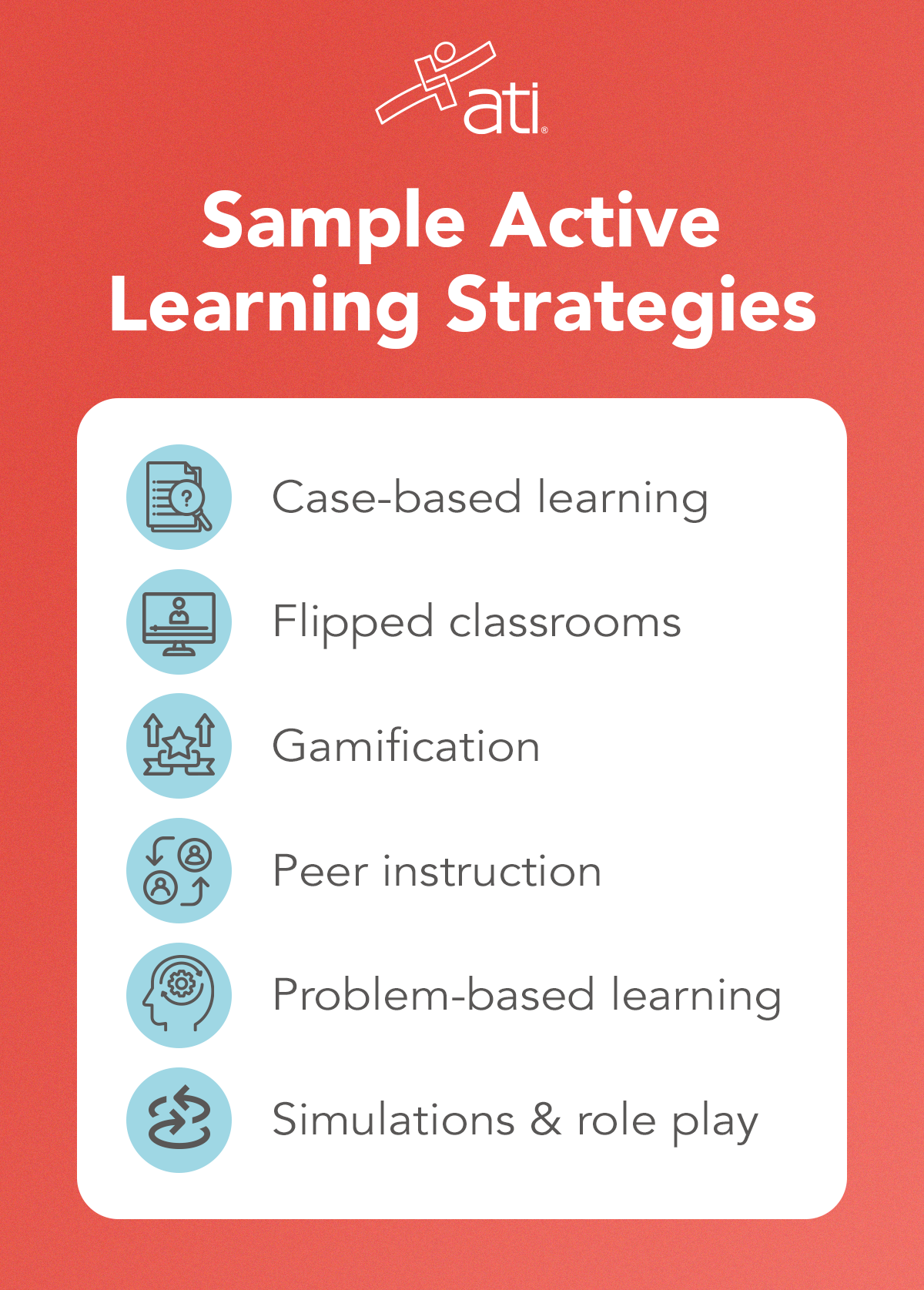
Common active learning techniques, such as those listed at right, help bridge the gap between theoretical knowledge and practical application. This bridging is a crucial step in nursing education — and one of the more challenging.
Active learning is used with students of all ages and at all levels of education. For nursing and STEM learners, studies show that active learning consistently outperforms the traditional passive methods used for these subject areas. The collective findings4-15 show that active learning produces:
- better learning outcomes and exam scores
- better essential skills, including clinical judgment
- better student engagement, motivation and confidence
- better transitions to clinical practice.
This article explores 5 reasons why academic nursing programs should integrate active learning strategies and how anchoring this approach with a robust multimodal active learning environment can help ensure the development of strong clinical judgment skills.

Reason 1: Active Learning Develops Critical Thinking & Clinical Judgment.
Active learning helps students practice and develop critical thinking and clinical reasoning skills in a safe environment, paving the way to mastery of clinical judgment. Within a curriculum, it facilitates teaching all 6 functions of clinical judgment identified by the National Council of State Boards of Nursing: recognizing cues, analyzing cues, prioritizing hypotheses, generating solutions, taking action and evaluating outcomes.
In a study published in 2025,4 Meredith Watkins, DNP, RN, CEN, documented that active learning can be more effective than passive learning in developing clinical judgment — specifically the function of interpreting/analyzing. Dr. Watkins is an assistant professor of nursing at the Elizabeth T. MacNeil School of Nursing at Dominican University.
“The findings suggest that active learning in the classroom surpasses passive learning for the development of the interpreting step of clinical judgment,” Dr. Watkins and coauthors wrote. They recommended that educators use active learning strategies to help build clinical judgment and prepare new nurses for practice.
Using a quasi-experimental design, Dr. Watkins randomly assigned senior students to a control group and an experimental group. Each group received 95 minutes of identical classroom instruction on burn care.
Next, the control group received passive instruction through a live lecture and a video. The experimental group received the same live lecture followed by an interactive unfolding case study using these active learning strategies:
- Take Report
- Idea Popcorn
- Think-Pair-Share
- Calculations
- Knowledge Checks
- Image Activity
- Round Robin
- Reflective Worksheet.
Both groups of students then answered an NCLEX-style posttest designed to measure their clinical judgment skills.“In the interpreting step of clinical judgment, we found a 10-point difference between the active learning and the passive learning groups,” Dr. Watkins said in an interview. “And if you think about what clinical judgment is, it is the outcome of our critical thinking. Critical thinking is the interpretation to make a decision. So one could argue that interpreting is the essence of clinical judgment.”
Dr. Watkins’ enthusiasm for active learning is evident in her research and her teaching methods. Her office drawers are filled with active learning supplies including thumbs up/thumbs down paddles, brightly colored stickers, rubber stamps, and laminated cards stating the functions of clinical judgment.

“All of this helps engage learners,” she said. “At the heart of active learning is engagement, so that means the first thing I’ve got to do is keep their attention.”
A teaching partner in Dr. Watkins’ classes is the Engage® Series, a digital active learning environment that also has been proven to increase students’ clinical judgment skills.16
The Engage Series is a unified active learning environment where students learn, practice, assess and remediate using comprehensive multimodal resources.
Students who use one or more Engage resources have significantly higher clinical judgment scores than those who do not use Engage,16 and 97% of educators report that ATI resources have a positive influence on students’ ability to develop clinical judgment.17
In addition to building clinical judgment, evidence shows that integrating active learning into a nursing curriculum contributes to improved student and program performance.
Reason 2: Active Learning Leads to Better Student & Program Outcomes.
Research across student populations shows that active learning improves long-term retention of knowledge.2,5 For nursing students, this means better recall of essential information during clinical rotations and throughout their careers. The hands-on nature of active learning also helps nursing students transfer knowledge to practical clinical settings more effectively.10
Active learning is also associated with higher test scores and deeper comprehension. For nursing programs, these are strong signals of academic and program success.
A meta-analysis of 225 studies involving STEM students found that those in active learning environments had significantly higher exam scores and lower failure rates compared to those who were taught using traditional lectures.5 Students in lecture-dominated courses were more likely to fail than students taught using active learning techniques. Specifically:
- Active learning led to exam performance that effectively raised averages by half a letter grade.
- Failure rates in lecture-dominated courses increased by 55% over failure rates in active learning classrooms.
Based on these findings, the authors recommended that active learning become a preferred teaching practice.5
Reason 3: Active Learning Fosters Collaboration & Teamwork.
Another advantage of active learning is that it develops teamwork skills essential to nursing practice.8 Active learning strategies can mirror the collaborative nature of healthcare environments, helping students learn to communicate and work together in simulated scenarios that reflect real-life practice.
Examples cited in the nursing education literature15 include:
- Collaborative problem-based learning can challenge nursing students to collectively analyze patient cases and require them to pool knowledge, negotiate different perspectives, and reach consensus on care plans.
- Using peer teaching and reciprocal learning, nursing students can teach concepts to peers or practice skills together. This helps students develop mentoring abilities and learn to give constructive feedback, skills that are important in the workplace.
- Collaborative clinical projects, such as group assignments requiring students to develop care plans, conduct community assessments, or create patient education materials, foster consensus-building and project management skills.
Reason 4: Active Learning Engages Students & Builds Their Confidence.
When students are highly engaged in their learning, the benefits are far-reaching. Studies show that students develop greater satisfaction, motivation, and self-efficacy when their learning environment engages them effectively.18

Interactive technology-based learning environments such as the Engage Series create this powerful engagement using multimodal resources that are unique within nursing education. When nursing programs integrate this comprehensive learning environment, students learn and perform better across core curriculum areas, including clinical judgment.16,17
The Engage Series immerses students in interactive cases, simulations, and applied exercises strongly aligned with the NCSBN Clinical Judgment Measurement Model (CJMM). This teaching strengthens students’ decision-making skills, increases their confidence, and prepares them for real-world clinical practice. In programs that incorporate one or more Engage Series learning environments, nurse educators have observed improvements in all of these areas:
“Engage is very active learning … It prepares students to come to class and actively put concepts into practice.” — Valerie Rakes, DNP, RN, CNE, Catawba College
“Engage evolves with nursing practice. The result is we have a much better prepared, more confident nursing student that’s going out and taking care of our patients” — Aaron A. Gann, DNP, MSN, RN, CMSRN, CNE, Amarillo College
Reason 5: Active Learning is Effective for a Variety of Learning Styles.
No discussion of active learning would be complete without noting its ability to engage learners who struggle with traditional teaching methods or experience neurodiversity.
Active learning incorporates visual, auditory, and kinesthetic elements that engage multiple cognitive processes and accommodate diverse learning styles. Neurodiverse learners in particular benefit from multimodal teaching,19 which is a core component of the Engage Series. Extensive multimedia resources within Engage also enhance learning in students who benefit from frequent visual and auditory stimuli.20
Metacognitive development is another advantage of active learning. When faculty use active learning techniques, students are prompted to monitor their understanding, evaluate their progress, and adjust their learning strategies — skills that passive learning/listening rarely develops.5-14 This self-regulation is important for students who struggle with traditional academic formats.
Bring Active Learning to Life — Without Adding to Faculty Workload
Active learning is the most direct way to develop the clinical judgment today’s nursing practice demands. For many faculty and programs, the challenge is operationalizing it across courses and faculty.
The Engage Series is the only unified multimodal environment where students learn, practice, assess, and remediate. And the value does not stop there. Engage is also where faculty can teach with ready‑to‑use lesson plans, case studies, and analytics aligned to clinical judgment and NCLEX content.
The pressure on faculty to help nursing students master clinical judgment will continue. Recent fluctuations in NCLEX pass rates hint at a letup on this emphasis how that the Next Generation NCLEX is fully implemented. It’s clearly not a time to ease the foot from the pedal.
To help fill the nursing pipeline and to ensure that graduates have the clinical judgment skills necessary for practice, academic programs require comprehensive teaching resources that deliver strong student outcomes and are simple for faculty to integrate and use. An interactive evidence-based learning environment that meets the needs of faculty as well as students is the strongest resource programs can implement to teach clinical judgment and ensure that graduates are ready for NCLEX and the patient care challenges ahead.
References
- Phillips BC, Johnson J, Khalid N, Zapparrata N, Albright G. Benefits of an Online Interactive Educational Program Over Traditional Textbooks. Nurse Educator. 2023;48(5):270-275. DOI: 10.1097/NNE.0000000000001398
- Bristol T, Hagler D, McMillian-Bohler J, Wermers R, Hatch D, Oermann MH. Nurse Educators’ Use of Lecture and Active Learning. Teaching and Learning in Nursing. 2018;14;94-96. https://doi.org/10.1016/j.teln.2018.12.003
- Khalid N, Zapparrata N, Phillips BC. Theoretical Underpinnings of Technology-Based Interactive Instruction. Teaching and Learning in Nursing. 2023;19(1):e145-e149. https://doi.org/10.1016/j.teln.2023.10.004
- Watkins M, Fruin BW, Brett A. Using Active Learning to Develop Clinical Judgment in Nursing Students. Teaching and Learning in Nursing. 2025;20(4):e1170-e1175. https://doi.org/10.1016/j.teln.2025.06.005
- Freeman S, Eddy SL, McDonough M, Smith MK, Okoroafor N, Jordt H, Wenderoth MP. Active Learning Increases Student Performance in Science, Engineering and Mathematics. Proceedings of the National Academy of Science. 2014;111(23):8410-8415. doi: 10.1073/pnas.1319030111
- Abdullah M, Zeb A, Ullah Hidayat, Bano N. Effectiveness of Active Learning in Nursing Education. International Journal of Scientific and Research Publications. 2017;7(6):588-590.
- Deslauriers L, McCarty LS, Miller K, Callaghan K, Kestin G. Measuring Actual Learning Versus Feeling of Learning in Response to Being Actively Engaged in the Classroom. 2019;116(39):19251-19257. Proceedings of the National Academy of Science. https://doi.org/10.1073/pnas.1821936116
- Culha I. Active Learning Methods in Nursing Education. Journal of Pedagogical Research. 2019;3(2):74-86. http://dx.doi.org/10.33902/JPR.2019254174
- Pivac S, Skela-Savic B, Jovic D, Avdic M, Kalender-Smajlovic S. Implementation of Active Learning Methods by Nurse Educators in Undergraduate Nursing Student Programs — a Group Interview. BMC Nursing. 2021;20(173). https://doi.org/10.1186/s12912-021-00688-y
- Liu W. Development of Clinical Decision-Making Among Undergraduate Nursing Students: the Effect of Unfolding Case-Based Learning. International Journal of Nursing Education Scholarship. 2024;21(1):2023115. https://doi.org/10.1515/ijnes-2023-0115
- Kalu F, Wosley C, Enghiad P. Undergraduate Nursing Students’ Perceptions of Active Learning Strategies: A Focus Group Study. Nurse Education Today. 2023;131:105986. https://doi.org/10.1016/j.nedt.2023.105986
- Yin SJ, Chern CL. The Effects of an Active Learning Mechanism on Cognitive Load and Learning Achievement: A New Approach for Pharmacology Teaching to Taiwanese Nursing Students. Nurse Education Today. 2023;124:10576. https://doi.org/10.1016/j.nedt.2023.105756
- Liu W. Effect of Unfolding Case-Based Learning on Clinical Judgment Among Undergraduate Nursing Students. Nurse Educator. 2023;49(3):141-146. DOI: 10.1097/NNE.0000000000001526
- Lanza M, Abajas-Bustillo R, Aparicio-Sanz M, Ortego-Mate. A Mixed Methods Study Examining a Socioemotional Skills Training Program Based on Active Learning Methodologies in Undergraduate Nursing Students. Nurse Education Today. 2025;147:106593. https://doi.org/10.1016/j.nedt.2025.106593
- Mancin S, Sguanci M, Pipitone V, Testori A, De Marinis MG, Piredda M. Efficacy of Active Teaching Methods for Distance Learning in Undergraduate Nursing Education: a Systematic Review. Teaching and Learning in Nursing. 2025;20:e485-e493. https://doi.org/10.1016/j.teln.2024.12.015
- ATI Nursing Education, 2025. Data collected from proctored ATI RN and PN student assessment results (N=52,447), fall 2024 semester.
- CSAT data, 2025. In a national survey of nurse educators (N=474), 97% said ATI has a positive influence on student clinical judgment.
- Office of Curriculum, Assessment and Teaching Transformation. University at Buffalo. Evidence of Active Learning’s Effectiveness. https://www.buffalo.edu/catt/teach/develop/design/designing-activities/active-learning-effectiveness.html
- Yeo K. How Multi-Sensory Learning Supports Neurodiversity. AdaptEd. 2024, Feb. 7. https://shop.adapted4specialed.com/blogs/news/how-multi-sensory-learning-supports-neurodiversity
- Kupuraj V.Role of Multimedia on Motivation and Knowledge Retention. International Journal of Analytical and Experimental Modal Analysis. 2020;XXII(IV):1500-1509.