Teaching nursing students the fifth clinical judgment function, take action
The ability to take action based on cues, hypotheses, and potential solutions is a key step in clinical judgment. Nursing students need to be confident in their observations, analysis, and hypotheses to make reasoned decisions about the actions necessary to care for a client.
Throughout the United States, nursing faculty have placed heightened emphasis on teaching clinical judgment in order to prepare students for the revised NCLEX that debuted in April 2023.
The Next Generation NCLEX, or NGN, introduced question types designed to specifically measure clinical judgment abilities in RN candidates — abilities that are essential to safe, competent nursing practice.
Technology-based interactive instruction helps students build nursing clinical judgment
Interactive digital learning that builds the trajectory of skills needed to exercise clinical judgment can be helpful to faculty, because it engages the senses more fully than textbooks and results in learning experiences that students retain.
In addition, interactive digital learning can increase the assimilation of complex material, especially among students who struggle with reading and memorization.
One of the technology-based interactive instruction tools nursing faculty rely on is the Engage Series from ATI. In a recent webinar, Amanda Jamison, Lead Product Training Specialist for ATI Nursing Education, explained how Engage Adult Medical Surgical develops student understanding of the clinical judgment functions.
Prepare students for real-life scenarios
In the video recording of this demonstration webinar, available here, Jamison focused on the effectiveness of Engage Adult Medical Surgical in teaching the fifth clinical judgment function, taking actions.
 “By implementing this interactive virtual resource into the curriculum as a textbook replacement, or as a complement to a textbook, faculty can better prepare students for the Next Generation NCLEX and set them up for success as a nurse,” Jamison said.
This article is the fifth in a series on the ATI Educator Blog that explains how Engage can help nursing faculty teach students about clinical judgment.
Missed the other articles in this series? Find all four previously published articles using these links:
Article 1: Teach nursing students how to recognize cues using the Engage Series
Article 2: Teach nursing students to analyze cues using interactive tools
Article 3: Teaching nursing students how to prioritize hypotheses using interactive learning tools
Article 4: Teaching nursing students to generate solutions.
Using evidence-based interactive resources to deepen how nursing students learn clinical judgment
The Engage Series is a multifaceted single resource that incorporates knowledge acquisition, knowledge retention, remediation, and review. The content in each Engage solution is based on current evidence and practice standards, and it is updated as those change.
Every solution in the Engage series provides heightened learning through interactive activities. These activities include quizzing within each module, summative review questions at the end of each module — plus videos, skills, virtual applications, animations, 3D diagrams, and games. Embedded podcasts extend the learning into real-life examples.
“Together, the features in Engage help students experience much deeper learning on important concepts,” Jamison said.
Engage also teaches important practical skills. In each module involving clinical interactions, students practice their documentation skills in EHR Tutor, an electronic health record program embedded into Engage modules and virtual applications.
Teaching nursing students to take action after they have progressed through the other 4 clinical judgment functions
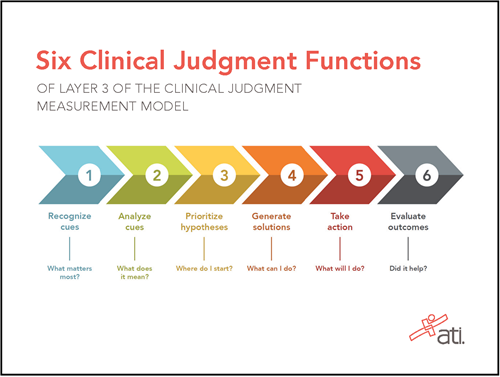
Taking action is the fifth cognitive skill in clinical judgment. The model for clinical judgment, depicted in the illustration above, was established by the National Council of State Boards of Nursing (NCSBN).
Engage Adult Medical Surgical presents scenarios that take students through all six clinical judgment functions. In the webinar, Jamison focused on a particular module in this solution to illustrate how it takes students from recognizing cues through taking action. The take action function is within the implementation phase of the nursing process and the responding phase of Tanner's clinical judgment model.
The take action function can be defined as the implementation of appropriate interventions based on nursing knowledge, priorities of care, and planned outcomes to promote, maintain, or restore a client’s health.
Expected responses and behaviors when taking action include:
- promptly and accurately performing nursing actions based on prioritized client problems
- implementing a plan of care in collaboration with members of the interprofessional healthcare team
- implementing a plan of care in collaboration with the client and care partners
- accurately documenting client care data and information
- incorporating client preferences and needs when performing nursing actions
- providing education to the client and/or care partners about the client’s health condition and care management
- participating in coordination of care with the client and healthcare team
- monitoring the client’s response to interventions.
“Considering the expected responses and behaviors is helpful when thinking about how you want students to learn and what they need to do in practice,” Jamison said. “For example, monitoring the client's response to interventions may not be viewed as taking action, but it definitely is because it is assessing for changes in vital signs or lab values. Noticing trends is an important action the nurse takes.”
How nursing students learn clinical judgment in a virtual technology-based interactive environment
Engage Adult Medical Surgical contains 26 modules providing comprehensive coverage of the medical surgical content nursing students need. The solution also includes five modules on critical care. Engage Adult Medical Surgical modules are organized into five units: medical-surgical concepts, comfort and dignity with death, alterations in health, surgical nursing, critical care nursing.
In the webinar, Jamison focused on the alterations in health module content on hematologic dysfunction to illustrate how Engage can help students learn about decision making using the six clinical judgment functions. The hematologic dysfunction module focuses on:
- alterations in hematologic function
- review of anatomy and physiology
- review of pathophysiology
- comorbidities
- epidemiology
- clinical presentation
- safety considerations
- client education.
The content in all Engage modules is based on epidemiology statistics from national resources and the most current evidence-based research, Jamison said. In addition to reflecting current practice and research, the content in each Engage solution is organized to promote the best possible understanding.
Evidence-based content and consistent module design ensure that nursing students learn key information
“Modules are laid out in a consistent way. This helps students organize their studying,” Jamison said. “The clinical presentations in Engage help students understand what a client may exhibit and what cues they need to look for,” she continued. “They include information on how to help clients understand their health and illness and ways to incorporate health promotion and prevent further disease.”
The hematologic disorders module takes the learner through the six clinical judgment functions, starting with recognizing cues. Using the assessment information provided in the module, the student recognizes cues presented in the client depiction. This client:
- recently returned from an overseas trip
- has a history of diabetes and obesity
- has a blood glucose level of 250 mg/dL and is taking oral medication
- complains of pain in right leg
- has redness and edema in the right calf.
Engage then prompts the student to analyze the cues. For example, the client’s trip may have had long flights with long periods of inactivity. The elevated blood glucose could be a result of stress or overeating. And the discomfort and edema in the knee could be related to infection — or another significant cause.
“In analyzing the cues, the student thinks about the immobility on the plane trip and the client's risk for circulatory problems,” Jamison said.
The student then can analyze the implications of the knowledge that:
- the client may have been immobilized during travel
- the client is at risk for circulation problems
- the client may need insulin to lower their current blood glucose level
- the right leg pain is a significant finding
- redness and edema in the leg are concerning.
“We know that the blood glucose cannot be ignored, but we are really concerned about that leg,” Jamison said.
As the student gathers and analyzes clues, they can then prioritize them. For example:
- The patient may have developed a DVT
- The client is at high risk for DVT
- The blood glucose level needs attention, but it is not the top priority
- A blood clot and associated complications are possible
- The nurse needs to call the client’s provider.
In this case example, the student should determine that a deep vein thrombosis may be present, and that this possibility requires quick intervention by the team. The student contacts a provider, who orders tests and reaches a diagnosis of DVT.
The Engage Series helps students learn all clinical judgment functions, and it connects the dots for nursing practice
Next, the student generates solutions. “We have to continue to care for the client and develop an appropriate plan,” Jamison said. “Then we take action.”
In the Engage depiction, the student should decide to take actions such as:
- Performing frequent assessments: calf measurement, monitoring changes in redness and pain, assessing the leg for pulses, encouraging mobility, and watching for complications (e.g., shortness of breath, venous system changes)
- Implementing orders: administering anticoagulants, pain medication and oxygen as needed; facilitating activity as ordered; arranging for serial lab draws; and providing client education about treatment, medications, and current and future prevention strategies.
“There are a lot of things to do for this client,” Jamison said. “Students often struggle to realize that assessment is the first intervention in a plan of care. This client will require frequent assessments.”
In addition, the student should recognize that the nurse has orders to implement and teaching to provide, Jamison said.
“Note that we would never get to the take action function if we hadn't performed the previous steps,” she said. “It may make sense to us as nurses, but students need to connect the dots and learn the process. And the Engage series will do that for them.”