How to win students and faculty: No more textbook!
Learn how this dean actually got rid of the textbook for more effective clinical judgment teaching
 Dr. B*, the Interim Assistant Dean and Associate Professor at a nursing program in the Southeast United States, knows what her students will face when they move from the classroom and into the clinical setting. (Spoiler alert: It’s clinical judgment!) She’s familiar with the literal blood, sweat, and tears of a nursing career after spending 30 years in a Level I trauma unit in New York City.
Learn more about the Engage Series
Today, in her educational role, she has continued to witness how nursing has evolved. She’s seen firsthand how working in settings such as a trauma unit is even more challenging now. But not only has healthcare changed; so have employers’ expectations. Unlike her early years as a nurse, Dr. B has seen how providers now require new graduates to be ready on Day 1 of their nursing careers to treat clients with a level of clinical judgment that took her years to develop.
Gaining in-depth clinical judgment before graduation requires enhanced learning resources not available in traditional textbooks. Students need resources that help them build their knowledge and experience more quickly, as well as ensure that they retain that information. To achieve that goal with her students, Dr. B recently introduced them — and her faculty — to a technology-based learning resource, Engage Fundamentals. This online tool takes the learning benefits and interactive features of ATI’s Engage Series and puts them to work for Fundamentals content. (Additional offerings in the Enhance Series include mental health and community and public health with new offerings, such as adult medical-surgical, being introduced regularly.)
Download the infographic at right as a handy reference
We spoke with Dr. B. about the process of switching from textbook teaching to the unique options offered by the Engage Series: interwoven activities, multimedia, unfolding case studies, EHR Tutor documentation, quizzes, podcasts, annotation capabilities, and ready-to-use educator resources.
This interview has been edited for length and clarity.
QUESTION: Can you explain more about replacing your textbook with Engage Fundamentals 1.0?
Dr. B:
Well, we did have our textbook; I felt like I couldn't take it away immediately because the students would get hysterical. I didn’t think they would open the book — and they never did — but I included it as a reference because I knew that if I didn’t, it was going to be an issue, especially when it came to an area in which a student didn't do well. I knew I’d hear comments like, “Well, we didn't have a book.” Sometimes you have to kind of skirt that political piece. So, the book was there for them if they needed it.I organized the curriculum the same way I usually do: I divided the semesters into weeks, and then I identified the content for each week. Using a modular format, I placed the Engage Fundamentals content at the top, and I told students to go through that content first. Then, if they needed supplemental material, they could use their textbook as a reference guide. So, we used the book but different than what they were used to.
I also included the ATI (Fundamentals of Nursing Review Module) book as a reference because some students like the short way that ATI hits everything — with bulleted points and lists. Then, each week, I included my Nearpod information. So, students had multiple references for each piece of content. But I used the videos and all the pieces in Engage Fundamentals as our primary source.
QUESTION: What did students think at the end of the semester?
Dr. B:
They really enjoyed it. And I asked them, “What did you guys wind up using with all your options?” They said they really used the Engage Fundamentals.
QUESTION: If Engage Fundamentals covers all the need-to-know information, but students aren’t comfortable with giving up their textbook, how does an educator tackle that quandary?
DR. B:
I told the faculty, who were a little uncomfortable about me pushing the use of Engage Fundamentals, “Honestly, you know students don't read the textbook.” We complain about that constantly. They really, truly do not read the textbook. So, I said, “Let's give them something that appeals to them.”
With Engage, they’ve got the PowerPoints and videos that are really colorful and catch students’ attention. They can look at the videos again, and they can go through the Powerpoint over and over. And I remind them to look at the other books as additional resources if they find something confusing or they’re not understanding.
QUESTION: Did you offer students tips for using Engage Fundamentals?
DR. B:
One of the first things I tell students is, “I want you to see things 5 times so that it becomes really yours.” That's the one way that they can really learn. And I encourage them to go back through the Engage lessons — to go back through the material over and over again.
QUESTION: When you first started using Engage Fundamentals, how did you prepare yourself and your students?
DR. B:
I went through each piece of the Engage lessons to see how it related to the content. Then I picked out specific Engage tools and matched them to my weekly topics. It was pretty easy. For example, Week 1 is “Introduction to nursing,” and Engage includes content about the nursing process [a fundamental aspect of clinical judgment] and similar information. We use Blackboard, so I was able to easily put the Engage content in folders I created.
Download the infographic at right as a handy reference
It was a lot of work upfront, but now it's done. And because Engage is going to include more topics [when Engage Fundamentals 2.0 is available], I’ll only need to go back and review those new aspects to include them in my weekly lessons.
QUESTION: Did you feel like it was easy to use the Engage content in your preferred order, rather than the way ATI presented it?
DR. B:
Oh, I thought it was very easy. Honestly, it was really very easy. And a coincidence I saw — which showed how your team really looked at how you ordered the material — was how everything was right there that I needed. I used one piece a lot. I can’t remember what it’s called ...
QUESTION: Our concept mapping?
DR. B:
That's it. I used a lot of the concept mapping throughout the course. It was helpful because it’s a condensed course — an intense 8-week program for 4 credits.
I love the concept maps, and so did the students because it felt like those were starting to prepare them for the Next Generation NCLEX (NGN) [which is focused on assessing clinical judgment]. I had them break into groups and work on the maps together every day, and the concepts made more sense to them. They could look at the patient, even with the little bit of knowledge they had, and then build on that knowledge.
I think they're understanding why we focus on those concept maps and look at the client as a whole. I think that made a little bit more sense to them. So, I really liked those.
QUESTION: Were there any particular resources helpful for your teaching?
DR. B:
I used the Engage content in teaching about pain, safety — I used a lot of the ATI resources in safety — fundamentals, the human growth and development case study, and the concept mapping. I used a lot of the case studies and discussion questions, which was really helpful. I didn't have to find any on my own.
QUESTION: If you hadn't had the Engage resources, you’d presumably have used a textbook. So, would you have had to write more of your own cases or used old ones that came with the textbook? How did Engage help with your teaching?
DR. B:
It made it much easier. The way it was organized made my life much easier because I didn't have to pull from here or pull from there. I was able to just use that concept map and give students the case and have them work from there. I think it facilitated my teaching. And, another reason I love the concept maps is because they had the diagnosis and the assessment information; they broke it down into problems.
Download the infographic at right as a handy reference
It also spoke to assessment intervention. When we do, for instance, physical assessment, the students are really just looking at assessment. Yes, there are interventions there, but the students are really focusing on the assessments. So now I can move them to the next step of the Nursing Process — I thought that was very helpful for the students — and I could begin to talk a little bit about medications and then total care of the client. Then, having the discussion questions, I could pull those in as we were talking.
QUESTION: As far as the learning experience for students — or their preparedness for class — do you think Engage Fundamentals is better than a textbook?
DR. B:
I felt they were more prepared, because it was something that was active that they could use. I would do a little bit of a lecture, then they would do the case studies, and then they would break up into groups, and we’d talk about whatever the topic was.
QUESTION: Did you feel like students’ level of learning was greater? Did the tutorials help make them more prepared? Do they have a better understanding of clinical judgment?
DR. B:
Well, the group that just finished, I think they all passed, which is kind of unusual. So, I think they all were able to flow in pretty easily. As far as my prep, you know the first time you use anything it's going to take a little bit more time. I had to read everything, and I looked at all the videos. But, I think this next semester, it's going to be like 1-2-3. Knock wood, I'm anticipating a very easy prep for the next semester.
QUESTION: What would you say to educators who are skeptical about moving away from a textbook as their primary teaching resource?
DR. B:
As I've worked with faculty, once they really start to use the ATI materials, they see the value in them. They say, “Oh, I didn't know that was in there!” even though I told them the information was there. Once they start using the materials, they see the value, and they say how much easier it made things for them; they’re not working from scratch, so to speak.
But I think that textbooks, quite frankly, are a waste because people do not use them. They simply don't.
QUESTION: It sounds like your hybrid approach was a good strategy. Could you see yourself eliminating the textbook altogether in the future?
DR. B:
I definitely think I could. Even this year, I'm sure our recent cohort spoke to the cohort behind it, and those students now know how little we used the textbook. And the next class will speak to the next class and say, “We didn't even open the textbook.” But we’ll eventually need to explain, “We didn't need to use the textbook.” So, it needs to be a progression, even in the minds of faculty. You've got people who've been teaching for 10-15 years, and they are still holding onto that textbook with two hands. But when you really look at the simplified content, you understand how students can access it quicker to get what they need. It’s almost like when they use the Internet. “I want to see this.” Then, boom. There it is. Because that kind of access is what students depend on.
Download the infographic at right as a handy reference
Plus, I think a progression is easier for people. For example, we have a recommended list and a mandatory list of references. We could move the textbook to the recommended list. Then, students don't have to buy it. But if they are really having trouble, it’s available.
QUESTION: How does Engage Fundaments compare to an e-text? That's a direction some companies are taking with their offerings, but there's still quite a bit of difference between an e-book and the Engage Series. What’s your perspective on the two?
DR. B:
I myself use e-text because I hate carrying a bunch of books; I usually download the text to my iPad. I like the searchability of an e-text. I do that with the ATI book, too, if I'm looking for something. It's good to have something that's searchable for people.
There are a lot of my students, though, who don't like e-text. They have to have that physical textbook. I find it funny because I’ll ask them — when they don't do well and we’ll be sitting 1-on-1 — “Did you read your textbook?” “No.” “So what did you do? Did you look at the resources?” Usually, they still say, “No.” But I think they're more likely to go for the Engage Fundamentals, that type of a learning system, than they are to go for a textbook, even if they say they must have the textbook. Don't ask me why. It's illogical.
QUESTION: We recently introduced some enhancements for Engage Fundamentals 2.0 last fall. They center on features students have requested, such as highlighting, notetaking, and text-to-speech. Do you think these features make learning easier for students — maybe more likely to be willing to let go of their textbooks?
DR. B:
I think those features mean a lot to them, because a lot of students are visual, and I do have some students who are auditory.
One of the things we do in our program is to have them take the VARK test so they can discover what kind of a learner they are. A lot of students really don't know what works best for them. So, I think having a multimodal approach to the content will go a long way.
QUESTION: We're also adding test banks with new NGN items that align with the Fundamentals modules. Is that something that will be beneficial for you?
DR. B:
Absolutely. Students love to review the content and then answer questions. So, they're going to really like that.
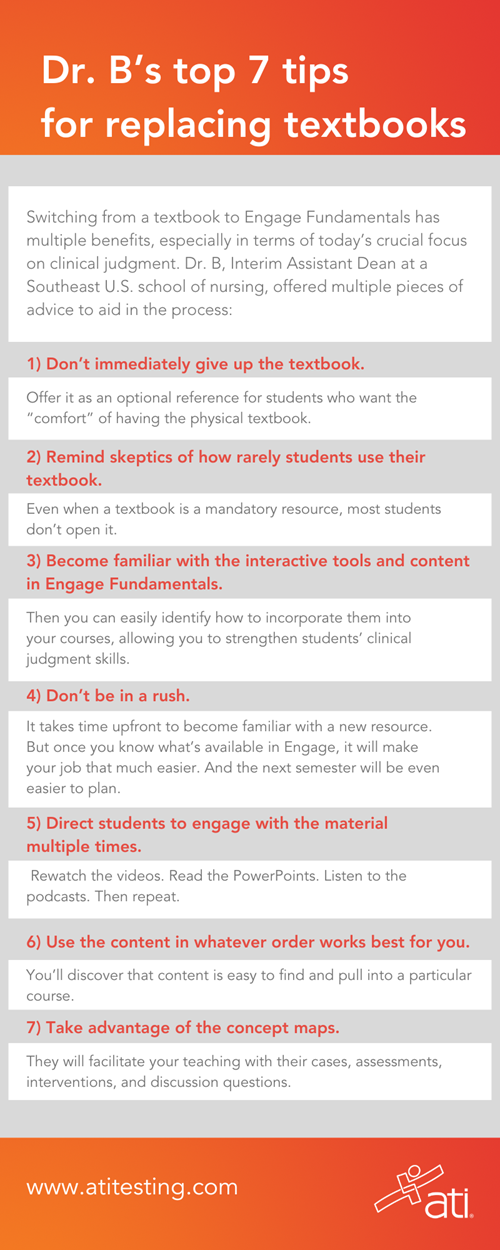
Dr. B’s top 7 tips for replacing the textbook
Switching from a textbook to Engage Fundamentals has multiple benefits, especially in terms of today’s crucial focus on clinical judgment. Dr. B offered multiple pieces of advice to aid in the process:
- Don’t immediately give up the textbook. Offer it as an optional reference for students who want the “comfort” of having the physical textbook.
- Remind skeptics of how rarely students use their textbook. Even when a textbook is a mandatory resource, most students don’t open it.
- Become familiar with the interactive tools and content in Engage Fundamentals. Then you can easily identify how to incorporate them into your courses, allowing you to strengthen students’ clinical judgment skills.
- Don’t be in a rush. It takes time upfront to become familiar with a new resource. But once you know what’s available in Engage, it will make your job that much easier. And the next semester will be even easier to plan.
- Direct students to engage with the material multiple times. Rewatch the videos. Read the PowerPoints. Listen to the podcasts. Then repeat.
- Use the content in whatever order works best for you. You’ll discover that content is easy to find and pull into a particular course.
- Take advantage of the concept maps. They will facilitate your teaching with their cases, assessments, interventions, and discussion questions.
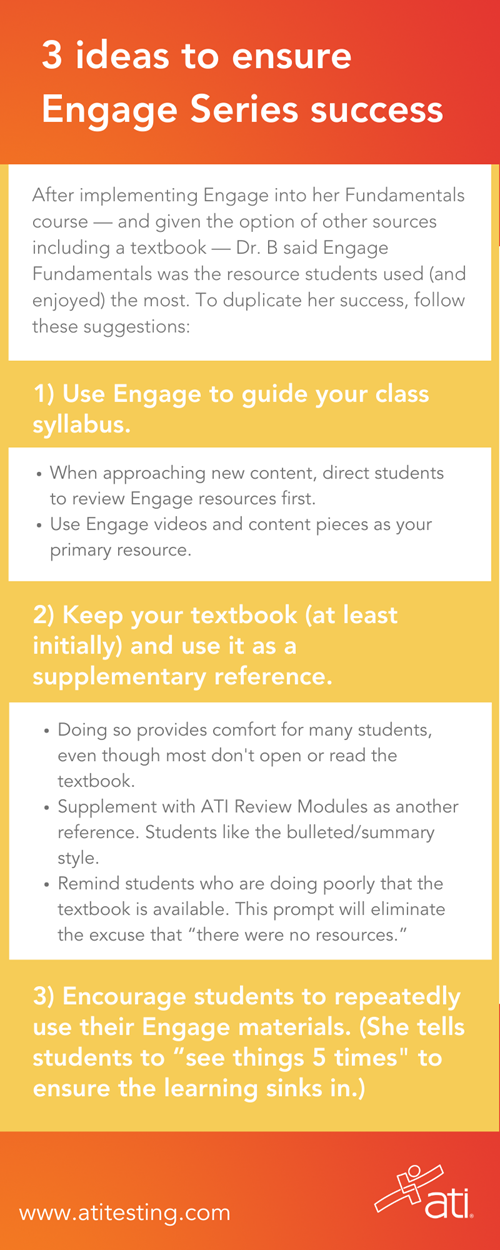
3 ideas to ensure Engage Series success
After implementing Engage into her Fundamentals course — and given the option of other sources including a textbook — Dr. B said Engage Fundamentals was the resource students used (and enjoyed) the most. To duplicate her success, follow these suggestions:
- Use Engage to guide your class syllabus.
- When approaching new content, direct students to review Engage resources first.
- Use Engage videos and content pieces as your primary resource.
- Keep your textbook (at least initially) and use it as a supplementary reference.
- Doing so provides comfort for many students, even though most don't open or read the textbook.
- Supplement with ATI Review Modules as another reference. Students like the bulleted/summary style.
- Remind students who are doing poorly that the textbook is available. This prompt will eliminate the excuse that “there were no resources.”
- Encourage students to repeatedly use their Engage materials. (She tells students to “see things 5 times" to ensure the learning sinks in.)
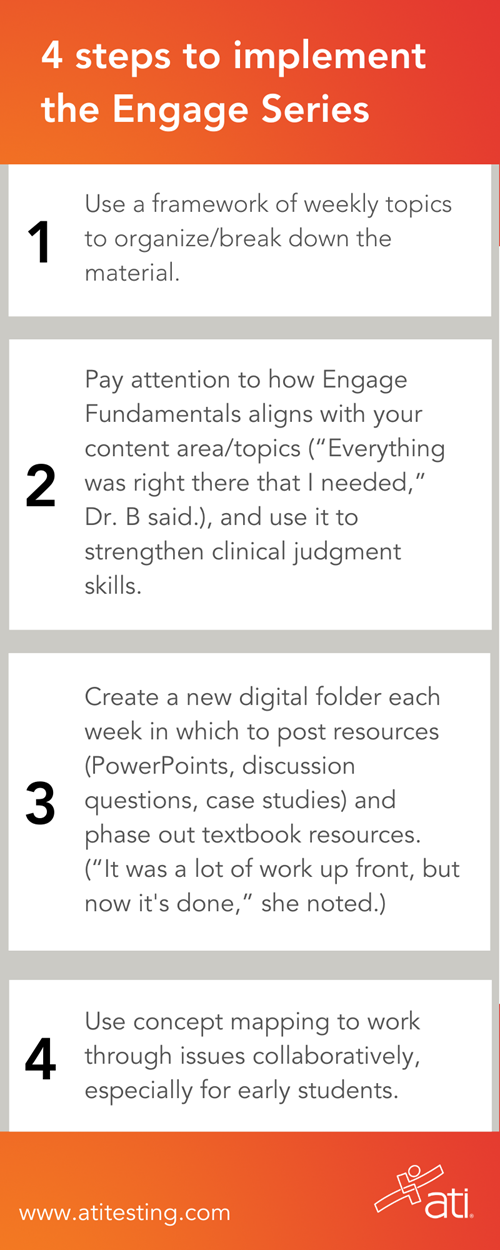
4 steps to implement Engage
- Use a framework of weekly topics to organize/break down the material.
- Pay attention to how Engage Fundamentals aligns with your content area/topics (“Everything was right there that I needed,” Dr. B said.), and use it to strengthen clinical judgment skills.
- Create a new digital folder each week in which to post resources (PowerPoints, discussion questions, case studies) and phase out textbook resources. (“It was a lot of work upfront, but now it's done,” she noted.)
- Use concept mapping to work through issues collaboratively, especially for early students.
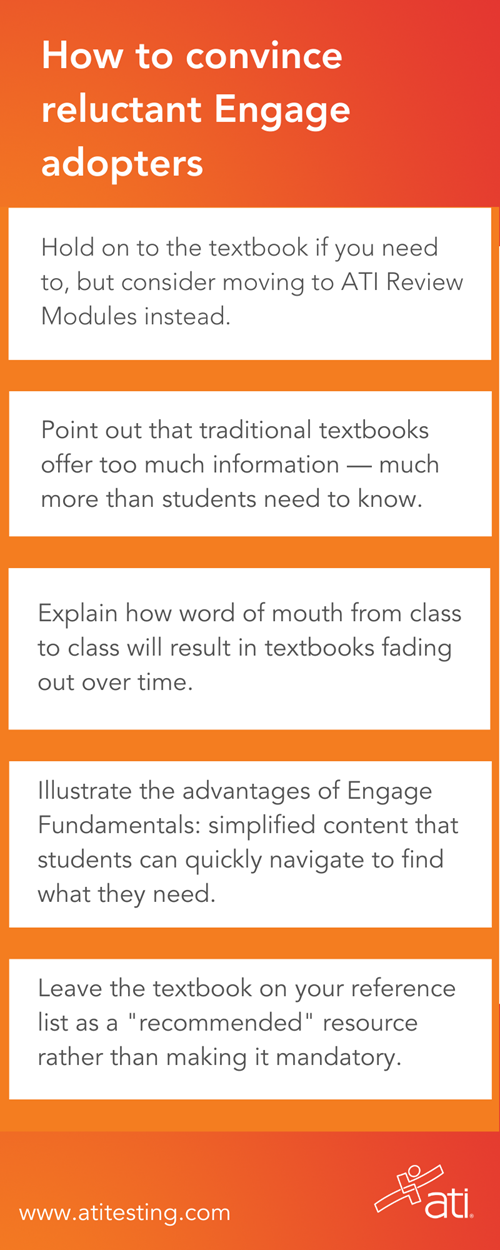
How to convince reluctant Engage adopters
- Hold on to the textbook if you need to but consider moving to ATI Review Modules instead.
- Point out that traditional textbooks offer too much information — much more than students need to know.
- Explain how word of mouth from class to class will result in textbooks fading out over time.
- Illustrate the advantages of Engage Fundamentals: simplified content that students can quickly navigate to find what they need.
- Leave the textbook on your reference list as a "recommended" resource rather than making it mandatory.
*We are only using Dr. B’s initial and are not identifying her nursing program due to her university’s confidentiality rules.