Need Strategies to Prepare for NGN? Put These to Work Now
6 Activities for Teaching Clinical Judgment as You Prep for Next Gen NCLEX
Next Gen NCLEX activity 1: Collecting cues to build clinical judgment
Present students with a simulated, written, or on-screen scenario. Ask students to identify the following in the scenario:
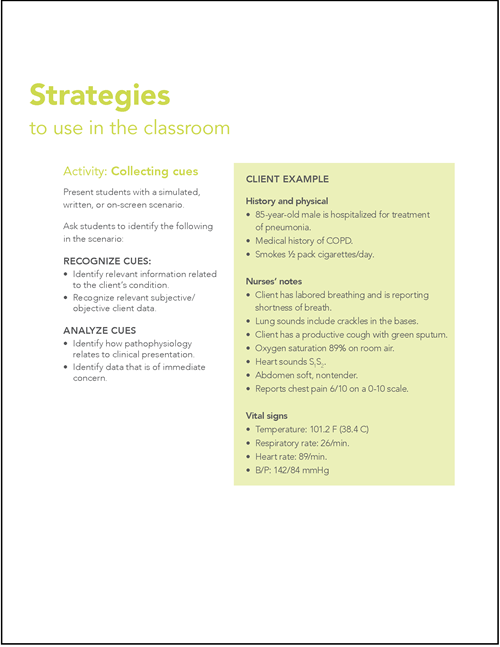
Recognize cues:
- Identify relevant information related to the client’s condition.
- Recognize relevant subjective/objective client data.
Analyze cues:
- Identify how pathophysiology relates to clinical presentation.
- Identify data that is of immediate concern.
Download a handy PDF of the page at right
Prepare for the activity by reviewing the following ATI tools and specific modules. Then determine how to best integrate them into this activity to help your students connect clinical judgment to clinical situations in the field. Doing so is an effective way to help improve students' clinical judgment so they are prepared for the Next Generation NCLEX (NGN).
Take advantage of these ATI resources:
- Airway Management
- Oxygen Therapy
- Gas Exchange and Oxygenation Fluid, Electrolyte, and Acid-Base Regulation
- Shirley Williamson: Bronchitis
- Adult Medical Surgical Heart Failure
- Adult Medical Surgical COPD
- Fluid Volume
- Oxygenation
- Technique Identifier: Client Living With Asthma
- COVID-19
Next Gen NCLEX activity 2: Identifying problems to strengthen clinical judgment
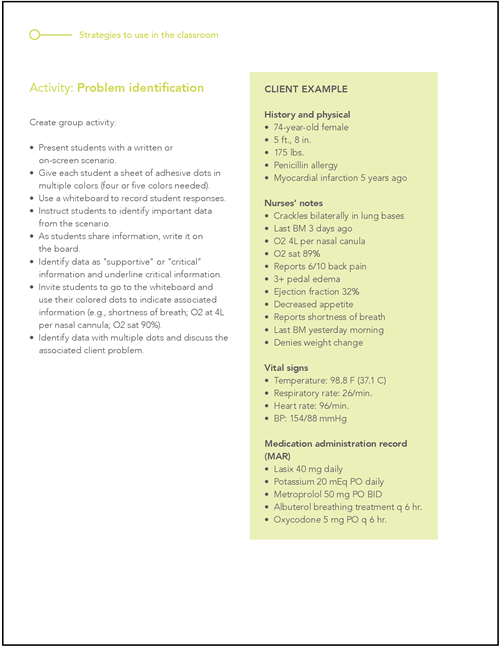
Create a group activity designed to enhance students’ clinical judgment as part of your Next Generation NCLEX lesson planning:
- Present students with a written or on-screen scenario.
- Give each student a sheet of adhesive dots in multiple colors (4 or 5 colors needed).
- Use a whiteboard to record student responses.
- Instruct students to identify important data from the scenario.
- As students share information, write it on the board.
- Identify data as "supportive" or "critical" information and underline critical information.
- Invite students to go to the whiteboard and use their colored dots to indicate associated information (e.g., shortness of breath; O2 at 4L per nasal cannula; O2 sat 90%).
- Identify data with multiple dots and discuss the associated client problem.
Download a handy PDF of the page at right
Prepare for the activity by reviewing the following ATI tools and specific modules. (These types of resources are crucial for building clinical judgment to help students pass the Next Gen NCLEX with high scores.) Then determine how to best integrate them into the activity:
- Fluid & Electrolyte Balance: Heart Failure
- Acid Base Imbalance
- Heart Failure
- Harold Stevens
- Adult Medical Surgical-Myocardial Infarction
- Complications
- Congestive Heart Failure
- Oxygen Therapy
- Airway Management
Next Gen NCLEX activity 3: Using a “tree of impact” to develop clinical judgment skills
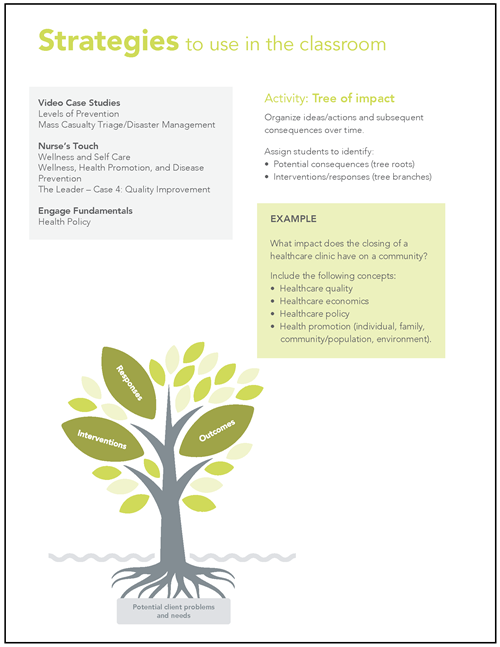
Organize ideas/actions and subsequent consequences over time to encourage students’ clinical judgment strength. Assign students to identify:
- Potential consequences (tree roots)
- Interventions/responses (tree branches).
EXAMPLE QUESTION
What impact does the closing of a healthcare clinic have on a community?
Include the following concepts:
- Healthcare quality
- Healthcare economics
- Healthcare policy
- Health promotion (individual, family, community/population, environment).
Download a handy PDF of the page at right
Prepare for the activity by reviewing the following ATI tools and specific modules. Then determine how to best integrate them into this activity:
- Levels of Prevention
- Mass Casualty Triage/Disaster Management
- Wellness and Self Care
- Wellness, Health Promotion, and Disease Prevention
- The Leader – Case 4: Quality Improvement
- Health Policy
A Strategy to use in Lab/Simulation
Next Gen NCLEX activity 4: Assessing health to build clinical judgment
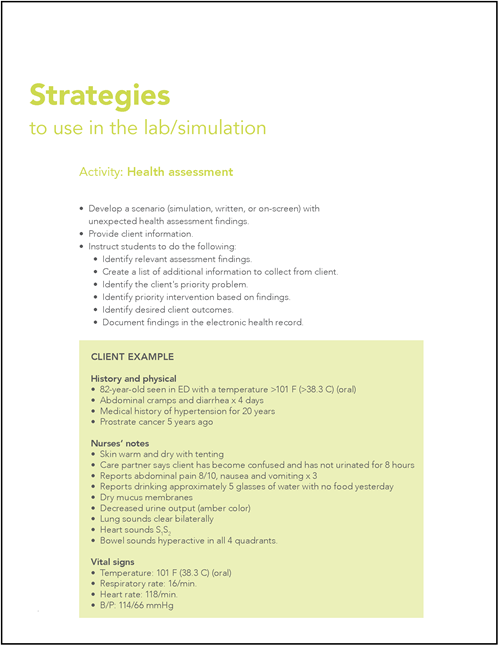
Develop a scenario (simulation, written, or on-screen) with unexpected health assessment findings. Provide client information, and then explain that students will foster their clinical judgment by doing the following:
- Identify relevant assessment findings.
- Create a list of additional information to collect from the client.
- Identify the client’s priority problem.
- Identify the priority intervention based on findings.
- Identify desired client outcomes.
- Document findings in the electronic health record.
Download a handy PDF of the page at right
Prepare for the activity by reviewing the following ATI tools and specific modules. Then determine how to best integrate them into this activity:
- Physical Assessment of an Adult
- Virtual Scenario: Nutrition
- Abdomen and Diane Radford
- Adult Medical Surgical Kidney Disease
- Dehydration and Gastritis
- IV Therapy & Peripheral Access
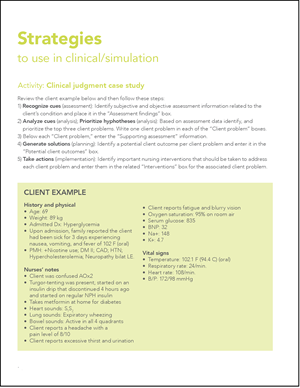
A Strategy to Use in Clinical/Simulation
Next Gen NCLEX activity 5: Progressing through a case study to enhance clinical judgment
1. Recognize cues (assessment): Identify subjective and objective assessment information related to the client’s condition and place it in the “Assessment findings” box.
2. Analyze cues (analysis); Prioritize hyphotheses (analysis): Based on assessment data, identify and prioritize the top three client problems. Write one client problem in each of the “Client problem” boxes.
- Below each “Client problem,” enter the “Supporting assessment” information.
3. Generate solutions (planning): Identify a potential client outcome per client problem and enter it in the “Potential client outcomes” box.
4. Take actions (implementation): Identify important nursing interventions that should be taken to address each client problem and enter them in the related “Interventions” box for the associated client problem.
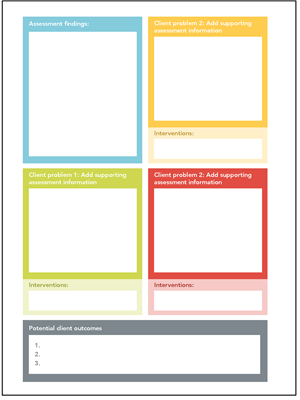
Download a handy PDF of the pages at right
Prepare for the activity by reviewing the following ATI tools and specific modules. Then determine how to best integrate them into this activity:
- Adult Medical Surgical Diabetes Mellitus
- Diabetes mellitus management
- Pain Management
- Oxygen Therapy
- IV Therapy & Peripheral Access
- Type 1 DM
- Mixing Insulins
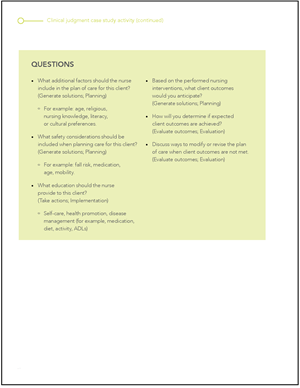 Pain Management
- Priority-Setting Frameworks and Managing Care
- Pneumonia
A Strategy to Use in Clinical
Next Gen NCLEX activity 6: Creating a change-of-shift report to boost clinical judgment
Create an end-of-shift report that incorporates information related to the steps of the Nursing Process.
- Recognize cues (assessment): Summarize important information from the change-of-shift report.
- Generate hypotheses (analysis): Identify client problems/needs.
- Judge hypotheses (planning): Select a priority-setting framework and prioritize the client problems/needs.
- Take action (implementing): Identify priority nursing actions.
- Evaluate outcomes (evaluation): Recognize client response to nursing actions.
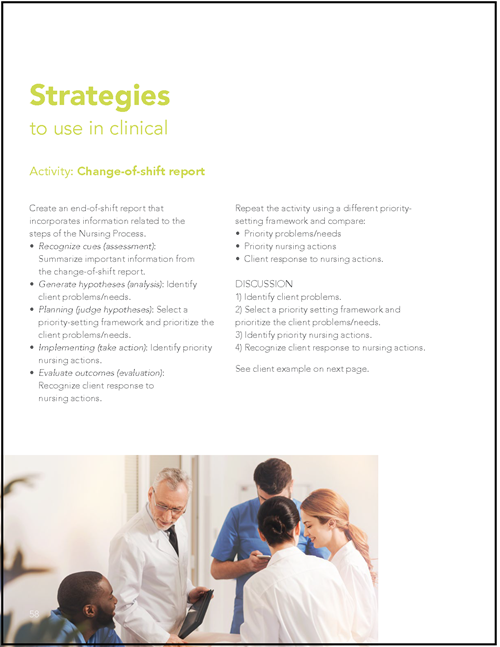
Download a handy PDF of the page at right
Repeat the activity using a different priority-setting framework and compare:
- Priority problems/needs
- Priority nursing actions
- Client response to nursing actions.
DISCUSSION:
- Identify client problems.
- Select a priority-setting framework and prioritize the client problems/needs.
- Identify priority nursing actions.
- Recognize client response to nursing actions.
Prepare for the activity by reviewing the following ATI tools and specific modules that can enhance clinical judgment. Then determine how to best integrate them into this activity:
- Pancreatitis
- Adult Medical Surgical: COPD or MH: Anxiety Disorder
- Engage Fundamentals
- Communication
- Documentation
- Hand-Off Reports
- The Leader – Case 1