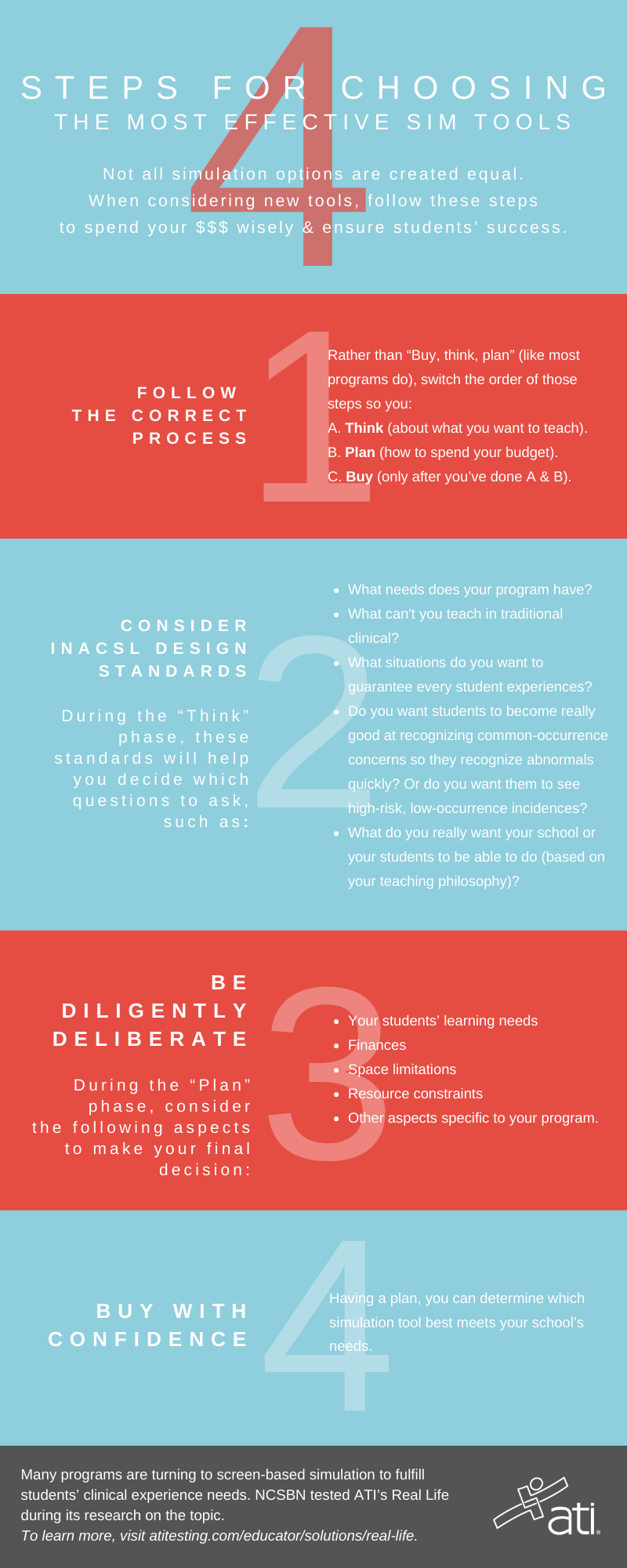
Rather than “Buy, think, plan” (like most programs do), switch the order of those steps so you:
A. Think (about what you’re trying to teach).
B. Plan (how to spend your budget).
C. Buy (only after you’ve done A and B).
2) Consider INACSL design standards.
During the “Think” phase, rely on INACSLstandards to help you determine which questions to ask, such as:
What needs do you have within your program?
What can't you teach using traditional clinical?
What situations would you like to guarantee that every student experiences?
Do you want to students to become really good at common-occurrence, everyday things so that they recognize abnormals when they occur? Or do you want them to see high-risk, low-occurrence incidences? What do you really want your school or your students to be able to do (based on your teaching philosophy)?
3) Be diligently deliberate.
During the “Plan” phase, consider the following aspects to make your final decision:
Your students’ learning needs
Finances
Space limitations
Resource constraints
Other aspects specific to your program.
4) Buy with confidence.
Having a plan, you can determine which simulation tool best meets your school’s needs.
Many programs are turning to screen-based simulation to fulfill students’ clinical experience needs. ATI’s Real Life was among those tested by NCSBNduring its research on the topic.
Real Life encourages critical thinking, clinical decision making, and clinical judgment. To learn more, visit ATI's Real Life solutions page.