
Nurse Educator Blog
State of Nursing Education
The State of Nursing Education is the authoritative ATI series examining key issues affecting today’s academic nursing programs, deans and faculty.
Explore All ArticlesTop Sim Expert Advises on Nursing Simulation Options
How to Choose the Perfect Nursing Simulation Tools for Your Program's Specific Needs
Your nursing program has received a grant. Or a large donor left a generous gift in their will. Or the government is doling out extra dollars for improvements. Now you’re eager to spend the money.
An item likely at the top of your list? Expanding — or creating — a simulation lab.
As you consider the options, you can be easily tempted to purchase whatever offerings have the most bells and whistles to fit your budget. But simulation experts suggest caution.
Instead of jumping into the purchase process, first take some time to review your students’ learning needs, finances, space, resource constraints, and more.
A Nursing Simulation Expert Has Smart Questions to Consider
 One of the top experts within nursing simulation is Suzan Kardong-Edgren, PhD, RN, ANEF, CHSE, FSSH, FAAN. She was a consultant on the landmark National Council of Nursing National Simulation Study that determined that up to 50% of traditional clinical could be replaced with high quality simulation. Among her many other qualifications, she currently is immediate past president of the International Nursing Association for Clinical Simulation (INACSL) and a Senior Fellow at the Center for Medical Simulation.
Dr. Kardong-Edgren suggests taking advice she heard years ago from Michael A. Seropian, MD, FRCPC, Director of Simulation for the Department of Anesthesiology at Oregon Health & Science University (Portland).
“He said you need to think about what you’re trying to teach,” Dr. Kardong-Edgren explained. “He says, ‘Think. Plan. Buy.’”
Few nursing programs follow that timeline, however.
Suppressing Temptation When Purchasing Simulation Tools
“What usually happens for us in schools of nursing,” said Dr. Kardong-Edgren, “is that we get a big grant, and we have to spend all the money by May.
"And, so, we buy.
“And then we think.
“And then we plan.”

She suggests schools consider following the “INACSL Standards of best practice: Simulation,” which are designed to meet identified objectives and optimize achievement of expected outcomes.
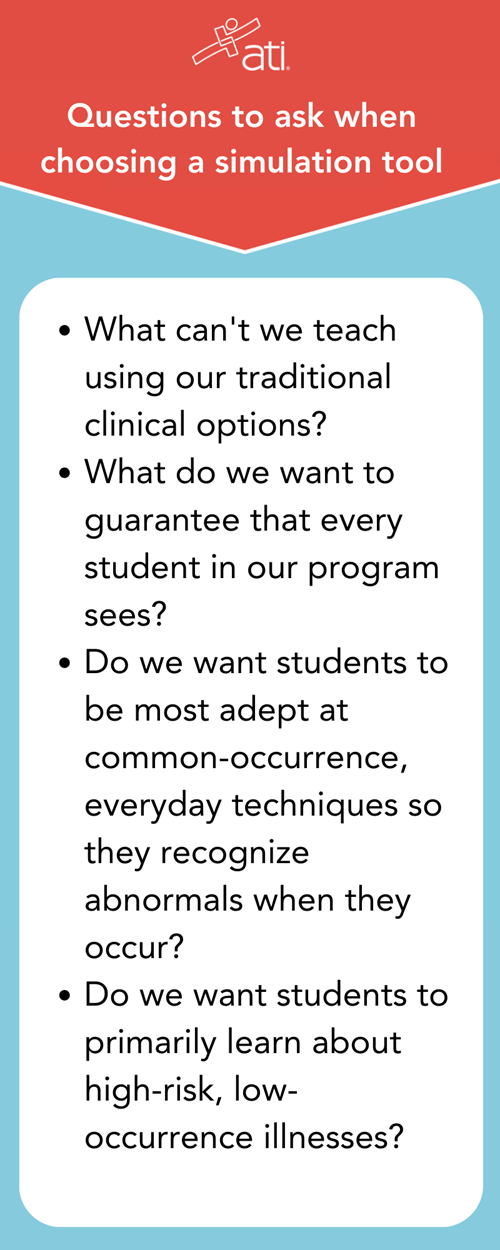
Once you’re familiar with design aspects described in the INACSL standards, she suggests asking these questions to consider what’s best for your nursing program:
- What can't we teach using our traditional clinical options?
- What do we want to guarantee that every student in our program sees?
- Do we want students to be most adept at common-occurrence, everyday techniques so they recognize abnormals when they occur?
- Do we want students to primarily learn about high-risk, low-occurrence illnesses?
Answers to these questions will be crucial in helping with your needs assessment.
She does offer one more query to consider: “What do I really want my school or my students to be able to do?”
The answer to that question, she said, comes down to the teaching philosophy at your school.
Consider Nursing Simulation Options That Can Replace a Textbook
ATI’s Engage Series is an innovative option for today’s nursing simulation learners. Designed to replace course textbooks, each content area in the Engage Series of modules offers an absorbing and compelling learning experience that provides details on all the need-to-know information required of students wanting to become a nurse generalist.
In one resource, on one platform, students experience learning by:
- processing knowledge
- visualizing it
- applying it
- practicing it
- assessing it
- remediating it.
Get the details on how you can meet your next generation of learners where they live and learn best – online and digitally engaged.