How to Improve Nursing Student Academic Readiness

Evidence-Based Strategies That Turn Student Struggles Into NCLEX Successes
It’s week 3 of fundamentals class with a new first-year nursing student cohort, and the telltale signs are there. Multiple students are struggling with foundational concepts or having trouble balancing the demands of nursing school with other responsibilities. You expect several students to withdraw before you get to week 6.
This scenario is all too common. When ATI polled faculty during a recent continuing education webinar, the majority said that 50% to 60% of incoming students aren't adequately prepared for nursing coursework.1 This lack of academic readiness produces rising student attrition, steep financial losses and a shortfall of new nurses joining a workforce that desperately needs them.2
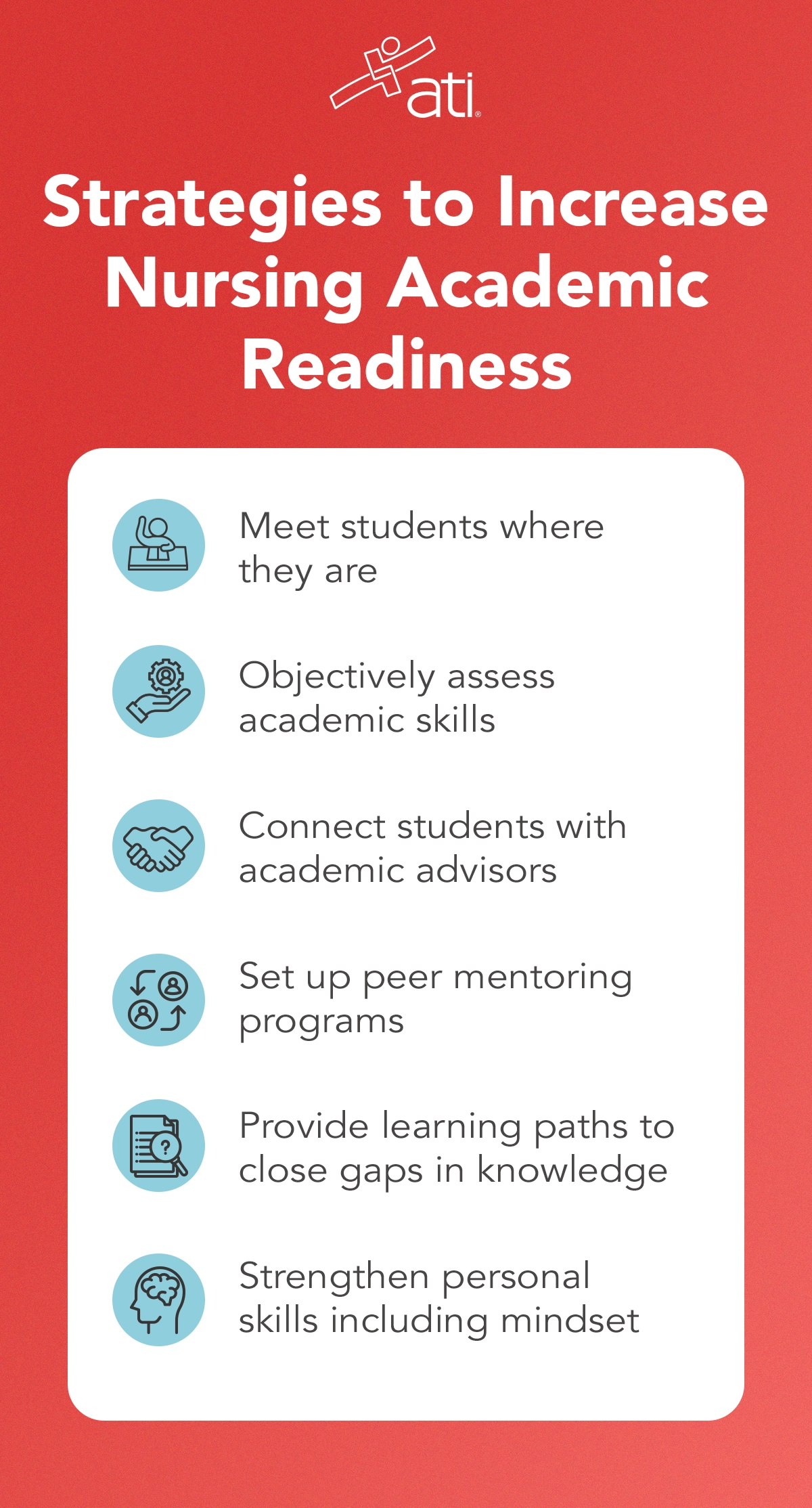 It doesn’t have to be this way. A 2025 scoping review found that when programs create supportive environments and make targeted curricular adjustments, they retain more students and graduate more resilient nurses.3 The best outcomes result from 2 steps: identifying where students struggle and implementing proactive strategies and support that fill academic gaps quickly and effectively.4
Programs that use evidence-based academic readiness interventions like Launch: Nursing Academic Readiness® experience these improved outcomes. When students enter their first nursing courses prepared for the rigor ahead, they are more likely to graduate from their program and achieve NCLEX success.
True Indicators of Academic Preparedness: Look Beyond GPA
Before implementing interventions, it’s crucial to understand what constitutes true academic readiness in today’s nursing students.
Academic preparedness is not determined solely by a high school or college transcript. When students are truly ready for nursing curriculum, they possess critical thinking skills, problem-solving abilities, effective communication, and a growth mindset.
"Academic preparedness is about more than grades," said Amy Edmison, DNP, RN, a former academic program director who is now a nursing education consultant for ATI. "It's about the ability to learn, adapt and persist."
Identifying students who possess the mix of academic and personal skills necessary for college-level learning is a challenge across higher education. Recent data shows only 20% to 30% of high school graduates are ready for entry-level college courses.4
During a webinar focused on nursing student retention strategies, Dr. Edmison and Beth Cusatis Phillips, PhD, RN, CNE, CHSE, discussed the challenge of academic readiness and how academic programs can address it. (This webinar is available on demand here.)
Understanding what preparedness entails naturally leads to the next question: Why do so many students fall short of these benchmarks?

The Root Causes: Why Students Arrive Unprepared
Research and educator experience have identified common reasons why nursing students start a program with weaknesses. Dr. Edmison discussed 4 of them during the webinar:
- Inconsistent K-12 preparation. Grade inflation leads to learning loss and poor preparation for college, creating a false assumption of mastery.
- Underdeveloped study skills. Students rely on memorization rather than building long-term retention.
- Significant outside commitments. Jobs, families and other responsibilities eat into homework and study time.
- Generational learning differences. A gap exists between how faculty teach and how students learn. Gen Z students process information rapidly through digital channels and prefer internet resources and videos over traditional textbooks, Dr. Edmison said.
These factors and others result in a perfect storm for nursing programs. But it’s a storm that can be calmed by a fundamental shift in approach.
"Yes, the demands today are higher at both work and at school,” said Dr. Phillips, who is a strategic nursing advisor and senior manager of content strategy for Ascend Learning and ATI. “But we have an opportunity to do something different to prepare them. It's about meeting students where they are — not where we want them to be."
Start at the Beginning: Good Admissions Decisions + Assessments
The eventual success of every cohort starts with a strong admissions process followed by support. This is the time to establish a foundation for academic success. (Read about new research on admissions assessments here.)
Dr. Edmison recommended using all available data — admission scores, prerequisite grades, self-assessments — to create individualized success plans. Establish a proactive plan for students who fall below typical metrics, including success coaching, regular check-ins, and early intervention protocols, she advised.
“Talk to students before classes begin about their deficits and set up a game plan,” Dr. Edmison said. "This lays groundwork for accountability, reflection, and self-awareness, helping students develop professional comportment."
Programs that identify student weaknesses early can better meet their academic needs. Launch: Nursing Academic Readiness provides this type of assessment and identifies personalized learning paths to address identified gaps.
This approach can produce rapid results. As one educator shared during the webinar, “We started using Launch for our new incoming cohort, and I feel this group is not as overwhelmed at this point of the semester as the new group was last semester.”
Find Out How to Admit the Right Students
Pillars of Student Support: Advisors and Mentors
Individualized support is an essential component of academic readiness. Dr. Edmison said preadmission advising that addresses academic and personal readiness makes a difference.
During these advising sessions, she recommends helping students:
- map out their schedules
- identify potential stressors
- develop contingency plans.
“Ask about their support systems, work obligations, and personal commitments. Be supportive but realistic about what nursing school will demand,” she said.
This transparency should continue throughout the program. “Make retention a normal topic of discussion with both faculty and students,” Dr. Edmison said. “This creates an environment where students feel comfortable seeking help before they consider leaving.”
Mentoring by peers or faculty is also valuable. Students in mentoring programs tend to be more comfortable in the academic setting, gaining confidence and skills that prevent attrition. Dr. Edmison recommended implementing mentoring programs that connect incoming students with current students or recent graduates who can share practical strategies and resource tips.
In the webinar chat, faculty from several programs reported success with prenursing boot camps and student success sessions. One educator described a 3- to 4-day boot camp that includes time management exercises in which students map out theory, lab, clinical, study time, work commitments, and family responsibilities. “This helps them create an active plan for success,” the educator wrote.
Accelerate Success With Evidence-Based Resources
Alongside the valuable strategies outlined during the webinar, evidence-based programs can accelerate student progress. Launch: Nursing Academic Readiness is a 6-week student-paced program that addresses core readiness gaps without adding to faculty responsibilities.
With an ATI Educator guiding them, each student progresses through interactive modules covering anatomy and physiology, medical terminology, nursing math basics, and essential student success skills (time management, mindset, studying). Learning is customized based on the objective findings of the preprogram assessment, and faculty receiving real-time reporting on students’ progress.
Programs that use Launch report statistically significant improvements in fundamentals scores and higher first-year nursing student retention rates,6 with 95% of participating students feeling the program would contribute to their success.
Ultimately, the goal of all academic readiness interventions is not just immediate academic improvement, but also long-term success for students and nursing programs.
Increase Retention, Decrease Remediation Needs & Build Better Nurses
Academic readiness isn't just about filling knowledge gaps — it's about transforming how programs welcome, support, and elevate the next generation of nurses.
“Everyone has strengths and areas that need improvement,” Dr. Edmison said. “It's okay not to know everything; what's important is figuring out how to find answers together.”
She emphasized that well executed readiness programs can yield significant wins: increased retention, stronger foundational knowledge, decreased remediation needs, and better student transitions.
“This is not a checklist but a cultural shift,” Dr. Edmison said. “To support academic preparedness and student success, we need to be both supportive and realistic. Track your data, get feedback from students and faculty, and make adjustments as needed.”
References
- Faculty poll during “Strategies That Stick: Supporting First-Year Nursing Student Success.” ATI Nursing Education webinar, Sept. 3, 2025. Available on demand: https://info.atitesting.com/academic-readiness-webinar
- NSI Nursing Solutions. 2025 NSI National Health Care Retention & RN Staffing Report. 2025. https://www.nsinursingsolutions.com/documents/library/nsi_national_health_care_retention_report.pdf
- Sheikoleslami RL, Princeton DM, Hansen LIM, Kisa S, Goyal AR. Examining Factors Associated with Attrition, Strategies for Retention Among Undergraduate Nursing Students, and Identified Research Gaps: A Scoping Review. Nursing Reports. 2025;15(182). https://doi.org/10.3390/nursrep15060182
- The Academic Readiness Gap: Why First-Year Nursing Students Struggle, and What Programs Can Do About It. ATI Nurse Educator Blog. Aug. 28, 2025.
- Manno BV. Are High School Graduates Ready for College? Forbes. 2024. https://www.forbes.com/sites/brunomanno/2024/05/28/are-high-school-graduates-ready-for-college/
- Phillips BC, Hodge K. Enhancing Student Retention in Nursing Education: Strategies and Interventions. Teaching and Learning in Nursing. 2025;20(3):248-252. https://doi.org/10.1016/j.teln.2025.02.018