
Nurse Educator Blog
State of Nursing Education
The State of Nursing Education is the authoritative ATI series examining key issues affecting today’s academic nursing programs, deans and faculty.
Explore All ArticlesMoving From Overwhelmed to Inspired: Reclaiming Joy in Nursing Education

Strategies & Resources to Lighten Your Load
If you’re a nurse educator or academic leader dreading the many hours you’ll need to work tonight or this weekend, you’re not alone. A 2025 national survey by the College and University Professional Association for Human Resources found that 51% of higher ed employees regularly work outside their full-time hours and 50% feel anxious or stressed by their workload.1
This survey also identified another pressing concern: Many respondents said they felt little institutional support for professional growth. Yet this strategy has the power to help faculty move from merely surviving to thriving.
Faculty burnout and retention are urgent issues in nursing education. This article outlines actionable strategies to help nurse educators move from feeling overwhelmed, overextended and isolated to empowered and effective. The result is focused faculty who enjoy their work and are more likely to remain at their institutions, contributing to student and program success.

Navigating the Pressures of Nursing Academia
The workplace strains in nursing education mirror those in clinical practice. More than 138,000 nurses left the workforce over the past 3 years, citing stress and burnout as primary reasons.2
As nursing faculty and education leaders, you see this crisis from both sides. You’re preparing the next generation of nurses while navigating your own distinct pressures: little preparation for the faculty role, heavy workloads, time-consuming administrative tasks, and lack of work-life balance.
A path forward exists. Research3 identifies 3 interconnected concepts that bring professional fulfillment and personal well-being within reach:
- resilience
- moral courage
- purpose
These are more than ideals. They are tangible skills that can help educators and leaders reclaim the joy and meaning of their work.
Understanding What's Draining You
 To effectively move toward inspiration, identify the factors that cause overwhelm. The Professional Quality of Life (ProQOL) Measure assesses the positive and negative aspects of helping professions and identifies strategies for achieving balance.4
Users answer prompts to assess current levels of compassion satisfaction (fulfillment from helping students succeed) and compassion fatigue (burnout and secondary traumatic stress) — both of which influence well-being.
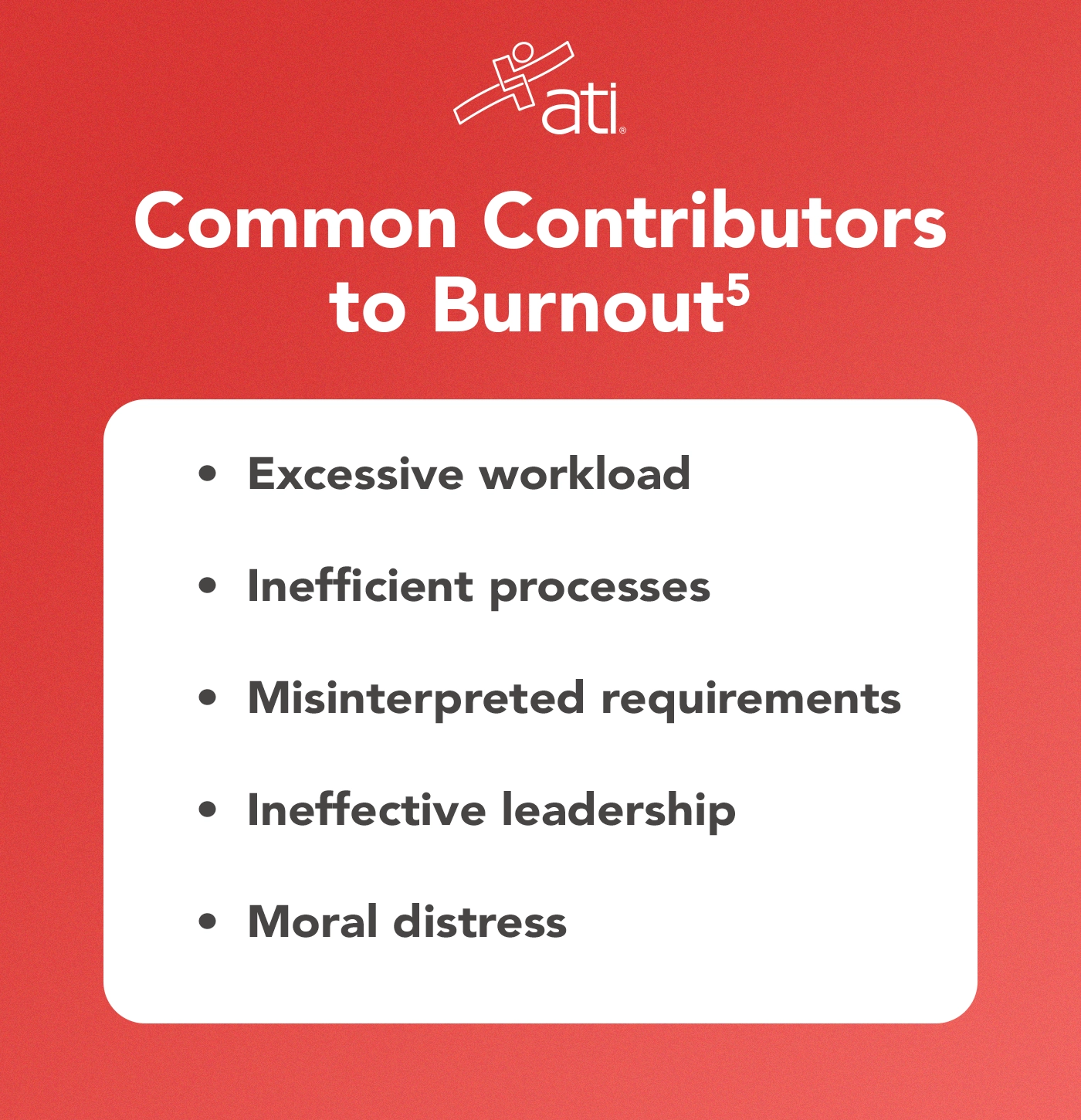
Burnout develops gradually, as a result of chronic unmanaged workplace stress. It causes feelings of depletion, detachment and inefficacy.5,6 The box at left lists common causes of burnout. See this article for information on taming burnout among nurse educators.
A Framework for Building Resilience
Building resilience is a powerful way to ignite joy in your work. Fortunately, resilience is a learned behavior that can be developed.7-10 Teresa Stephens, PhD, MSN, RN, CNE, created the 4 Ps of Personal Resilience framework to help nurses and educators achieve greater resilience. The framework guides educators through 4 reflective themes, shown in the box at lower right.
Reflecting honestly on the 4 Ps of Personal Resilience helps you identify actionable strategies. Dr. Stephens said it’s important to understand that resilience isn’t passive. Rather, it’s a mindset demonstrated through intentional choices.
“Applying the 4 Ps of Personal Resilience means committing to growth and being willing to change,” Dr. Stephens said. “This process restores agency, empowers us to choose our response to stress and adversity, and helps us reclaim control in challenging environments.” 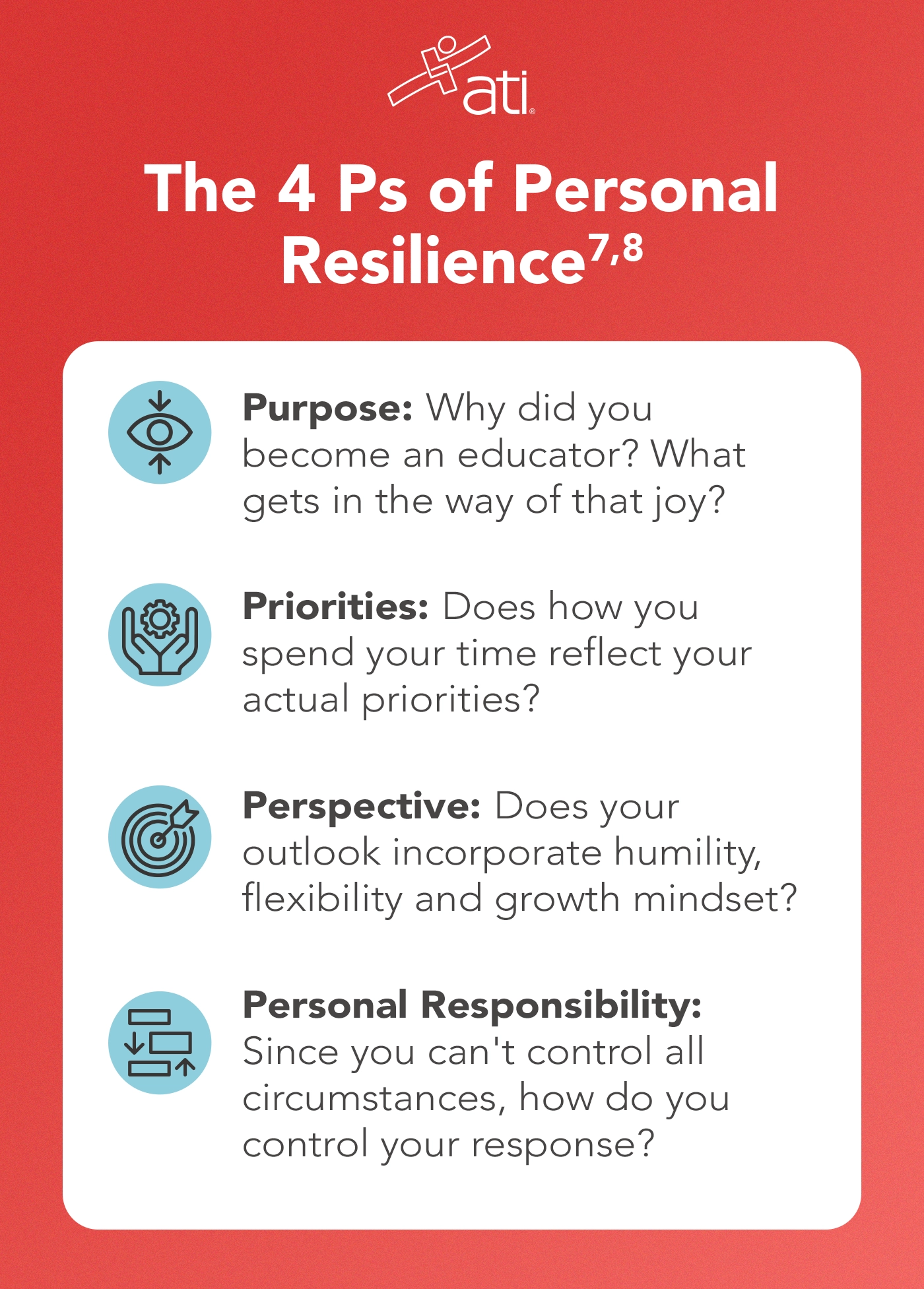
Your Toolkit for Moving from Overwhelmed to Inspired
Below are 3 high-impact resilience-building strategies you can start today.
Strategy 1: Prioritize Self-Care
Self-care requires a holistic approach to improved well-being. This can include:
- Recognizing the early signs of burnout: exhaustion, frustration, loss of motivation, difficulty concentrating
- Setting real boundaries: defining work hours, saying no when necessary, separating work from family and personal time
- Cultivating physical and mental wellness: exercise, adequate sleep, regular breaks, hobbies
- Building support networks: connecting with peers, seeking mentorship, asking for help when needed
- Building a mindfulness approach: this includes a beginner's mindset, letting go, compassion, gratitude, authenticity, commitment, and trust.11
Strategy 2: Cultivate Moral Courage
Building resilience also requires moral courage, an inner strength that shapes responses to ethical dilemmas. In nursing education settings and in clinical practice, hierarchy can deter moral courage.12,13 But Dr. Stephens’ research shows that moral courage can be a form of active resistance and a defining characteristic of advocates and changemakers.3
Take these steps to develop moral courage:
- Adopt tenets of civility and resilience: This results in clear, respectful, courageous communication that supports moral courage.12
- Develop skills for managing fear: Cognitive reframing, self-soothing and building risk tolerance can be helpful.
- Seek training: Attend workshops on ethics, assertive communication and negotiation.
Strategy 3: Pursue Professional Growth
Professional growth is a cornerstone of fulfillment. By investing in ongoing learning and skill development, nurse educators can reignite their passion for teaching and enhance their impact on student and program outcomes. This investment doesn’t require a significant time commitment; it can be as simple as setting aside 10 minutes to read articles like this one.
- Find your why: Clarify your purpose and ensure your role aligns with it.
- Point yourself in the right direction: Identify opportunities that fuel your passion.
- Set a course for success: Pursue professional development and education.
- Elicit help: Develop professional networks and seek external learning opportunities.
Resilience & the Need for Systemic Change
While personal resilience strategies are essential, individual actions alone cannot solve systemic problems. As Dr. Stephens and coauthor Diana Layne, PhD, RN, CPHQ, noted in their 2023 study,14 developing personal resilience and mastering civility competencies do not solve root causes. However, both can enhance the ability to sustain personal health, well-being and professional fulfillment.14
“When you embrace resilience personally, you model it for your students and colleagues and help build resilient teams capable of addressing the systemic issues that drive burnout and moral injury,” Dr. Stephens told the ATI Educator Blog. “Systems don’t change until the people within them change. Personal resilience is your superpower — and the key to professional fulfillment."
Efficiency & Support Systems Encourage Resiliency
A key step in addressing systemic challenges is implementing support systems and tools that streamline workload and reduce inefficient processes. When faculty have access to evidence-based resources, assessment tools and efficient workflows, they can focus more energy on what matters most: meaningful teaching and student relationships. This is possible when they can spend less time on administrative burden and resource creation.
Strategic partnerships make a considerable difference. Efficient systems for student evaluation and assessment, remediation, and evidence-based teaching save time and foster more of the meaningful work that protects against burnout.
ATI provides this type of partnership by supporting nurse educators and academic leaders with a suite of evidence-based resources and expert services:
- ATI Academy offers on-demand, self-paced professional development and continuing education, helping faculty build skills and confidence at every career stage.
- ATI Consultant Solutions provide personalized guidance in classroom management, curriculum development and other teaching needs, all tailored to the unique needs of each program.
- Claire AI®, integrated into resources including Custom Assessment Builder and the Engage® Series, streamlines assessment creation and delivers 24/7 support for both faculty and students.
Return to What Drew You to Education
The strategies outlined in this article will help you build greater resilience, allowing you to reclaim the joy that drew you to nursing education. And the impact of these practices will reverberate widely. Dr. Stephens and Dr. Layne put it this way in their paper on nursing faculty resilience, moral courage and purpose:14
“As individual faculty, we have an ethical responsibly to teach, model and promote resilience, moral courage, and purpose for ourselves and our colleagues — and most importantly, for our learners who will lead the new era of nursing.”

References
- Schneider J, Bichsel J. The CUPA-HR 2025 Higher Education Employee Retention survey. 2025. https://www.cupahr.org/resource/higher-ed-employee-retention-survey-findings-september-2025/
- Smiley R, Kaminski-Ozturk N, Reid M, Burwell P, Oliveira C, Shobo Y, Allgeyer R, Zhong E, O'Hara C, Volk A, Martin B. The 2024 National Nursing Workforce Study. Journal of Nursing Regulation. 2025;16(1):S1-S88. DOI: 10.1016/S2155-8256(25)00047-X00047-X
- Stephens TM, Layne D. A national survey of nursing faculty resilience, moral courage, and purpose. Journal of Nursing Education. 2023;62(7):381-386. https://doi.org/10.3928/01484834-20230509-01
- Stamm BH. The Concise ProQOL Manual. (2nd ed). 2019. https://proqol.org/proqol-manual
- World Health Organization. Burn-out: "An occupational phenomenon": International Classification of Diseases. 2025. https://www.who.int/news/item/28-05-2019-burn-out-an-occupational-phenomenon-international-classification-of-diseases
- Aljabery M, Coetzee-Prinsloo I, van der Wath A, Al-Hmaimat N. Characteristics of moral distress from nurses’ perspectives: An integrative review. International Journal of Nursing Sciences. 2024;11(5):578-585. https://doi.org/10.1016/j.ijnss.2024.10.005
- Stephens TM. Build resilient teams to tackle nursing burnout. American Nurse, 2020;15(3). https://www.myamericannurse.com/build-resilient-teams-to-tackle-nursing-burnout/
- Stephens TM. Building personal resilience. American Nurse Today. 2019;14(8):1-2. https://www.myamericannurse.com/wp-content/uploads/2019/08/ant8-Resilience-729a.pdf
- Stephens TM. Nursing student resilience: A concept clarification. Nursing Forum. 2013;48(2):125-133. DOI: 10.1111/nuf.12015
- Stephens TM, Cherry C, Smith P. (2017). Promoting resilience in new perioperative nurses. AORN Journal. 2017;105(3), 276-284. DOI: 10.1016/j.aorn.2016.12.019
- Sieg D. 7 habits of highly resilient nurses. Sigma blog: Nursing Centered. Nov. 16, 2020. https://nursingcentered.sigmanursing.org/features/top-stories/Vol41_1_7-habits-of-highly-resilient-nurses
- Hudgins T, Brown KD, Layne D, Stephens TM. The effect of academic nurse leaders' toxic behaviors. Journal of Nursing Education. 2022;61(2), 88-92. https://doi.org/10.3928/01484834-20211213-02
- Mollaei M, Metanat F, Javazm A, Motie M. Exploring the foundations and influences of nurses' moral courage: a scoping review. BMC Medical Ethics. 2025;26(43):1-12. DOI: 10.1186/s12910-025-01205-5
- Stephens TM, Clark CM. Civility and resilience practices to address chronic workplace stress in nursing academia. Teaching and Learning in Nursing. 2024;19(2):119-126. https://doi.org/10.1016/j.teln.2024.02.004