
Nurse Educator Blog
State of Nursing Education
The State of Nursing Education is the authoritative ATI series examining key issues affecting today’s academic nursing programs, deans and faculty.
Explore All Articles5 Ways Nursing Education Leaders Can Enhance Faculty Development

Faculty Retention Increases When Well-Being & Growth Are Supported
Faculty shortages continue to challenge academic nursing programs, where the overall vacancy rate for full-time faculty was 7.2% in the 2025-2026 academic year.1 These approximately 1,600 unfilled positions increase educators’ already heavy cognitive and administrative loads, leaving many feeling isolated, overextended and overwhelmed.
For nursing education leaders, the ongoing challenges associated with faculty retention present an opportunity to foster a workplace where educators thrive and want to remain. This is achievable using the 5 strategies outlined in this article.
Faculty Retention Requires Faculty Development
Educators are more likely to remain in environments where they can do their best work. This requires that they feel supported and appreciated. Meaningful, flexible professional development, structured mentorship and support, and time-saving resources and technology help achieve this.
Importantly, professional growth opportunities should help nurse educators reduce their workload and stress — not add to it. Faculty whose professional development is supported in these ways report higher job satisfaction and lower attrition rates.2,3
Let’s dig into the specific ways that programs can enhance professional development for nursing faculty.

1. Implement Personalized Mentorship Programs
Frequent leadership changes and evolving curricula can leave educators without guidance they need. Establishing structured, personalized mentorship provides faculty with coaching and practical support that fosters professional growth and increases efficiency.
Many models of mentorship exist, including peer-to-peer and senior-to-novice. A broader and more comprehensive option is direct access to an expert community that provides new ideas, approaches and customizable services to tailor support where educators need it most.
Why this works: Strong mentoring relationships are linked to higher job satisfaction and lower attrition.2-5 Mentors provide practical strategies and resources that build the skills and confidence that help educators reduce their mental workload, allowing them to focus on impactful teaching.
The solution: ATI Consulting Solutions connects nurse educators with a community of experts who address a range of tailored needs, including faculty role development, curriculum design and classroom management. The Consulting Solutions team of educators provides structured resources that streamline faculty efforts, enhance educational outcomes, and help ensure program quality.
2. Use AI to Streamline Assessment & Course Planning
Developing lesson plans, writing test items and assessments, and aligning all this work to syllabi and curriculum is time consuming and tedious. Juggling these responsibilities with the range of tasks associated with academic work often leaves faculty feeling overextended. Artificial intelligence tools built specifically for nursing education can help faculty reclaim a significant portion of that time.
Why this works: By reducing manual authoring and planning tasks with AI-supported faculty tools, educators can reinvest time in student engagement, remediation, and clinical judgment development — the key drivers of student and program outcomes.
The solution: Claire AI® is an AI-powered nursing-focused engine that fuels faculty efficiency. It accelerates item writing and assessment refinement, enabling faculty to create and edit test items 73% faster than traditional methods.6 In addition, Claire AI supports lesson planning, maps course syllabi to relevant ATI materials, and delivers student insights to guide more personalized instruction and remediation.
Claire AI results draw from vetted learning materials and question banks within ATI resources, which means educators can rest assured that their AI partner is not only efficient, but accurate and evidence based.
3. Provide Flexible Professional Development
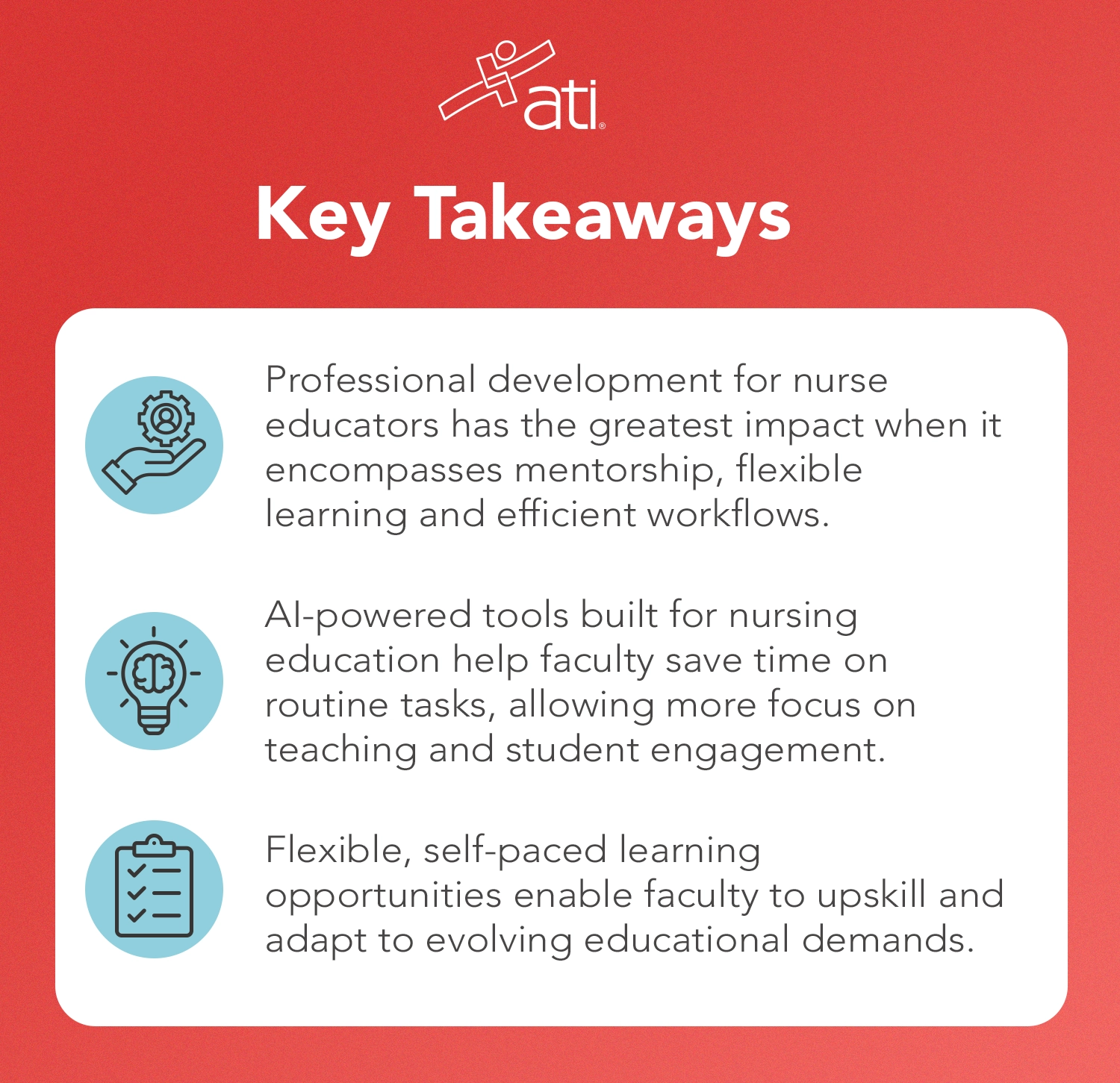
An educator’s schedule is constantly changing. Bobbing and weaving to navigate competing demands makes it difficult for faculty to access or complete standard training workshops and continuing education courses. An easy-to-access, self-paced model makes upskilling achievable and sustainable.
Why this works: Providing on-demand courses and learning opportunities targeted to educators’ needs and interests reshapes the capacity for professional development.
Faculty need flexible resources that keep them up to date on evidence-based practices, advance their knowledge, and increase their confidence in integrating new approaches and tools.
Regularly engaging in learning also helps faculty model the continuous learning mindset that fuels student success.
The solution: ATI Academy provides more than 100 comprehensive faculty development courses in engaging formats. This robust environment allows educators to earn contact hours and build skills on their own schedules — selecting from quick-bite tutorials that last less than an hour and deeper learning when more time is available. Course topics range from teaching clinical judgment to developing academic integrity to creating concept-based curriculums. Educators can even complete a prep course for the certified nurse educator (CNE) exam.
4. Streamline Administrative Workflows
Administrative tasks such as grading, reporting and curriculum mapping are essential but often inefficient. Leaders overcome this drag on time and energy by adopting centralized dashboards, analytics and program review support that standardize excellence and reduce faculty overwhelm.
Why this works: When educators spend less time on manual processes, they have more time to provide feedback, remediation and mentorship7 — all of which correlate with better faculty morale and student outcomes.
The solution: ATI Consulting Solutions delivers structured resources such as needs assessments and mock accreditation visits, as well as surveys and report reviews to simplify workflows and ensure quality across accreditation requirements and instructional planning.
5. Build a Culture of Continuous Improvement
Faculty thrive in collaborative environments where they’re encouraged to share insights, explore pedagogical approaches, and try new things. Access to expert communities, customizable services and learning opportunities helps leaders foster a culture that supports growth and accelerates problem-solving.
Whether the need is enhancing simulation, refining teaching strategy, or preparing for accreditation, an improvement-focused culture empowers faculty to innovate, collaborate and continuously elevate teaching practices. When programs foster open dialogue and provide access to expert resources, leaders can create an environment where faculty feel valued and supported in their professional growth.
Why this works: Institutions that commit to continuous improvement benefit from stronger faculty and student engagement, more resilient programs, and faculty who feel supported to innovate and excel. These initiatives strengthen faculty engagement and satisfaction and drive improvements in student outcomes. Programs that prioritize continuous improvement are better equipped to adapt to changing educational demands and maintain accreditation standards.
The solutions: ATI Academy delivers ongoing professional development and peer learning that help faculty stay current with best practices and emerging trends. The expert guidance and tailored support provided by ATI Consulting Solutions helps programs implement continuous improvement strategies, ensuring sustained excellence and compliance.
Empower Your Faculty & Your Program Outcomes
Programs that invest in evidence-based resources, efficiency-generating tools and streamlined workflows enable faculty to spend less time on administrative tasks and more energy on meaningful teaching.
Faculty satisfaction is an ignitor of student success, program quality and institutional reputation. By providing personalized mentorship, AI-enabled assistance for time-consuming tasks, flexible professional development, streamlined workflows, and a culture of continuous improvement, leaders can transform the day-to-day experience of nurse educators. ATI solutions are built to do exactly that. Integrating the resources outlined here can reduce time drains, enhance teaching, and sustain the people at the heart of nursing education.

References
- Keyt J, Herrington M. American Association of Colleges of Nursing Survey on Vacant Faculty Positions for Academic Year 2025-2026. https://www.aacnnursing.org/Portals/0/PDFs/Reports/Faculty-Vacancy-Report-2025.pdf
- How Nursing Programs Can Retain One of Their Biggest Assets: Faculty. ATI Educator Blog. Feb. 28, 2025. https://www.atitesting.com/educator/blog/knowledge/2025/02/28/how-nursing-programs-can-retain-faculty
- Reducing Nursing Faculty Attrition With Evidence-Based Onboarding. ATI Educator Blog. Jan. 5, 2024. https://www.atitesting.com/educator/blog/knowledge/2024/01/05/faculty-onboarding-and-retention
- Boamah SA, Kalu ME, Havaei F, McMillan K, Belita E. Predictors of Nursing Faculty Job and Career Satisfaction, Turnover Intentions, and Professional Outlook: A National Survey. Healthcare. 2023;11(14):2099. https://doi.org/10.3390/healthcare11142099
- Livingston L. The Effect of Formal Mentorship Programs on Nurse Faculty Retention: An Integrative Review. 2024. Doctoral Dissertations and Projects, 5220. https://digitalcommons.liberty.edu/doctoral/5220
- ATI Nursing Education. 2025. Results of internal time-and-motion study. Faculty generated and refined test items with Claire AI approximately 73% faster than manual methods in Custom Assessment Builder (11 min/item vs. 3 min/item; Wilcoxon p <0.001).
- Singh A. Time Management Skills Among Nursing Faculty: Implications for Teaching Effectiveness. Journal of Advance and Future Research. 2025;3(7). https://rjwave.org/jaafr/papers/JAAFR2507011.pdf
About the author: Michelle Perron is a healthcare writer and editor who develops evidence-based content for ATI Nursing Education. With more than 20 years of experience in healthcare publishing, journal development, medical editing, and editorial management, she helps connect nursing research and education best practices to today's faculty needs.