
Nurse Educator Blog
State of Nursing Education
The State of Nursing Education is the authoritative ATI series examining key issues affecting today’s academic nursing programs, deans and faculty.
Explore All ArticlesPublic Policy & Nursing Education: Using Our Collective Voice to Make a Change

How ATI Advocates for Faculty, Students & the Nursing Workforce Pipeline
Across the country, nursing education leaders, employers, and policymakers are grappling with a concerning yet all too common set of challenges: persistent faculty shortages, uneven academic preparedness among incoming students, high attrition, and the downstream impact these pressures have on patient care quality and workforce stability.
Policymakers at the state and federal levels are being asked to address these challenges. However, they often lack a clear understanding of how laws and regulations shape what happens within nursing programs. At ATI, we are intentionally expanding our advocacy efforts to build a two-way dialogue with these policymakers and shape the policies that impact nursing education.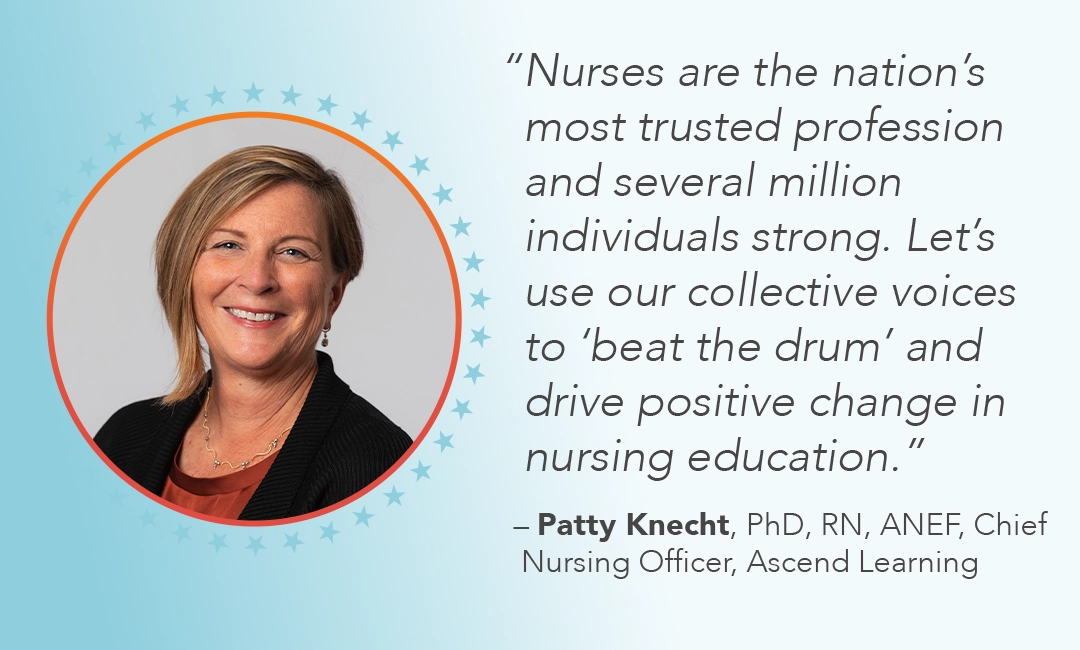
Elevating Voices on the Ground
Your real‑world perspective is essential. We want to better understand the challenges you face and your ideas for how public policy can scale successful practices and strengthen the nursing education pipeline.
Public policy is most effective when it reflects the lived experience of nurse educators and institutions on the ground. That’s why we want to hear directly from you, our partners — nurse educators, deans and directors, ATI Champions and ATI Advisory Board members — about where policy helps and where it unintentionally creates barriers. Every story and every experience are powerful tools for us to share with policymakers.
ATI is committed to advancing bipartisan policy priorities by combining data, research and the voices of trusted nurse educators. Four core policy goals and principles guide this work:
- Recruit, retain, and support nurse educators.
- Address academic readiness gaps.
- Help more nursing students succeed.
- Improve patient care quality, safety and satisfaction.
Let’s take a look at the policies ATI is advocating for to achieve these goals.
ATI’s Current Legislative Priorities
Informed by the four principles, ATI is engaging on several federal legislative initiatives in 2026. These bipartisan bills reflect targeted opportunities where federal policy can strengthen nursing education and workforce capacity.
- Title VIII Nursing Workforce Reauthorization Act of 2025 ( S.1874/ H.R.3593) seeks to strengthen grant programs supporting nurse and nurse educator education.
- PRECEPT Nurses Act (S.131/ H.R.392) seeks to create a $2,000 nonrefundable tax credit for eligible nurse preceptors.
- Train More Nurses Act (S.547/ H.R.5052) would direct the Department of Health and Human Services and the Department of Labor to evaluate grant programs to expand nursing faculty and the nursing pipeline.
- National Nursing Workforce Center Act of 2025 (S.1482/ H.R.4407) would establish a pilot program to support state‑based nursing workforce centers.
- Rebuild America’s Health Care Schools Act of 2025 (S.1087/ H.R.1708) would ensure that hospitals receive full Medicare reimbursement for clinical training costs for nursing and allied health students.
- Modernizing Rural Physician Assistant and Nurse Practitioner Utilization Act (H.R. 5199) would provide greater flexibility for nurse practitioners and physician assistants to provide high-level healthcare services.
Priority Nursing Education Issues in 2026
In addition to the legislation listed above, ATI is engaging on the following issues that are top of mind for the nursing education community.
- Graduate Nursing Degree Loan Classification. ATI is actively advocating to reverse the Department of Education’s classification of postbaccalaureate nursing degrees outside the definition of “professional degrees,” which will significantly reduce federal student loan limits beginning July 1, 2026. ATI has engaged bipartisan lawmakers on this issue and will submit formal comments to encourage a policy approach that reflects the cost and workforce value of graduate nursing education.
- Apprenticeships. The Department of Labor has announced $145 million in funding for expansion of the Registered Apprenticeship Program, with healthcare as a focus sector. ATI is monitoring opportunities relevant to our nursing education partners.
- Appropriations. ATI supports efforts to protect funding for Title VIII nursing workforce development programs. As Congress begins to debate funding decisions for fiscal year 2027, ATI will advocate for increased funding for these critical programs.
How You Can Get Involved
Your perspective matters! Our voices are stronger when we come together to advocate collectively. ATI invites you to engage with our Government Relations and Public Affairs team to share your real-world perspective. Your experiences help us establish and deepen policymakers’ understanding of nursing education, inform policy discussions, and ultimately strengthen the nursing education pipeline.
If you have questions or would like to get involved in our advocacy work on behalf of nursing education, please contact Kurt Burkum, ATI Senior Director of Government Relations, at [email protected].
About the author: Kurt Burkum is the Senior Director of Government Relations for Ascend Learning. ATI is an Ascend Learning brand. With more than 20 years of experience in education policy, workforce development, public affairs, and policy research, Kurt works with policymakers, educators, and industry leaders on issues that shape learner success and workforce readiness. His writing explores the legislative, regulatory, and policy trends affecting postsecondary education, career pathways, credentialing, and professional training.