
Nurse Educator Blog
State of Nursing Education
The State of Nursing Education is the authoritative ATI series examining key issues affecting today’s academic nursing programs, deans and faculty.
Explore All ArticlesWhich Content Areas and Milestones Matter Most in Nursing Programs?

New PN & RN Data Provides Answers That Fuel Student Success
A recent analysis of nearly 10,000 PN and RN students provides new clarity on how course-level performance connects to end-of-program readiness — and how faculty can use assessment data more intentionally to support student success.
The findings show that learning patterns in nursing students are measurable, consistent and actionable, with direct implications for teaching, assessment placement, and student support. When programs refine how and when assessments are used, they can improve student retention and NCLEX pass rates.
To move from insight to action, let’s dig into what the researchers examined and how their findings map to everyday curriculum decisions.
What the Research Examined, and What It Determined
Miller et al.1 reviewed data from 9,728 PN and RN students in U.S. nursing programs to evaluate how well standardized assessments predict nursing student success. All students had completed a sequence of standardized learning content and assessments in 2023 and 2024. 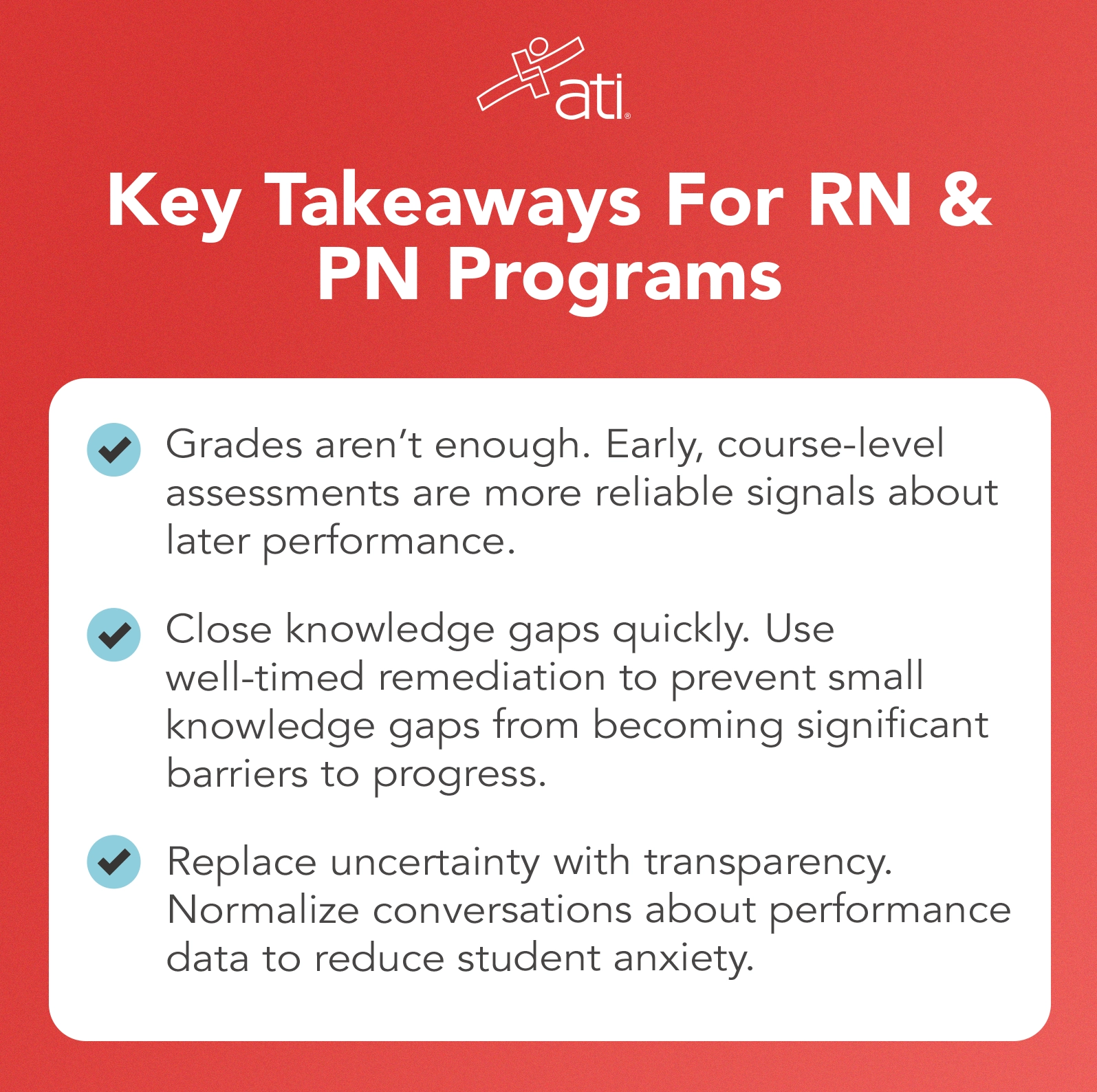
The standardized assessment results evaluated in the research were from the ATI Content Mastery Series® and the ATI Comprehensive Predictor.®
- Content Mastery Series (CMS)
CMS delivers secure proctored assessments aligned to NCLEX test plans. These assessments measure mastery in core content areas against standardized proficiency benchmarks, enabling programs to determine whether students are on track for graduation and licensure.
- Comprehensive Predictor (CP)
The CP is a secure end-of-program predictive assessment that determines a student’s probability of passing the NCLEX. The 180-item assessment reflects NCLEX question formats and provides detailed performance reports to guide focused remediation.
In the analysis, researchers sought to determine:
- The relationship between individual CMS assessment performance and CP performance
- Whether CP scores and predicted NCLEX scores increase as students achieve greater proficiency on CMS assessments
- Which CMS assessments are most predictive of CP outcomes.
The analysis found that among these students, performance on CMS assessments was strongly associated with outcomes on the CP, indicating that course-level mastery builds toward NCLEX readiness. Students’ CP scores and their probability of passing the NCLEX increased steadily each time they achieved proficiency on a CMS assessment
Among PN students, predicted NCLEX pass rates rose from approximately 72% for those with no CMS proficiency achievements to more than 97% for students who were proficient across all 7 CMS assessments.
RN students showed a similar pattern, with those achieving Level 2 or higher across all 9 CMS assessments reaching a nearly 98% probability of passing.
What the Research Confirms About Building Readiness Over Time
The 2026 study is the second large-scale analysis to examine the relationship between CMS performance and CP outcomes, and its findings reinforce the previous findings.2
“These results show remarkable consistency across years, test plan changes, and the integration of clinical judgment,” said Kari Hodge, PhD, ICE-CCP, a coauthor of the 2026 study.
“The pattern confirms that Content Mastery Series assessments function as intended — as building blocks that lead to end-of-program readiness,” said Dr. Hodge, who is manager of psychometrics at Ascend Learning. ATI is an Ascend Learning brand.
Why CMS and CP Work Best as a Connected Strategy
Given that course level performance strongly predicts end of program readiness, how and when assessments are used becomes critical. CMS and CP are familiar resources in many nursing programs, but their complementary roles may not always be fully leveraged. The new research underscores the value of using both.
“These two assessments serve different but complementary purposes across the curriculum,” said Pamela Roland, PhDc, MBA, MSN, RN, nurse educator and ATI content strategist focused on NCLEX preparation and success.
By drawing from module content in the Content Mastery Series, subject area-focused CMS assessments evaluate student learning at specific points in the curriculum. “They pinpoint individual student knowledge and identify areas of strength and weakness so that students can remediate right away and stay on track,” Roland said.
Roland recommends placing CMS assessments at the end of each corresponding course (e.g., adult medical-surgical, pediatrics), so that students can address weaknesses while content is fresh in their minds. This timing also gives faculty actionable student and cohort performance insights that can guide teaching and remediation.
In contrast, the CP provides a comprehensive picture of readiness near the end of the program. “It is a predictor of NCLEX success,” Roland said. “It aligns with NCLEX test plan percentages and includes clinical judgment items reflective of licensure expectations.”
To maximize impact, Roland recommends administering the Comprehensive Predictor after the majority of program content has been delivered, but early enough to allow meaningful remediation before graduation.
“For optimal success, both products should be incorporated,” Roland said.
What The Study Demonstrates About Consistency and Retention
Beyond NCLEX readiness, the new analysis points to a practical lever for supporting student progression. One of the study’s most compelling findings is that consistency across content areas matters more than isolated success.
Students who demonstrated proficiency across multiple CMS assessments were significantly more likely to show NCLEX readiness on the CP, a finding with important implications for retention.
“Knowing that students can take CMS exams throughout their program to identify areas of weakness and remediate early can increase program retention and success,” Roland said. “Ultimately, this produces success on NCLEX.”
What This Means for Curriculum Planning and Student Support
The 2026 analysis reinforces earlier research showing that student progression follows recognizable patterns. When nursing programs use structured, well-timed assessments throughout the curriculum, they gain early insight into student needs and can address them.
By using CMS to guide course-level support and CP to inform end-of-program readiness, nurse educators can make data-informed decisions on how to strengthen retention, improve outcomes, and provide students with a more confident path to licensure.
The research reinforces a core principle in nursing education: Readiness is built over time. CMS assessments provide targeted, course-level insight, while the Comprehensive Predictor offers a cumulative view of licensure preparedness. Together, they create a feedback loop that supports timely intervention.
“When educators use assessment data intentionally and early, they shift from reacting to student outcomes to shaping them,” Roland said. “Content Mastery Series helps faculty see where learning is taking hold course by course, and the Comprehensive Predictor confirms whether that work has truly prepared students for licensure. Together, they give programs the clarity needed to intervene sooner and support more students all the way to NCLEX success.”
References
- Miller JE, Hodge KJ, Yoo H, Taylor K, Phillips BC, Zapparrata N. Predicting Nursing Students Success Through Standardized Assessments. Teaching and Learning in Nursing. 2026. https://doi.org/10.1016/j.teln.2025.12.021
- Brussow JA, Dunham M. Students' midprogram content area performance as a predictor of end-of-program NCLEX readiness. Nurse Educator. 2018;43(5):238-241. DOI: 10.1097/NNE.0000000000000499
- Miller JE, Hodge KJ, Lin Y, Haugan TR, Yoo H, Philips B. Evaluating Alignment Between the RN Comprehensive Predictor and the NCLEX-RN Test Plan. Journal of Nursing Education. 2026. doi: 10.3928/01484834-20251121-01
- Hodge KJ, Miller JE, Lin Y, Yoo H, Phillips B. Evaluating Construct Alignment of the PN Comprehensive Predictor and the NCLEX-PN Test Plan. HSOA Journal of Practical and Professional Nursing. 2026. DOI:10.24966/PPN-5681/100066
About the author: Michelle Perron is a healthcare writer and editor who develops evidence-based content for ATI Nursing Education. With more than 20 years of experience in healthcare publishing, journal development, medical editing, and editorial management, she helps connect nursing research and education best practices to today's faculty needs.