
Nurse Educator Blog
State of Nursing Education
The State of Nursing Education is the authoritative ATI series examining key issues affecting today’s academic nursing programs, deans and faculty.
Explore All ArticlesHow Faculty Efficiency Improves Nursing Education Outcomes

When Programs Achieve True Efficiency, Educators Are Freed to Teach More Effectively
Faculty workload and burnout are more than staffing challenges. They directly affect teaching effectiveness and student outcomes in nursing education. Recent research shows that when programs reduce administrative burden and streamline daily tasks, faculty gain the time and focus they need to do their most important work more effectively.
How can your program get there? Key advances in technology and program support are making it easier to address nursing faculty workload in targeted, practical ways. These efforts are shaped in part by the literature documenting the widespread negative impacts of excess workload and repetitive tasks in higher education at large.
Studies1-8 published over the last 4 years (see table below) have examined the challenge of faculty efficiency and its potential solutions. The findings show that efficiency improvements in higher education produce better outcomes when they:
- reduce overall faculty burden
- minimize low-value tasks
- introduce technology appropriately
- free cognitive resources for higher-quality work.
This research makes a clear case for reducing workload, but nursing programs and their faculty need solutions that fit into daily workflows. The following innovations target the most time-intensive areas for nurse educators in ways that don’t add complexity and can achieve benefits quickly.
Strategies to Reduce Nursing Faculty Workload
The innovations outlined in this article focus on specific sources of faculty frustration and demonstrate where the right support can rapidly make meaningful differences. They improve efficiency in daily tasks, and perhaps most importantly, they support faculty effectiveness and satisfaction that contribute to educator retention and strong student outcomes.
These innovations, which were developed by ATI and will be introduced over summer and fall 2026, provide:
- seamless development of learning and testing experiences
- data insights to customize teaching and remediation
- scalable support that reduces repetitive and complex tasks
- education and support for the clinician-to-educator transition.
When programs lean into these new options, faculty can plan faster, teach more effectively, make better assessment decisions, and help new educators succeed. Let’s take a closer look at how these innovations will make a difference.
Create a Targeted Learning Experience Without Increasing Workload
Preparing nursing students for practice requires faculty to frequently adjust teaching materials. Learning gaps vary, and some students have more complex needs than others. To create personalized learning resources that maximize student learning, faculty need accurate and specific insights.
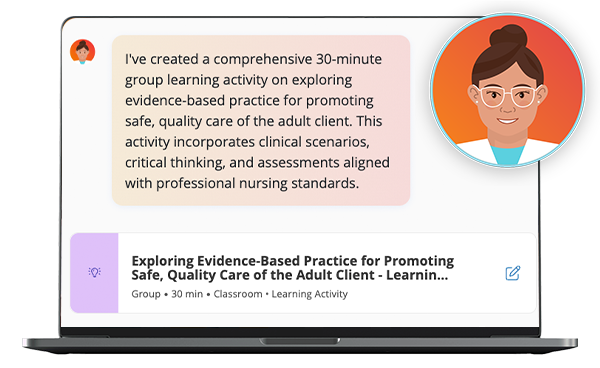
This is possible using Claire AI®, the artificial intelligence engine purpose-built for nursing education. In 15 to 30 seconds, Claire AI creates and delivers classroom activities that reflect student activity and interaction within the Engage® Series. The result is an education approach that is more impactful and specific.
Using Claire AI in any Engage module, educators can:
- meet a wider range of learning needs by delivering multiple types of classroom activities (e.g., discussion questions, case studies)
- close knowledge gaps by providing learning content in more engaging ways
- organize classroom activities for easy repurposing or repeat use
- reduce their workload and stress by minimizing prep time and repetitive tasks.
Early faculty experience with Claire AI in Engage suggests that the impact goes beyond time savings to influence how faculty design and deliver learning activities.
“I’m excited to see how I can use Claire AI in my classroom to create learning activities such as case studies and group projects.” said Lakesheia T. Walker, MSN, RN, MEDSURG-BC, an assistant professor of nursing at Delaware State University.
After previewing Claire AI in the Engage Series, Walker expressed appreciation and excitement about the time savings it will produce. “It’s going to make everything a whole lot easier and result in less prep work for me.”
Streamline & Improve Assessment Creation Without More Work
Writing and revising assessments is an important part of an educator’s work — and one of the more challenging. Today’s programs need efficient methods to build assessments that are accurate and aligned to course materials and cohorts. Another goal is for assessments to remain reliable over time.
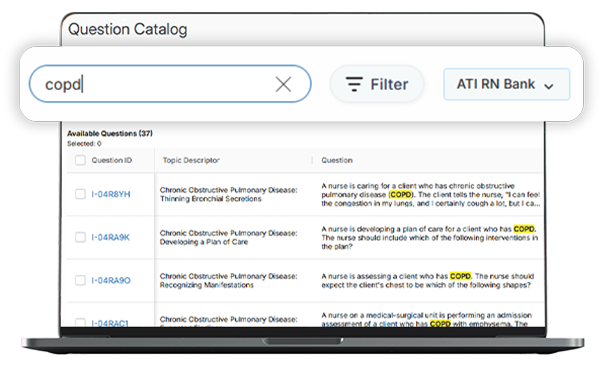
To address these needs, ATI is making enhancements and updates to Custom Assessment Builder (CAB), the robust single-platform test creator used by thousands of institutions.
The new CAB experience provides a smarter, faster way for faculty to create assessments that:
- are effective and evidence based
- are easier to maintain over time
- provide full-context performance history.
In addition, faculty can:
- track item effectiveness and reliability
- get insights into group performance
- fine-tune items using responsive search and filtering.
The new CAB experience makes it easier for faculty to customize tests to reflect class materials and student cohorts. In addition, CAB analytics identify and track usage patterns to maintain assessments. This allows educators to strategically rotate items and prevent repeat exposure, ensuring that results remain accurate and reliable.
Because assessment creation requires both precision and time, improvements to this process will have a significant impact on faculty workload.
“The new experience in Custom Assessment Builder is a real difference maker because building assessments is one of the most time-consuming demands on nurse educators,” said Beth Cusatis Phillips, PhD, RN, CNE, a former nurse educator and program director who now serves at Strategic Nursing Advisor for ATI.
She described the new CAB experience as “removing friction across the entire assessment workflow, so that educators can build tests faster, act on insights immediately, and continuously improve content — all in one place.”
Support the Transition from Nurse Clinician to Nurse Educator
Transitioning from clinical nursing practice to nursing education requires a new set of skills, but many academic programs don’t have the resources to help new educators acquire and master them.
That’s why ATI developed the Nurse to Educator Program, to be introduced in fall 2026. This comprehensive resource provides flexible, self-paced paths that help new educators get up to speed quickly. It also provides peer-to-peer support through community discussions, with additional options for one-on-one mentorship.

The ATI Nurse to Educator Program provides flexible learning, community-based discussions, and optional expert mentorship with ATI nurse educators.
These development resources are organized in three series:
- Educator Introduction Series, focused on the initial questions and challenges new educators face
- Educator Essential Series, focused on next-step knowledge such as lesson planning and clinical judgment; includes interactive group discussions
- Educator Excellence Series, focused on deeper knowledge; provides live mentoring sessions.
For programs facing ongoing faculty shortages and onboarding challenges, structured support can make a critical difference in how quickly new educators become comfortable and confident.
"This is a solution we need,” said Jennifer Barrow, MSN, RN, CNE, assistant professor and program coordinator for undergraduate nursing at McNeese State University, after previewing the program. “We needed somebody to help us and ATI has done just that."
Using Efficiency to Drive Teaching Quality & Student Success
The efficiency and effectiveness of faculty is shaped by what happens every day. How quickly can educators create useful learning activities? How confidently can they interpret performance data? How well are new faculty supported when they step into classroom roles for the first time?
ATI’s new innovations meet these needs directly, with easy-to-implement resources that streamline classroom activity planning, improve and speed assessment creation, and help new educators assimilate. This approach focuses on redesigning faculty workflows, not adding complexity or responsibilities.
Collectively, the research highlighted in this article suggests that day-to-day efficiencies should not be viewed as separate from program outcomes. True efficiency is not doing more tasks more quickly. In the context of nursing education, true efficiency is freeing faculty to teach more effectively.
When programs provide resources that help faculty reduce repetition, plan faster, assess students more accurately, and develop strong teaching skills, they are better positioned to build and maintain the instructional quality that prepares nurses who are ready for today’s clinical settings.
Improving teaching effectiveness doesn’t require faculty to do more. It requires giving educators the time, tools and support to focus on what matters most.
Find out how ATI solutions can enhance your program’s faculty efficiency and effectiveness to improve outcomes. Complete this form to get started.
References
- Woelert P. Administrative Burden in Higher Education Institutions: A Conceptualisation and a Research Agenda. Journal of Higher Education Policy and Management. 2023. https://doi.org/10.1080/1360080X.2023.2190967
- Kanwal A, Rafiq S, Afzal A. Impact of Workload on Teachers’ Efficiency and Their Students’ Academic Achievement at the University Level. Gomal University Journal of Research. 2023;39(2). https://doi.org/10.51380/gujr-39-02-02
- Creagh S, Thompson G, Mockler N, Stacey M, Hogan A. Workload, Work Intensification and Time Poverty for Teachers and School Leaders: A Systematic Research Synthesis. Educational Review. 2025;77(2):661-680. https://doi.org/10.1080/00131911.2023.2196607
- Deep Promethi, Ghosh N, Chen Y. Faculty Burnout in Higher Education: Effects on Student Engagement, Learning Outcomes, and Artificial Intelligence-Driven Institutional Responses. Journal of Educational and Developmental Psychology. 2025;15(1). http://doi.org/10.5539/jedp.v15n1p29
- Beltran-Salipong R. Balancing the Scales: The Impact of Faculty Workload in Relation to Burnout and Teaching Efficacy of Bisu System. International Journal of Research and Innovation in Applied Science. 2025;10(10). DOI: https://doi.org/10.51584/IJRIAS.2025.1010000015
- Sun TY, Yoon M. The Impact of Digital Transformation on Faculty Performance in Higher Education: The Mediating Role of Digital Self-Efficacy and the Moderating Role of Task-Technology Fit. Frontiers in Psychology. 2025. https://doi.org/10.3389/fpsyg.2025.1693375
- Morrow JL, Reinard LM, Barber JN. Redesigning Student-Focused Success Strategies for Optimal NCLEX-RN Outcomes. Journal of Nursing Education. 2026;65(5). https://doi.org/10.3928/01484834-20250902-01
- Abao JU, Balaba CR, Namoco SS. Exploring Faculty Experiences on Workload: A Phenomenological Approach. International Journal for Multidisciplinary Research. 2025;7(4). DOI:10.36948/ijfmr.2025.v07i04.51218