
Nurse Educator Blog
State of Nursing Education
The State of Nursing Education is the authoritative ATI series examining key issues affecting today’s academic nursing programs, deans and faculty.
Explore All ArticlesTeaching for the Next Gen NCLEX: Which Strategies Work Best?

Educators Share 4 Techniques to Prepare Nursing Students
INTRODUCTION
Clinical judgment is a skill nurses must use to decrease the occurrence of patient safety events and improve patient outcomes. The National Council of State Boards of Nursing (NCSBN) integrated new item types focused on assessing clinical judgment in April 2023. As educators, it is our responsibility to prepare students for this new way of testing and ensuring safe practice. This shift requires us to reevaluate the way we teach and incorporate learning activities that focus on the development of clinical judgment rather than tasks.
— Pamela Roland, MSN, MBA, RN, ATI Nursing Strategist
By Ariel Wright, DNP, MS, RN, CNE, CNECL, CHSE, Lanette Stuckey, PhD, MSN, RN, CNE, CMSRN, CNECL, NEA-BC, CHSE, and ELENI KEY, MSN-ED, RN
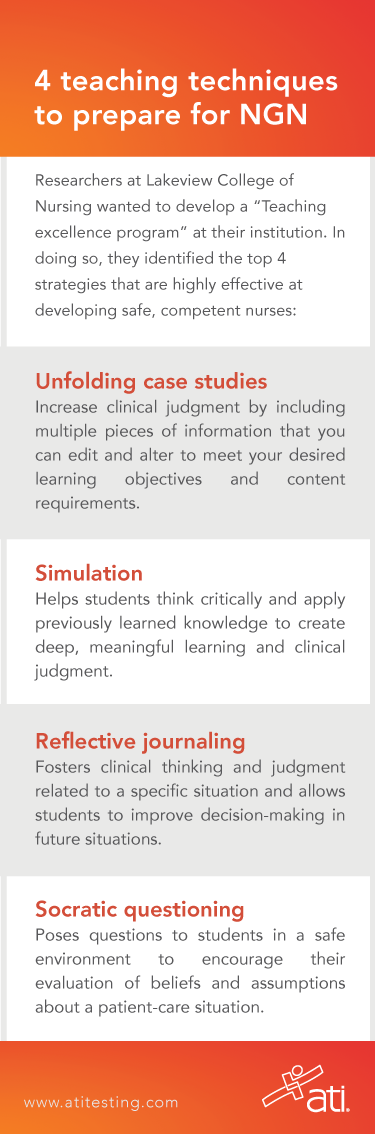 Now that NCLEX evaluation of clinical judgment has launched, nurse educators need to integrate it into current teaching practice. Preparation of new graduates for clinical practice and passing NCLEX protects the public and develops safe and competent nurses. Through various professional development activities, the expansion of clinical judgment has included 4 key techniques:
- Unfolding case studies
- Simulations
- Reflective journaling
- Socratic questioning.
Educators should focus on clinical judgment by using these types of teaching strategies to increase student engagement, which will help develop safe, competent nurses.
Why the NCLEX Now Measures Clinical Judgment
Nurses must have sound clinical judgment when taking care of patients. Clinical judgment is an essential skill used in more than 46% of tasks routinely performed by nurses in their first year of practice. The National Council of State Boards of Nursing (NCSBN) reviews the NCLEX test plans every 3 years to assess current and comprehensive competency of safe, competent nursing practice. The NCSBN introduced the Next Generation NCLEX in 2023 due to the growing concern that novice nurses who pass the NCLEX did not have the knowledge, skills, or cognitive abilities to practice safely.
One study found that only 23% of newly graduated nurses demonstrated beginning-level competencies (Hensel & Billings, 2020). The revised NCLEX focuses on clinical judgment and asking better questions to help nurses think critically when providing care and make the right decisions.
Understanding NCLEX Teaching Strategies
Most nurse educators want to teach the same way that their instructors taught them, but these old approaches no longer work. Today, nurse educators need to embrace a new way of teaching that focuses on clinical judgment.
It is not realistic to expect students to use clinical judgment without first teaching them how to think in this way. Nurse educators must incorporate clinical judgment into the nursing curriculum. Building in this detailed thinking process gives students many chances to practice these thinking skills and strategies (Caputi, 2019).
NCLEX Teaching Strategy No. 1: Unfolding Case Studies
One type of case study that has become more prevalent in recent years is the unfolding case study. This strategy provides a real-world situation with limited information at one specific time. The limited information is intentional, because it encourages students to critically think and apply prior knowledge. Research shows the use of unfolding case studies helps students make clinical reasoning decisions (Hensel & Billings, 2020).
Unfolding case studies differ from the traditional case study, which provides all the information regarding the situation to the student at the onset. Unfolding case studies are beneficial for increasing clinical judgment because they include multiple pieces of information that an educator can edit and alter to meet the scenario’s desired learning objectives and content requirements (Hensel & Billings, 2020).
NCLEX Teaching Strategy No. 2: Simulation
A specific active teaching strategy that research has proven to be one of the most effective — especially with students who use a variety of learning styles and those who prefer to learn through reflection — is simulation (Hanshaw & Dickerson, 2020). High-fidelity simulation is the current gold standard for obtaining skills and knowledge to prepare nursing students for real-life experiences. Simulation helps students think critically and apply previously learned knowledge to create deep, meaningful learning and clinical judgment (Hanshaw & Dickerson, 2020).
The nurse educator can use simulation to encourage clinical judgment by giving students a prompt in which they encourage students to progress through each step of the simulation with minimal guidance. An example of each of the steps that the students would complete during the simulation would be:
- Recognizing and analyzing cues
- Prioritizing the hypothesis
- Generating solutions
- Taking actions
- Evaluating outcomes (Sherrill, 2020).
Having students go through these steps during the simulation enhances critical judgment and deep learning that will help them be successful on the NCLEX.

Below is a copy of the poster on which this article was based. Download a copy of the poster here.
NCLEX Teaching Strategy No. 3: Reflective Journaling
Reflection activities are imperative for students to summarize and evaluate how they performed during a simulation or a clinical experience. Reflective journaling is an introspective activity that educators can use as a clinical assignment or as an impromptu activity in a post-conference or post-simulation session.
Reflective journaling fosters clinical thinking and judgment related to a specific situation (Ignatavicius, 2021). The technique can focus on areas the student wants to improve or situations that the student successfully completed. Students’ ability to reflect allows them to improve their decision-making in future situations (Ignatavicius, 2021). Reflective journaling also develops students’ abilities to analyze their personal and professional growth as nursing professionals.
NCLEX Teaching Strategy No. 4: Socratic Questioning
Since the beginnings of Western thought, teachers have been using Socratic questioning. This teaching technique within nursing education can provide intellectual stimulation and determine clinical thinking (Ignatavicius, 2021). Nurse educators can pose questions to students in a safe environment to encourage the evaluation of beliefs and assumptions about a patient-care situation (Yip, 2021).
Asking questions such as, “Why would the selected nursing intervention be the priority for this situation?” can be assistive in reviewing the “why” in the nursing action (Ignatavicius, 2021). However, an instructor must ensure that the student reflects through self-examination in a nonhostile environment when using this technique. For clinical judgment growth, it is essential that you ensure you never compromise a student’s confidence (Yip, 2021).
Socratic questioning is a tool that nurse educators can use quickly in all nursing settings to elicit critical thinking skills in students to develop their nursing practice.
Preparing Students for NCLEX Measurement of Clinical Judgment: Take Some Initiative
Nurse educators need to be proactive when preparing teaching practices as we enter a new era of nursing. Nursing autonomy is at the forefront of today’s society. Nurse educators need to ensure graduates can pass the NCLEX in its new format and enter the nursing profession prepared to utilize the nursing process, protect the public, and achieve superior outcomes by giving safe, competent care. To do this, nurse educators must use these effective teaching strategies that focus on clinical judgment to actively engage students in learning activities in the classroom, simulation, and clinical settings.
About the Authors: Ariel Wright, DNP, MS, RN, CNE, CNECL, CHSE; Lanette Stuckey, PH.D., MSN, RN, CNE, CMSRN, CNECL, NEA-BC, CHSE; and Eleni Key, MSN-ED, RN, were educators at Lakeview College of Nursing (Danville, Ill.) at the time they developed the poster presentation “Teaching Excellence Program” for the 2021 National Nurse Educator Summit. This article is based on that poster.

Dr. Wright is Director of Assessment and an Associate Professor at Lakeview College of Nursing. She has written 5 articles for Nurse Educator since 2019, as well as writing for other nursing journals. She has presented on topics such as “BSN post-graduate mentorship” at the 2021 QSEN International Forum and been interviewed on the Nurse Educator Podcast on “Medication commercials.” A recent honor was the “Innovations in professional nursing education award for Lakeview College of Nursing” presented by the American Association of Colleges of Nursing (AACN) (2019).
 Dr. Stuckey is the former Dean of Nursing at Lakeview (and current dean at Arizona College). She wrote an article for Nursing Leadership and Management and Nurse Educator in 2021, as well as writing for Nursing Education Perspectives, ProQuest, and The Nursing Voice. In 2020, she also was honored by AACN for the “Innovations in professional nursing education award.” In 2019, the Illinois Nurses Foundation recognized her with a “40 Under 40 Emerging Nurse Leaders Award.”
 Professor Eleni Key is an Assistant Professor at Lakeview College. She has written articles that have appeared in Nurse Educator, has multiple certifications, and has received honors that include the Sarah Bush Lincoln Health Center Bravo President’s Award (2018). She is Chair of the Faculty Organization Committee, serves as a faculty mentor, and is on the Curriculum committee.
References
- Caputi, L. (2019). Reflections on the Next Generation NCLEX with implications for nursing programs, Nursing Education Perspectives, 40(1), 2-3. doi: 10.1097/01.NEP.0000000000000439
- Hanshaw, S. L., & Dickerson, S. S. (2020). High fidelity simulation evaluation studies in nursing education: A review of the literature, Nurse Education in Practice, 46, 1-9
- Hensel, D., & Billings, D.M. (2020). Strategies to teach the National Council of State Boards of Nursing clinical judgment model, Nurse Educator: 5(6), 45(3), 128-132. doi: 10.1097/NNE.0000000000000773
- Ignatavicius, D.D. (2021). Preparing for the new nursing licensure exam, Nursing, 51(5), 34-41. doi: 10.1097/01.NURSE.0000743100.95536.9b
- Sherrill, K. J. (2020). Clinical judgment and Next Generation NCLEX® – A positive direction for nursing education!, Teaching and Learning in Nursing, 15(1), 82-85
- Sturdivant, T., Allen-Thomas, K. (2021). Teaching with a purpose: An NGN approach to clinical instruction and evaluation. Teaching and Learning in Nursing, 0(0), 1-4. doi: 10.1016/j.teln.2021.10.004
- Yip, Y. C. (2021). Using Socratic inquiry to enhance critical thinking in nursing students, Nursing, 51(11), 13-16. doi: 10.1097/01.NURSE.0000795320.17836.07