
Nurse Educator Blog
State of Nursing Education
The State of Nursing Education is the authoritative ATI series examining key issues affecting today’s academic nursing programs, deans and faculty.
Explore All ArticlesNursing Student Retention: Challenges, Insights & Solutions

Evidence-Based Strategies to Keep Nursing Students Enrolled & Thriving
Retaining nursing students is a formidable challenge for academic institutions — and its fallout doesn’t stop at the college gates. Attrition also impacts the healthcare workforce, diverting potential new nurses from meeting widespread patient and system needs.
As Trotty observed in her 2024 study of influences on retention and academic success, “a limited nursing workforce prohibits access to safe and cost-effective health care, and staffing issues will only worsen if the supply of nurses does not meet the demand.”1
Beyond the human impact, nursing student attrition strains program resources. Admissions investments are lost, cohort planning is disrupted, and pressure increases on already-stretched faculty.
This article examines current issues in nursing student attrition and shares insights and strategies proven to keep more students enrolled and on track toward their professional goals.

Causes & Contributing Factors in Nursing Student Attrition
Academic nursing programs struggle with attrition at all degree levels. Although the exact challenges vary among program types, a single characteristic is common: Students are most vulnerable during the early semesters.2
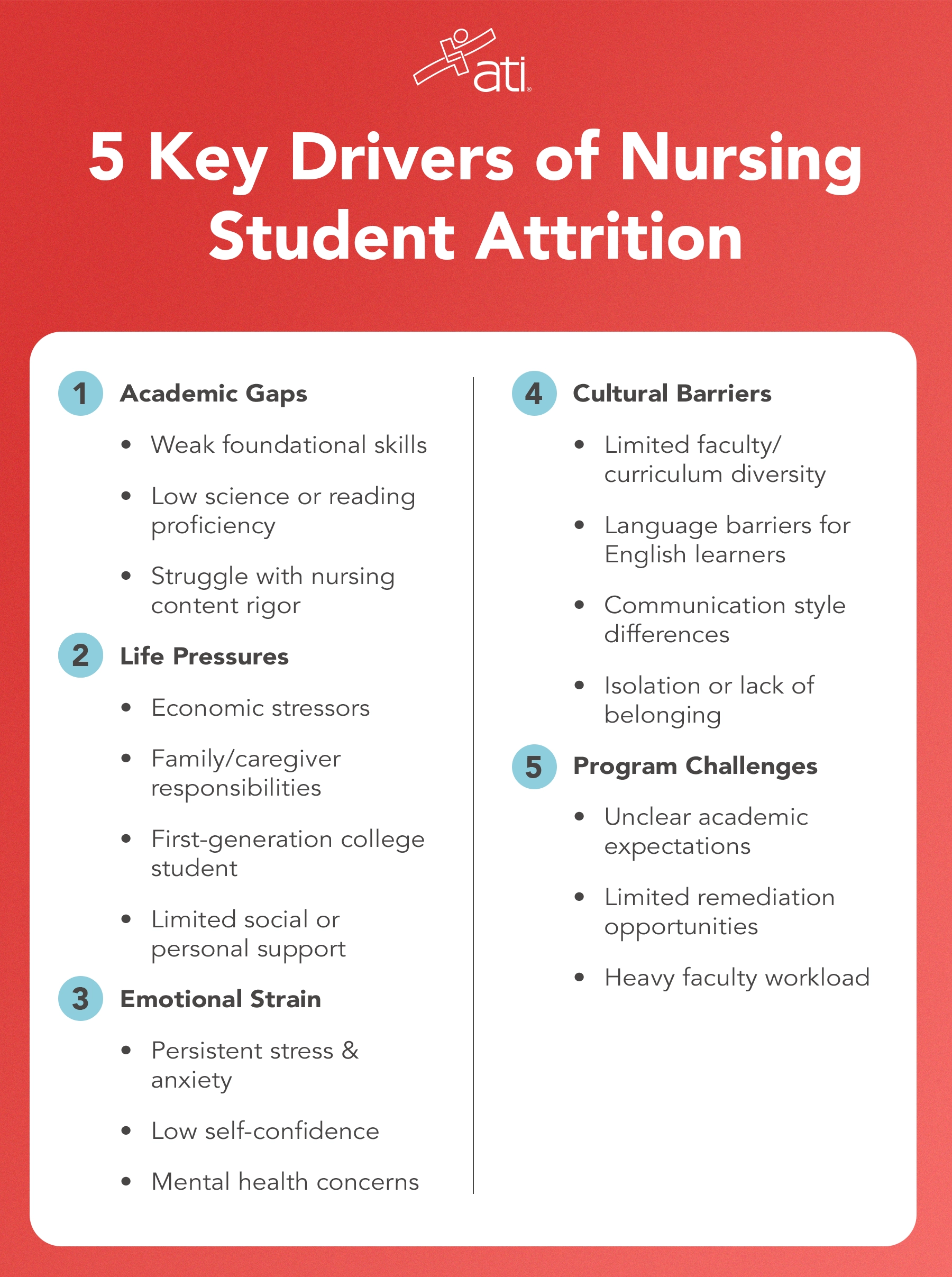 Multiple interconnected factors contribute to nursing student attrition. Research shows that the most common reasons are in the categories of academic readiness, personal circumstances, psychological and social well-being, culture and environment, and program characteristics.1-6 The table at right provides a brief summary of each contributor.
Strategies to Reduce Nursing Student Attrition: Insights from Recent Research
Recent research on nursing student retention shows that reversing high attrition rates requires a multifaceted approach. These studies emphasize the importance of identifying at-risk students during admissions and providing ongoing monitoring and support once classes begin.
Torregosa et al.4 found that prenursing science GPA, college GPA, and reading ability were significant predictors of attrition and dismissal. They recommended emphasizing aptitudes in science and reading when admitting students. Similarly, Gushue et al.5 found that students who performed well in anatomy and physiology courses and high school biology had better success rates in academic nursing programs.
Research by Katy Trotty, EdD, MSN, RN, IBCLC, CNE, also points to the importance of using traditional cognitive measures to make admissions decisions. Her 2024 study determined that although character strengths like grit are valuable and can contribute to student success and retention, science GPA and Test of Essential Academic Skills (TEAS) scores are more accurate predictors of nursing GPA.1 (Read more about the validity of TEAS for admissions here.)
As associate director and BSN program coordinator at DeWitt School of Nursing at Stephen F. Austin State University, Dr. Trotty has worked with program faculty to increase student retention in several ways. Admission now requires a total TEAS score of 58.7 and a 3.0 GPA in all prerequisite courses.
Once admitted, guardrails help ensure success. They include:
- labs to help students work through challenging course concepts
- improved course consistency
- remediation opportunities for students who score below 75 on any exam
- access to campus academic and resource assistance.
As a result of these changes, on-time program completion rates have increased 28% in just 2 years. Dr. Trotty credits Stephen F. Austin’s highly dedicated faculty for these improvements.
“The culture of our department is one in which students feel safe to approach faculty, and faculty are invested in supporting students who are willing to put the effort in to learn,” Dr. Trotty told the ATI Educator Blog.
In addition to strong admission policies and faculty support, recent research documents the importance of structured peer-led learning interventions10,11 and creating a sense of belonging for all students, especially when a program has multiple campuses or uses hybrid models.12
The collective findings of these studies, all published in 2024 and 2025, suggest that nursing programs should:
- strengthen preadmission science and reading requirements
- provide academic support for incoming students with lower science GPAs
- offer remediation or bridging programs to students who need additional preparation in foundational sciences
- monitor early student performance data to identify students at risk
- provide targeted remediation as needed.
The table below outlines 4 ways to implement these strategies. Click the hyperlinked text to learn more about specific resources to implement them.
Improve Nursing Student Retention Rates With Proven Interventions
Current research shows that nursing student retention requires multifaceted, evidence-based approaches that address academic, personal, and systemic factors. Successful programs combine early identification and intervention with comprehensive support to create environments where all students can succeed. ATI Nursing Education provides resources that help academic nursing programs take these exact actions.
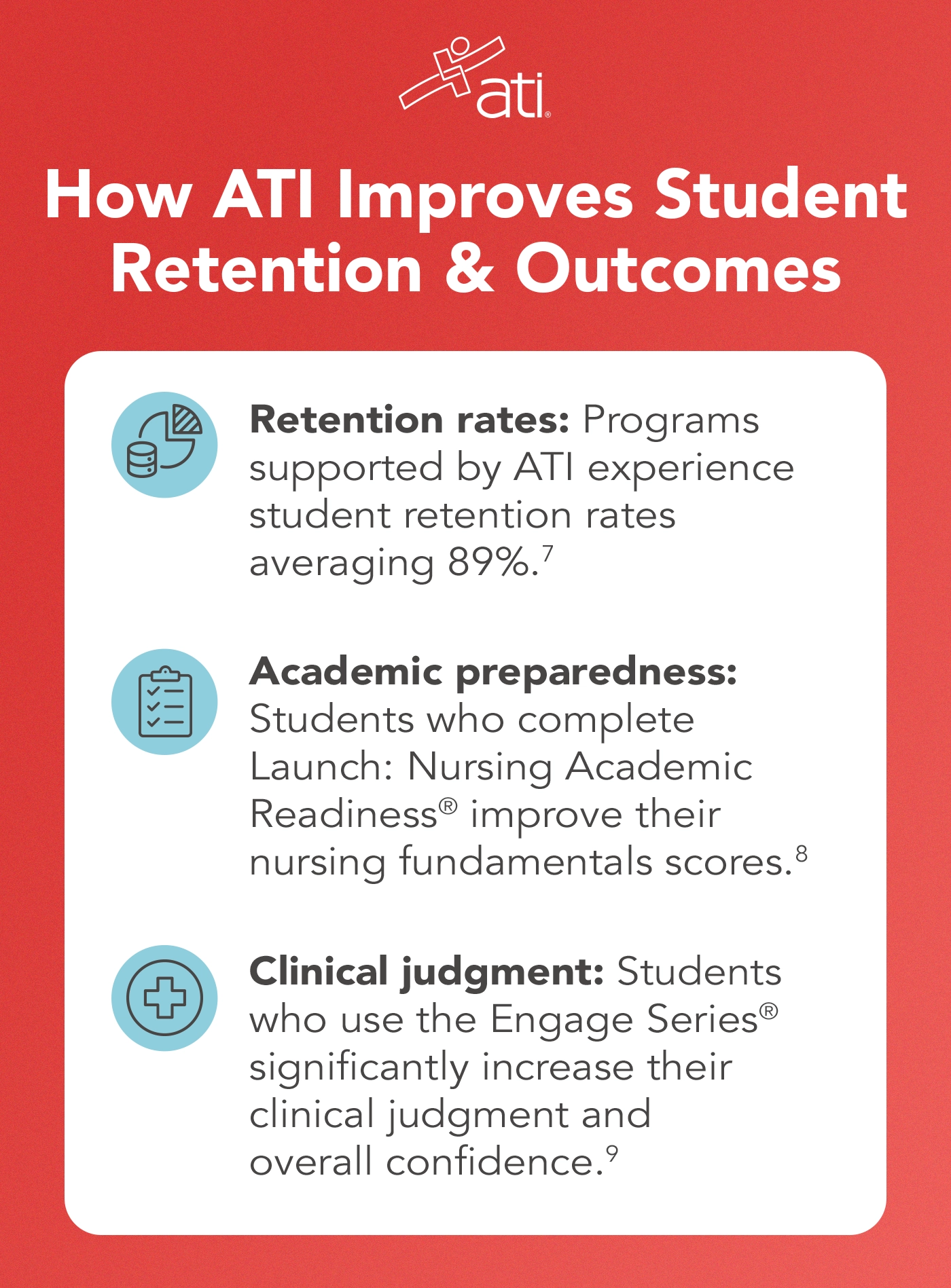
ATI helps nursing programs overcome retention challenges with a suite of proven, data-driven solutions. These products address each stage of the student journey: academic readiness and remediation, development of clinical skills and clinical judgment, and NCLEX preparation and success. Using ATI’s predictive analytics, curriculum enrichment, and personalized remediation, programs identify at-risk students early and provide targeted support — without additional faculty workload.
As a result, ATI-supported programs consistently achieve retention rates of 90%7 and first-time NCLEX pass rates that are 5% to 7% higher than the national average.13 The challenge of improving student retention is complex. But as this article explains, targeted interventions decrease nursing student attrition and support students in ways that help them complete an academic nursing program and enter the healthcare workforce equipped with the skills and knowledge today’s patients need.
References
- Trotty KA. Exploring the relationship between grit scores and academic potential in baccalaureate nursing students. Journal of Professional Nursing. 2024;53(July-Aug):80-85. https://doi.org/10.1016/j.profnurs.2024.05.006
- From at Risk to Resilient: 4 Ways Nursing Programs Can Increase Student Retention & NCLEX Pass Rates. ATI Educator Blog. June 26, 2025. https://www.atitesting.com/educator/blog/knowledge/2025/06/26/4-ways-nursing-programs-can-increase-student-retention
- Crisp E, Cook R, Jones S. A model for predicting student nurse attrition during pre-registration training: A retrospective observations study using routinely collected administrative data. Nurse Education in Practice. 2025;85:1043777. https://doi.org/10.1016/j.nepr.2025.104377
- Torregosa MB, Patricio O. Predictors of attrition and program dismissal in a nursing major. Nurse Education Today. 2024;132:105988. https://doi.org/10.1016/j.nedt.2023.105988
- Gushue K, Curnew D, Baggs R, Crotty M, Deeb A. Pre-admission factors associated with student success in a practical nursing program: A retrospective cohort study. Nursing Education in Practice. 2025;89:104605. https://doi.org/10.1016/j.nepr.2025.104605
- Admitting the Right Nursing Students: Why the Numbers Matter. ATI Educator Blog. Nov. 12, 2025. https://www.atitesting.com/educator/blog/knowledge/2025/11/12/admitting-the-right-nursing-students
- ATI Nursing Education. 2025. Data collected from ATI graduate cohorts in 2024-2025. Based on standardized program entry and completion requirements across U.S. regions. Results validated by ACS Ventures. National average based on U.S. Department of Labor data, which reports an average of 80% student retention rate for nursing programs.
- Phillips BC, Hodge K. Enhancing Student Retention in Nursing Education: Strategies and Interventions. Teaching and Learning in Nursing. 2025;20(3):248-252. https://doi.org/10.1016/j.teln.2025.02.018
- ATI Nursing Education. 2025. Data collected from proctored ATI RN and PN student assessment results (N=52,447), fall 2024 semester.
- Cupelli LM, Colalillo GC. Implementing Peer Learning to Enhance Academic Performance in First-Year Nursing Students. Teaching and Learning in Nursing. 2025;20:e150-e158. https://doi.org/10.1016/j.teln.2024.09.008
- Tomlinson A, Cameron NG. Association of peer mentoring on nursing student retention: A systematic literature review. Journal of Nursing Education. 2025;64(5):294-298. doi: 10.3928/01484834-20250108-08. https://journals.healio.com/doi/10.3928/01484834-20250108-08
- Fangonil-Gagalang E, Kim Y, Schneider J, Gregg-Chastain R. Sense of belonging of bachelor nursing students: a descriptive-comparative study. Teaching and Learning in Nursing. 2025;1-6. https://doi.org/10.1016/j.teln.2025.09.008
- ATI Nursing Education. 2025. Longitudinal data and predictive analytics from more than 1 million proctored assessments.