
Nurse Educator Blog
State of Nursing Education
The State of Nursing Education is the authoritative ATI series examining key issues affecting today’s academic nursing programs, deans and faculty.
Explore All ArticlesWork Smarter, Not Harder, and Get More Out of Your Day

How AI Helps Faculty Reclaim Their Time & Refocus on What Matters
Nurse educators are mentors, innovators and leaders who shape the future of nursing and patient care. This calling is fulfilling but also exhausting. Research shows that faculty members regularly work beyond their contracted hours in order meet the demands of their jobs.1,2
This article offers a way to reduce that load. Not by lowering standards or skipping steps, but by partnering with artificial intelligence to absorb or speed the most repetitive tasks required in an academic position. This partnership can create more time to focus on the mission that drew faculty to education in the first place — developing new nurses.
The Hidden Cost of Repetitive Work
Nurse educators spend a significant amount of time on repetitive tasks that are necessary but don’t require their most valuable skills.
Consider exams and assessments. Writing NCLEX-style items demands both nursing knowledge and question-writing expertise, but it also involves more mechanical tasks. Another time grabber is email. Students need help when they're actually studying — which could be the middle of the night. As a result, the morning inbox of an educator is crammed with questions.
Lesson planning is another repetitive demand. Matching learning objectives to resources and identifying activities that align with course material and NCLEX content is tedious. Add it all up and the time available for the high-impact work of teaching, mentoring and curriculum innovation disappears.
The issue isn't that educators need to become better time managers. It’s that they’re having to apply human brainpower to tasks that technology can handle — leaving a void of energy for the distinctly human work of education.
Why Nursing Education Needs Purpose-Built AI
This vacuum can be filled with the right artificial intelligence-powered tools. The distinction is essential. All-purpose chatbots and their spinoffs aren't built on foundational nursing education knowledge and lack the context, evidence base and specialized knowledge nursing training requires.
What educators need is AI that is purpose-built for nursing education. That technology is Claire AI®, an artificial intelligence engine designed specifically for academic nursing programs and built on ATI's trusted, evidence-based content library.
Claire AI is a multifaceted faculty partner that creates NCLEX-style items and complete assessments to accurately evaluate student knowledge. It also maps curriculum to competencies and teaching resources and provides students with accurate learning support whenever they need it.
Claire AI’s capabilities translate into time savings across three areas that weigh faculty down. Let’s explore them.
Take Assessment Creation From Hours to Minutes
Creating quality assessments represents one of faculty’s most significant time investments. Every item requires clinical accuracy, appropriate difficulty level, plausible distractors, and alignment with competencies. Multiply this across the volume of exams per semester and faculty easily spend dozens of hours per course on assessment writing alone.
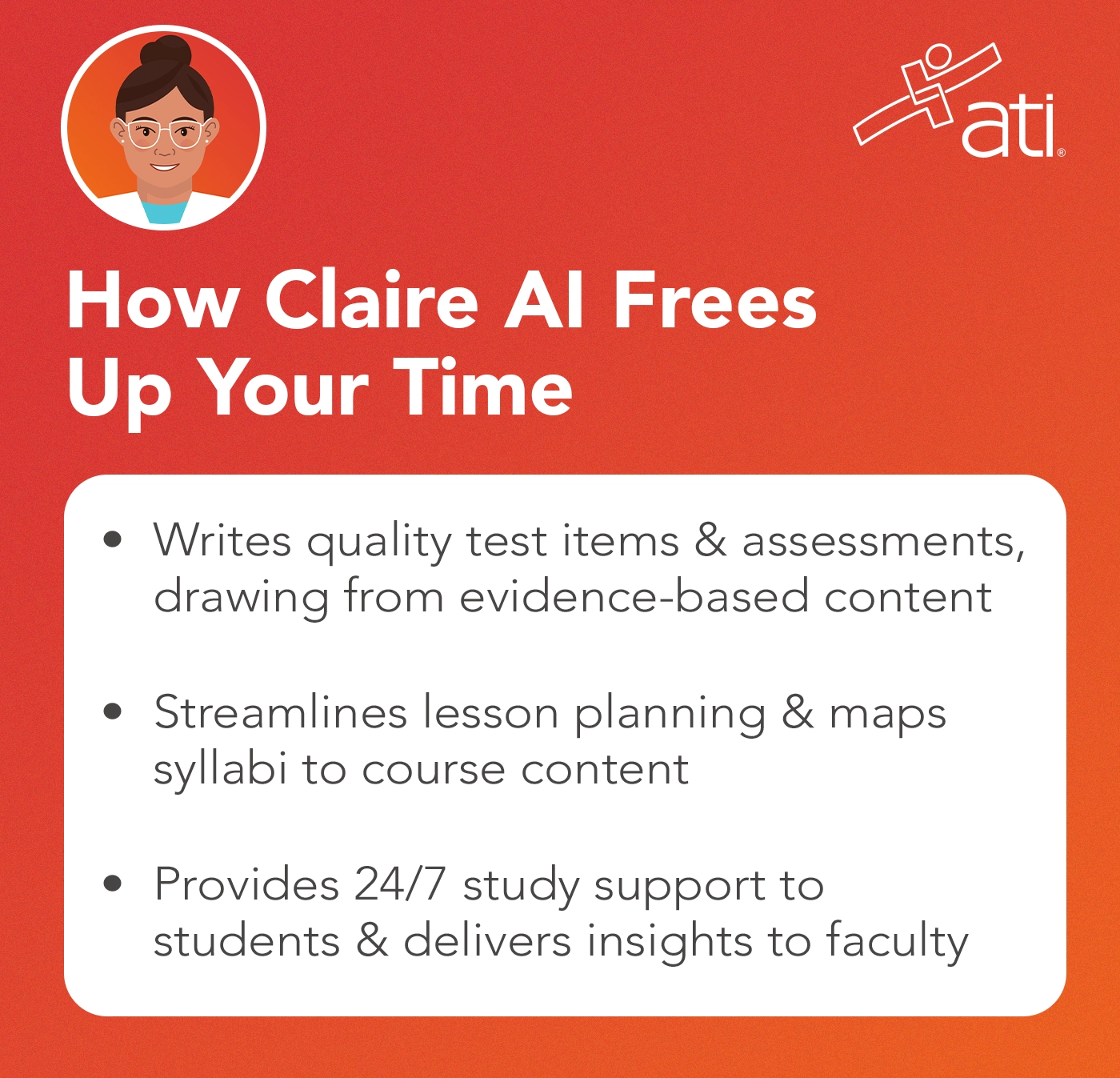
Claire AI shrinks this time requirement. Using this resource, faculty report that they can create and edit test items 73% faster than traditional methods.3
Claire AI produces multiple question types in seconds, including complex NCLEX-style items that assess clinical judgment across cognitive levels. Claire AI is integrated seamlessly within Custom Assessment Builder, allowing faculty to quickly generate, review and refine items without starting from scratch.
Quality is assured because Claire AI draws from ATI's evidence-based content, generating items that have the rigor and validity nursing education demands. Faculty remain in control, reviewing and customizing items to ensure they align with course objectives and student learning needs.
“Building new tests is fast,” said David Everhart, MSN, RN, CEN, lead nursing instructor at Caldwell Community College & Technical Institute. “The information provided by Claire is accurate, and I rarely need to edit the questions. It’s a real time saver.”
The practical impact of Claire AI extends beyond quantifiable time savings. When assessment creation becomes more efficient, faculty can:
- develop formative assessments more often to assess understanding
- create item banks that allow assessment variation across semesters
- easily and quickly analyze test results to improve teaching and address gaps
- invest more energy in innovative teaching strategies
- spend more time on the creative work of education.
These reclaimed hours create opportunities for more of the work that requires the human expertise and passion of nurse educators.
Scale Student Support More Appropriately
Nurse educators are challenged by work days that don’t seem to end. Students study at night, struggle with concepts over weekends, and need clarification when they're actually engaging with content — not when it fits the faculty schedule.
It’s common to be fatigued by inbox overload, frequent interruptions, and even guilt about not being available enough. But many student communications are routine. They seek to clarify content already covered, request additional examples, or get help with foundational concepts that don't necessarily require faculty intervention.
Claire AI in the Engage®️ Series and Flashcards Hub is the solution. These two learning companions powered by Claire AI provide 24/7 personalized support for students plus insights for faculty.
Claire AI adapts to personal learning styles and delivers instant help with course content. Students can create practice questions to test their understanding and develop creative memory aids like musical jingles tailored to their learning preferences.
Claire AI creates flashcards from within students’ ATI learning products or from student prompts. Students can quickly search and favorite flashcards for repeat study, and they can track their progress and view study streaks.
The support provided by Claire AI meets students where they are, exactly when they need it. For faculty, the benefits of Claire AI are also substantial:
Fewer routine, repetitive questions: When students can get immediate help with straightforward content questions, faculty inboxes become more manageable.
Aggregated learning insights: Faculty receive data on what students are asking about most often. This serves to flag areas of confusion. Using this valuable intelligence, faculty can identify learning gaps they need to address.
Opportunities for deep mentoring: When routine questions are handled by Claire AI, faculty can dedicate their one-on-one time to students who need more in-depth remediation or help.
Targeted responsiveness: When aggregated data show a high percentage of students are struggling with a specific concept, faculty can adjust the next class session or the course itself to respond directly to actual learning needs.
The academic assistance students receive with these always-on study lifelines has and will continue to reduce considerable time demands on faculty. Students who use these resources describe them intuitive, helpful and personalized to their needs. Here are two of many appreciative comments:
- “When I started utilizing Claire AI to summarize topics and create practice questions, it improved my understanding of subjects as well as my test scores.”
- “Claire AI is able to explain more on the topic and pull questions to test my knowledge and understanding.”
Streamline Lesson Planning & Resource Mapping
Beyond assessment and student support, Claire AI shortens another time-consuming task: matching course content to appropriate resources. Every semester, faculty spend hours reviewing syllabi, identifying which (and where) ATI resources align with specific learning objectives, and ensuring students have clear guidance on what to study when.
Claire AI simplifies this process by automatically mapping course syllabi to ATI's evidence-based resources. Rather than manually cross-referencing learning objectives with content libraries, faculty can quickly generate resource guides that help students navigate their learning more effectively.
This lesson planning support reduces considerable manual work each semester — hours that can instead be used to innovate teaching, develop active learning strategies, and evaluate and improve curriculum.
Get a Partner, Not a Replacement
Claire AI is designed to handle repetition so faculty can do what they do best. It can generate exam items, but it can't understand the nuanced learning needs of specific students. It can provide general content support, but it can't mentor a struggling student through a crisis of confidence. It can map resources, but it can't make pedagogical decisions about how to sequence and deliver content for maximum impact.
Educators remain at the helm — reviewing AI-generated content, customizing it for students, and applying professional judgment and acumen. Most importantly, this artificial intelligence partner gives educators a priceless gift: more time.
When Faculty Gain Time, Students Gain Opportunity
The positive impacts of AI-powered efficiencies are numerous. When educators get time back, they have bandwidth for:
- exploring new teaching methods
- engaging more deeply with students
- professional development and skill building
- research and scholarship
- meaningful work-life balance.
When faculty are happier in their roles and feel supported and valued, their students have better outcomes.6,7 This strengthens key program effectiveness indicators, including faculty retention, accreditation and NCLEX pass rates.
An AI resource purpose-built for nursing education and built on trusted evidence-based content can dramatically improve educators’ day-to-day efficiency and work satisfaction. Claire AI simplifies quality exam creation, streamlines lesson planning, and provides key insights into students’ learning needs. The result is time savings and peace of mind that frees educators to focus on student engagement and personalized instruction that help students reach their full potential.
As one attendee at the 2025 National Nurse Educator Summit put it: “Claire AI saves us a lot of time, which allows us to do our jobs more efficiently and focus on other things that help us meet student needs.”
References
- Johnson HL, Cruthirds DF, Taylor LA, Suszan LT, Owen RP, Trautmann JL, Beatty JR, Seibert DC. Redefining Faculty Workload Metrics: A Data-Driven Approach. Journal of Professional Nursing. 2024;55:112-118. https://doi.org/10.1016/j.profnurs.2024.08.006
- Watson M. Perceptions of Burnout Among Nursing Faculty: A Qualitative Study. Proceedings of International Conference on Humanities, Social and Education Sciences, 2024. https://files.eric.ed.gov/fulltext/ED673065.pdf
- ATI Nursing Education. 2025. Results of internal time-and-motion study. Faculty generated and refined test items with Claire AI approximately 73% faster than manual methods in Custom Assessment Builder (11 min/item vs. 3 min/item; Wilcoxon p <0.001).
- ATI Nursing Education. 2025. User data for Claire AI, July 2025 through December 2025.
- ATI Nursing Education. 2025. User data for Claire AI in Flashcards Hub, July 2025 through December 2025.
- Opoku-Danso R, Commey IT, Agyare DF, Owusu G, Amoadu M, Abraham SA. Quality faculty-nursing student relationship: A systematic review of facilitators, barriers and impact on students. BMC Nursing. 2025;24:925. https://doi.org/10.1186/s12912-025-03580-1
- Boamah SA, Kalu ME, McMillan K, Belita E. Predictors of Nursing Faculty Job and Career Satisfaction, Turnover Intentions and Professional Outlook: A National Survey. Healthcare. 2023;11(14):2099. doi: 10.3390/healthcare11142099
About the author: Michelle Perron is a healthcare writer and editor who develops evidence-based content for ATI Nursing Education. With more than 20 years of experience in healthcare publishing, journal development, medical editing, and editorial management, she helps connect nursing research and education best practices to today's faculty needs.