
Nurse Educator Blog
State of Nursing Education
The State of Nursing Education is the authoritative ATI series examining key issues affecting today’s academic nursing programs, deans and faculty.
Explore All ArticlesWhat Nursing Faculty Need to Know About the 2026 NCLEX Test Plan

Unlike the NGN overhaul 3 years ago, the 2026 NCLEX test plan makes minimal changes
When the National Council of State Boards of Nursing (NCSBN) released the 2023 NCLEX test plan, it launched a seismic shift in how new nurses are evaluated for licensure. Compared to that major overhaul, the 2026 NCLEX test plan is likely to generate a sigh of relief among educators.
Academic nursing programs will find little need for adjustments in teaching, testing or curriculum based on the 2026 plan. And for institutions that use ATI resources, leaders and faculty can rest easy knowing that all necessary learning content and assessment updates are well under way. 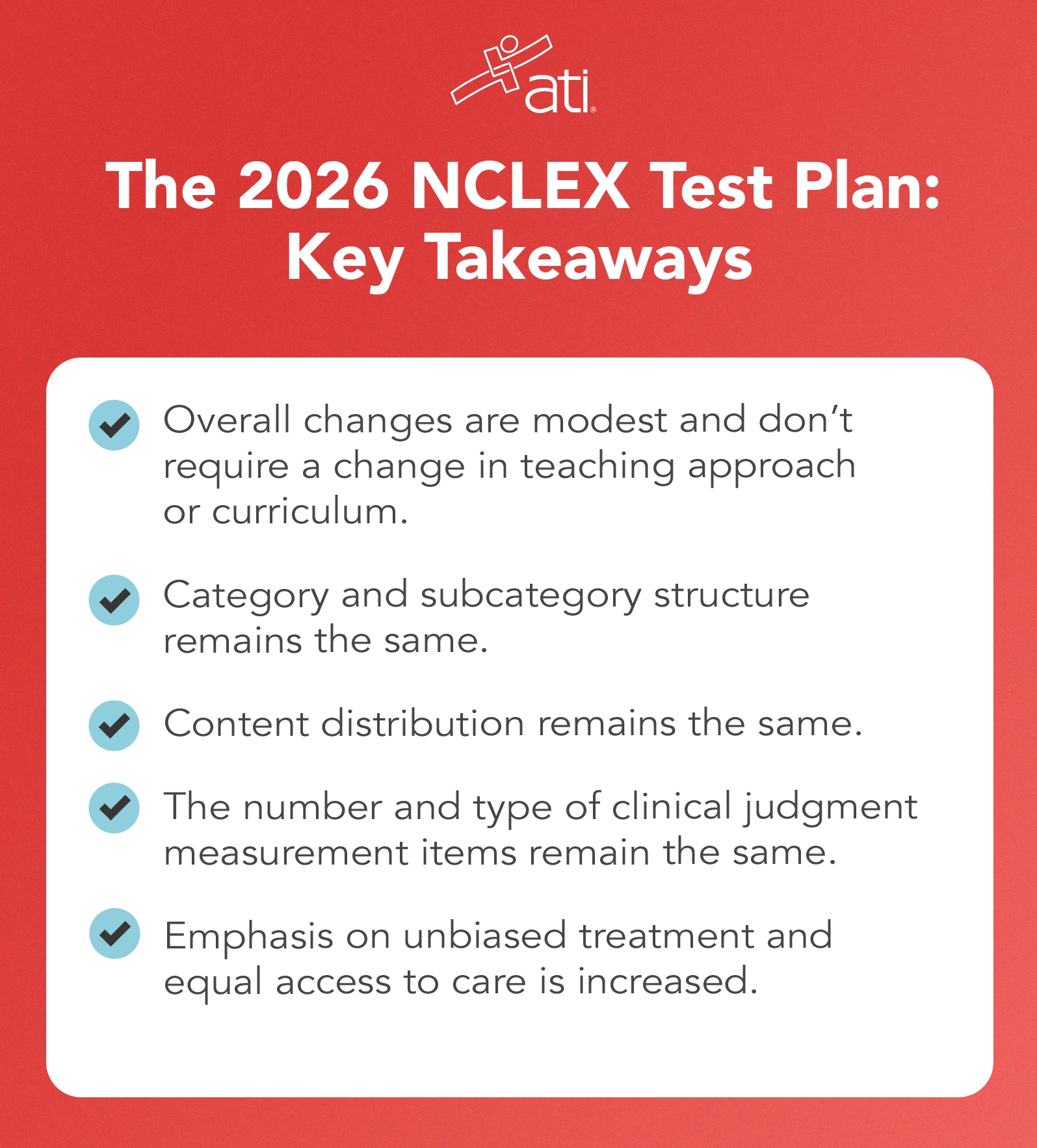
“Programs shouldn’t worry — no curriculum changes are needed if you are already following the current test plan,” said Pamela Roland, PhDc, MBA, MSN, RN, an ATI content strategist who specializes in NCLEX preparation. “The changes in the new plan are minimal.”
Comparing the 2026 & 2023 Test Plans
Although the changes to the test plan are not significant, they are important for faculty to understand. The list below breaks down what’s changing, what’s staying the same, and how ATI is ensuring your students remain fully prepared for their NCLEX exam.
1. Content distribution percentages are unchanged for RN and PN test plans.
The Client Needs category percentages (e.g., 15% to 21% for Management of Care, etc.) remain the same as in the 2023 test plan.
This is welcome news for curriculum planners, who often depend on these percentages to balance instructional time, Roland said.
2. Activity statements were added to RN and PN test plans (2 on RN, 4 on PN).
For RN exams, the following activity statements were added:
- Under Safe and Effective Care Environment, the NCSBN added this statement as an advocacy activity under Management of Care: “Perform care to support unbiased treatment and equal access to care, regardless of culture, ethnicity, sexual orientation, gender identity, and/or gender expression.”
- Under Physiological Integrity, Basic Care and Comfort, the NCSBN added this statement as a Personal Hygiene activity: “Maintain client dignity and privacy during care.”
In practice, this means students should be prepared to recognize and respond to scenarios where implicit bias may affect care delivery. Most programs already cover this content in health equity modules.
For PN exams, NCSBN added the following four activity statements:
- Under Safe and Effective Care Environment, Coordinate Care, Advocacy: “Perform care for clients to support unbiased treatment and equal access to care, regardless of culture/ethnicity, sexual orientation, gender identity and/or gender expression.”
- Under Safe and Effective Care Environment, Coordinated Care, Assignment/Delegation: “Utilize the rights of delegation (e.g., right task, right circumstances, right person, right direction/communication, right supervision/evaluation).”
- Under Coordinated Care, Collaboration with Interdisciplinary Team (Safe and Effective Care Environment): “Serve as resource to other staff.”
- Under Reduction of Risk Potential, Laboratory Values (Physiological Integrity): “Perform point-of-care testing (e.g., pregnancy test, troponin, urine dipstick).”
3. Activity statements were changed on RN and PN test plans (2 on RN, 2 on PN).
Beyond the additions listed above, NCSBN refined several existing activity statements to improve clarity and alignment.
On the RN test plan, NCSBN removed two activity statements under Physiologic Integrity but retained the activities by reassigning one to a different subcategory and rewording another.
- Intracranial pressure monitoring moved from Reduction of Risk Potential, Changes/Abnormalities in Vital Signs, to Physiological Adaptation, Alterations in Body Systems: “Monitor and maintain internal monitoring devices (e.g., intracranial pressure monitor, intrauterine pressure catheter).”
- Fetal monitoring, under Reduction of Risk Potential, Diagnostic Tests, was changed from “Perform fetal heart monitoring” to “Perform testing within scope of practice (e.g., electrocardiogram, point-of-care testing, fetal monitoring).”
On the PN test plan, NCSBN removed two activity statements but retained the activities by reassigning or rewording them.
- Under Physiologic Integrity, Reduction of Risk Potential, the new blueprint removed “Evaluate client oxygen saturation” from Potential for Complications of Diagnostic Tests/Treatments/Procedures and moved oxygen saturation to Changes/Abnormalities in Vital Signs. The wording is now “Monitor and evaluate client vital signs (e.g. oxygen saturation, blood pressure).”
- Under Safe and Effective Care Environment, Coordinated Care, Ethical Practice, the NCSBN made the following change: “Review client and staff member knowledge of ethical issues affecting client care” was revised to “Inform client and staff members of ethical issues affecting client care.”
4. Within the activity statements for RNs, NCSBN didn’t remove any tasks performed by entry-level nurses.
On the PN test plan, one activity statement was removed.
Under Psychosocial Integrity, Influences on Health, NCSBN removed the activity statement “Respect client’s self-reported religious/spiritual beliefs.”
5. A subcategory title in the RN and PN test plans was adjusted to add 2 words.
In the Client Needs categories for the PN and RN exams, the subcategory of Safety & Infection Control became Safety & Infection Prevention and Control. The definition of this category did not change.
6. Many things remain the same: exam structure, length and format.
NCLEX candidates will continue to receive:
- A minimum of 85 items (maximum 150)
- 5-hour testing window
- 3 scored case study item sets (18 items total)
- 15 unscored pretest items (which may include a case study)
- Standalone clinical judgment items comprising about 10% of test content
- Partial credit scoring.
The 2026 test plan makes no changes to computerized adaptive testing scoring or how exam questions are mapped to the NCSBN Clinical Judgment Measurement Model.
What These Changes Mean for Faculty
With these changes in mind, what should faculty do differently? The answer is reassuring: More of the same. The box in this section provides key guidance. Commenting on the overall impact of the test plan changes, Roland emphasized that the new activity statements align with best practices faculty already teach and that the 500+ activity statements continue to anchor preparation across the curriculum. 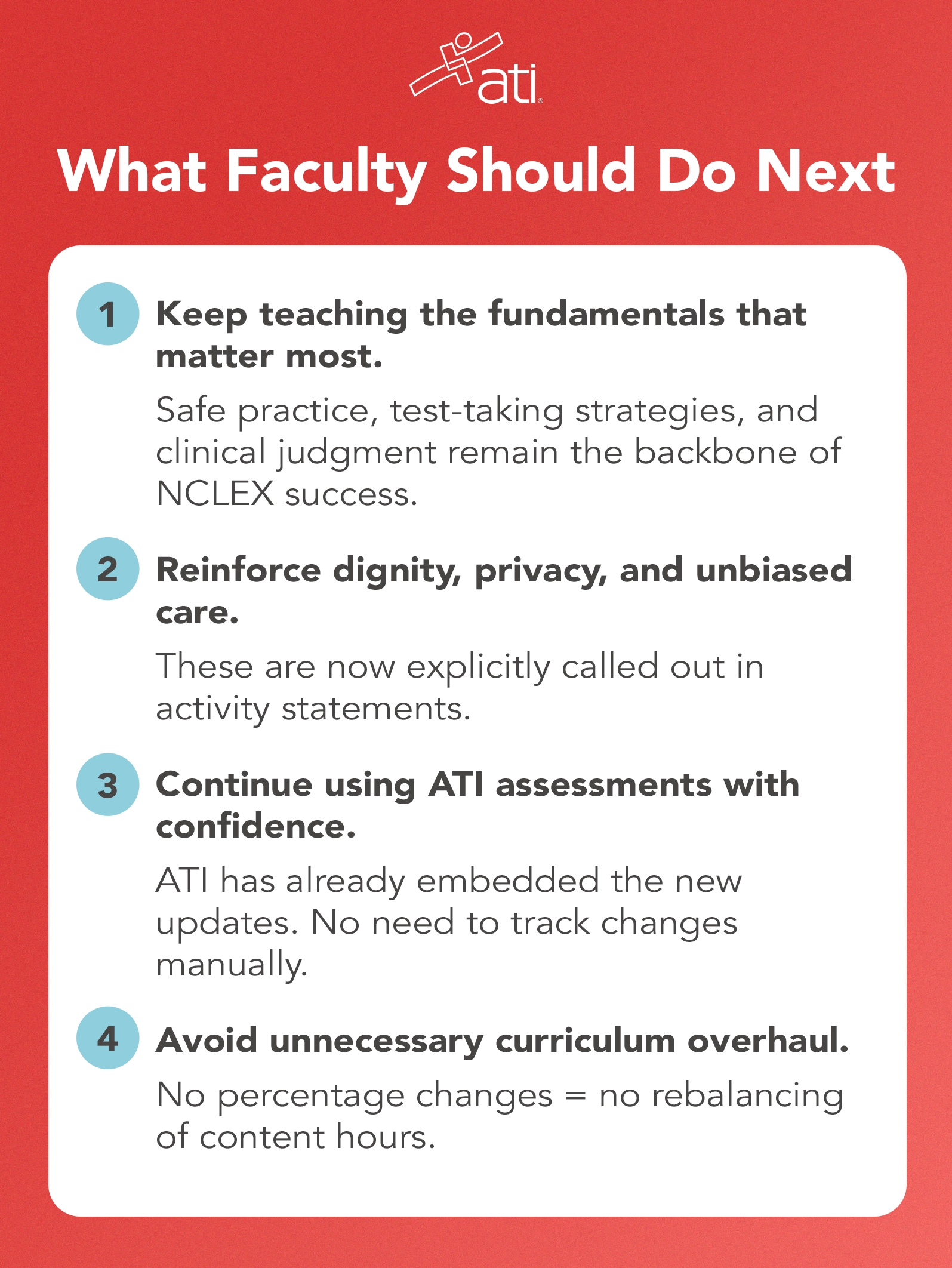
She recommends that faculty continue to:
- ensure every activity statement is taught somewhere across the program
- emphasize safe practice readiness
- reinforce clinical judgment strategies
- teach unbiased, equitable, dignity-centered care.
How ATI Adapts to the New Test Plan
Programs that use ATI teaching and assessment resources will experience a seamless transition of material. “Everything ATI releases in 2026 or later will reflect the new test plan,” Roland said.
ATI adapts to each new NCLEX test plan by:
- conducting a detailed crosswalk of all activity statements
- using the crosswalks to identify every ATI item mapped to those statements
- writing new content and test items where needed
- re‑evaluating all items tied to changed or removed statements and making any necessary adjustments or updates.
ATI teams are making the necessary, albeit minor, revisions to ensure that learning and assessment materials reflect the new test plan. These revised items will appear in the Comprehensive Predictor®️ in April 2026 and the Content Mastery Series®️ exams as each course-specific exam rotates for its scheduled release.
The 2026 NCLEX Test Plan is a Low-Impact Update
Compared to the substantive shift required by the 2023 test plan introducing the measurement of clinical judgment, the 2026 NCLEX test plan is a minor alignment. The new activity statements affirm essential values — equity, dignity and safety — that programs already integrate into teaching.
“Overall, the changes in the new test plan are minor,” Roland said. “Format and structure were retained, and NCSBN made minor edits for clarity. Core definitions did not change, and percentage ranges did not change. All activity statements are intact except the one removed from the PN exam.”
From a curriculum perspective, no changes are needed. “These added activity statements reflect things RNs and PNs already do,” Roland said. “Programs can feel confident that maintaining their focus on developing students’ nursing knowledge and clinical judgment skills will help them graduate nurses who are confident and practice ready.”