
Nurse Educator Blog
State of Nursing Education
The State of Nursing Education is the authoritative ATI series examining key issues affecting today’s academic nursing programs, deans and faculty.
Explore All ArticlesReframing Nursing Curriculum to Improve Practice Readiness

Why Concept-Based Learning Is Gaining Momentum
As healthcare environments become more complex, academic nursing programs are feeling distinct pressure to ensure their graduates meet a higher readiness bar. Employers want new nurses who are ready to think, prioritize, and make sound clinical decisions in real-world settings.
In response, many programs are adopting a concept-based learning approach. This method reframes the teaching focus from nursing content as individual disease processes to the concepts nurses repeatedly encounter in practice.
This article provides an overview of concept-based learning and shares research and resources that support its integration.
From Memorization to Clinical Application
Concept-based learning organizes teaching around core concepts rather than individual diagnoses. The student explores each concept through exemplars, which are clinical conditions that illustrate how the concept presents across populations and settings.
For example, rather than learning pneumonia, cystic fibrosis and pulmonary embolism as separate units, students focus on learning the concept of oxygenation: what it is and its appropriate nursing and medical management. Then, they apply that understanding across multiple conditions.
The approach is designed to combat a challenge familiar to nursing faculty: the overwhelming volume of information students are expected to absorb. “The idea behind it is that it organizes information into much more manageable concepts,” said Susan Wade, MSN, RN, CPN, CCRN, an Integration Specialist Nurse Educator for ATI. “Instead of just teaching in the single disease model, the concepts reoccur.”
In concept-based curricula, emphasis shifts from memorizing content to recognizing patterns and applying knowledge. The goal outcome of concept-based learning is better preparation for nursing practice.
Aligning Nursing Curriculum With Clinical Practice
Concept-based learning has become part of national conversations about nursing curriculum as programs seek ways to streamline content and provide more opportunities for synthesis and application. This teaching approach focuses on what transfers from one situation to another, potentially creating a more connected learning experience.
“Instead of learning each disease process, learners focus on the core concepts and applying that concept to disease processes,” said Lisa Homer, PhD, RN, CNE, a Nursing Content Strategist for ATI. “It encourages clinical judgment and higher-order thinking, rather than rote memorization.
Active learning that emphasizes the student experience is a key to the success of this approach. “Concept-based learning encourages active learning because it’s a student-centered approach in which students apply knowledge from concepts to different patient situations as they progress through the nursing program,” Wade said.
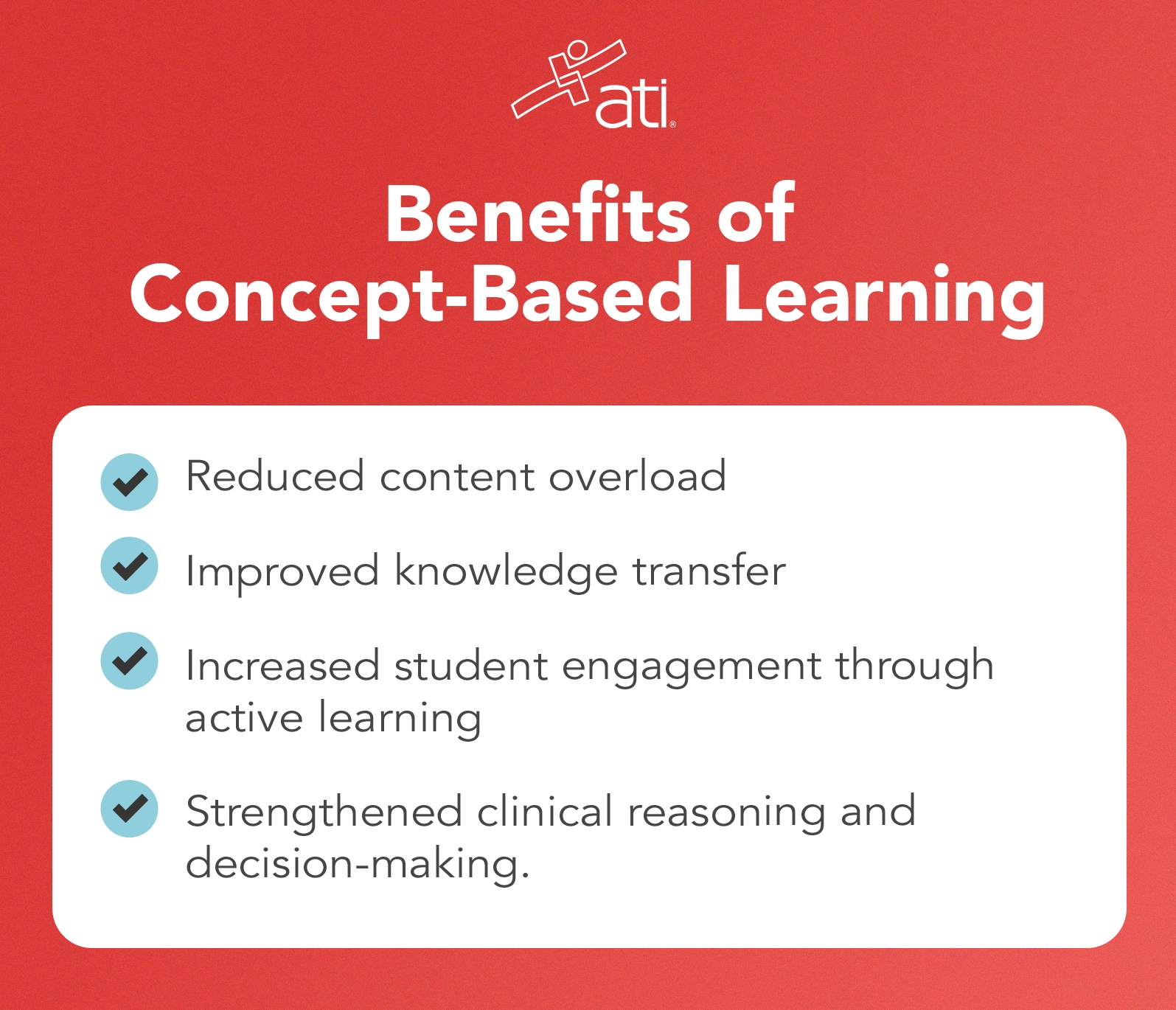
Recent research and implementation studies1-4 have linked concept-based approaches to distinct benefits, including those listed at left.
What is Required to Adopt a Concept-Based Curriculum?
To adopt a concept-based curriculum, faculty must rethink how courses are structured, how content is delivered, and how learning is assessed. This requires a shift not only in thinking but also teaching and learning practices.
"It's common to see resistance to this change,” Dr. Homer said. “Switching from a traditional, disease-focused model requires work."
Concept-based learning asks students to analyze, compare and apply. But most students are accustomed to being asked to recall and repeat learning material. The transition may take some time.
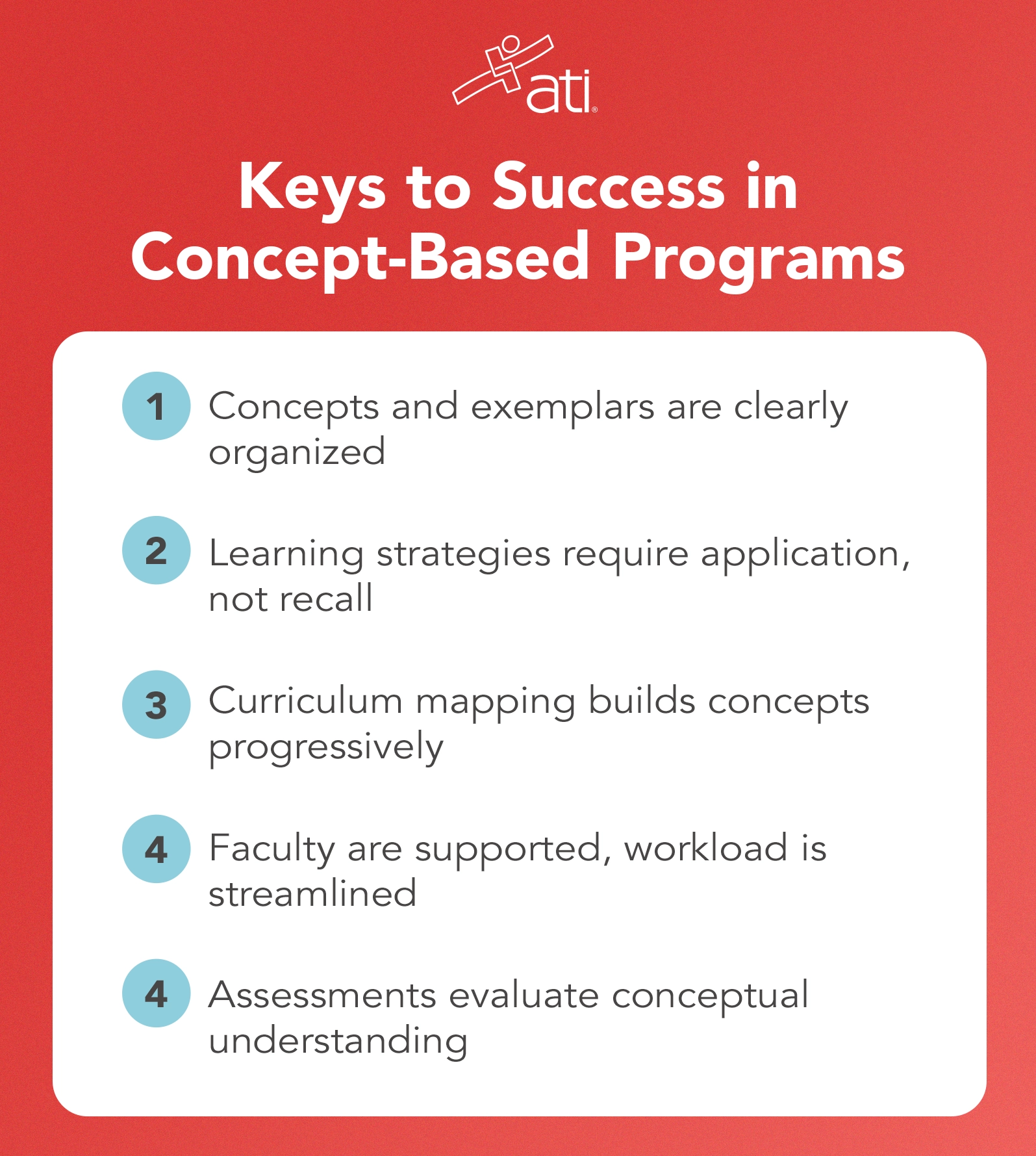
Research shows that successful concept-based programs tend to share a few common characteristics (see the "Keys to Success" box below).1-4 When programs have the right structure and resources, they can maintain consistency across courses, align exemplars effectively, and support faculty through the transition.
A Purpose-Built Resource for Concept-Based Learning
Even when faculty understand the value of concept-based learning, implementation often stalls without tools designed for this approach. Common questions and concerns include:
- How do we pull concept-related content together without increasing faculty workload?
- How do we ensure consistency across courses and instructors?
- How do we support students as they adjust to a new way of learning?
- How do we keep learning active, engaging, and clinically relevant?
To answer these questions and meet these needs, ATI developed Engage® Nursing Concepts, a learning platform built specifically to support faculty and programs that use concept-based curricula.
Engage Nursing Concepts aligns existing Engage Series content to nursing concepts and exemplars. Students receive the same experience-rich learning provided in all offerings in the Engage Series. (In spring 2026, the Engage Series consists of Engage Adult Medical-Surgical, Engage Community & Public Health, Engage Fundamentals, Engage Mental Health, Engage Maternal, Newborn and Women's Health, Engage Nursing Concepts, Engage Pediatrics, and Engage Pharmacology.)
The content in Engage Nursing Concepts is organized around more than 40 core nursing concepts and 240 exemplars, directly aligning learning resources with how concept-based programs are structured. By incorporating Engage Nursing Concepts, programs don't have to reconfigure or retrofit existing learning material to implement concept-based learning.
During pilot studies5 prior to the release of Engage Nursing Concepts, educators identified multiple strengths in the new resource, including:
- Well-developed exemplars supported by case studies and activities
- Integrated anatomy, physiology and pharmacology content to reinforce understanding
- Embedded lifespan perspectives within learning materials
- Organization that makes it easy for students to follow and apply concepts.
One educator praised the case studies in particular, noting that they will help students put concepts into practice through the use of the nursing process, thus reinforcing learning beyond the classroom. Another pilot participant described the integrated anatomy review as "excellent and necessary to truly understand the concept being taught." This feedback illustrates how foundational knowledge supports conceptual thinking — the ultimate goal of concept-based learning.
A standout feature highlighted during pilot testing was the concept analysis map embedded within each module.
"Concept maps are really going to help build clinical reasoning because they're nonlinear," Wade said. "They help students think like a nurse, make important connections, and build clinical reasoning."
Students can use concept maps independently when studying, and faculty can project them in class for group exercises. They continue as a relevant reference point throughout clinical rotations, Wade said.
Other pilot participants expressed appreciation for seamless connections between content and related ATI resources and 3D anatomy images. "I think this will follow our concept-based curriculum well," one nurse educator wrote. "It is organized in a way that will be easy for students to follow."

How Engage Nursing Concepts Develops Clinical Judgment
Engage Nursing Concepts, like the entire Engage Series, provides a unified multimodal environment where students learn, practice, assess, and remediate clinical judgment skills — moving from understanding concepts to applying them in practice.
Learning experiences include interactive cases, simulations, 3D models, EHR-based activities, and AI-supported learning through Claire AI®️, the artificial intelligence engine specific to nursing education. Claire AI is embedded in multiple ATI resources to streamline faculty workload, personal student learning, and expand study and testing resources. (Read more about these functions in this article.)
"Claire pulls directly from ATI content," said Jennifer Stravinsky, a Product Training Specialist for ATI. "Claire AI’s guardrails prevent students from getting outside of ATI content. This means the assistance they get from Claire AI is based on quality, evidence-based information.”
For students, this creates a consistent support system across the arc of their learning.
“It's like having a little mini-mentor sitting on their shoulder 24/7,” Wade said. She added that Claire fields student questions in the moment — which means faculty aren’t disturbed in the middle of the night.
Claire AI’s value extends to faculty through detailed insights. Student interactions with Claire are aggregated and displayed to educators in an analytics dashboard, giving instructors real-time insight into where students are struggling.
“Educators can then take that data to guide their conversation in class the next day,” Stravinsky said. “You'll have insight into the topics your students are concerned about and can revisit them as a group.”
Engage Nursing Concepts also provides built-in remediation, real-time insights, and comprehensive, supportive onboarding. Programs receive ready-to-use teaching tools that help promote consistency across courses and keep student engagement high.
How Engage Nursing Concepts Reduces Faculty Workload
The features in Engage Nursing Concepts and the Engage Series help streamline faculty workload and save time.
"Engage Nursing Concepts will pull content related to all core concepts together in one place for faculty and students," Dr. Homer said. "The educator resources also provide active learning strategies, which saves faculty time when they’re designing their courses."
Educator resources include lesson plans, slide decks, and case studies based on the NCSBN Clinical Judgment Measurement Model. Wade encourages faculty to approach these tools with flexibility and consider using them in class, clinical, lab, and simulation environments.
"I think of the lesson plans as a buffet — you're not going to use every single item, but pick and choose what works for you and your students for that particular day," she said. "Engage Nursing Concepts provides multiple ideas and reflection questions, so some of the work has already been done for you. It can make your life a little bit easier and maximize your time."
A searchable, 125-page learning module overview — which Stravinsky describes as "the bullet points of exactly what you need to know about that module" — helps faculty quickly locate specific content, identify video lengths for lesson planning, and pinpoint resources suited for classroom, lab, clinical, or simulation use. This minimizes the need to scroll through the product itself.
By centralizing content, aligning exemplars, and providing structured teaching tools, Engage Nursing Concepts can help reduce the friction that often accompanies curriculum change.
Turning Concept-Based Learning Into Practice Readiness
The gap between academic preparation and workplace readiness is a challenge the nursing profession is committed to address. Concept-based learning is a curriculum path that can help meet this goal.
For programs that are ready to make this shift or seek to strengthen a transition already under way, incorporating a resource designed to support concept-based learning provides peace of mind. Engage Nursing Concepts brings valuable content, structure and faculty support together in one place. The focus can stay where it belongs: on preparing students for the realities of practice.
References
- Al-Omari E, Dorri R, Blanco M, Al-Hassan M. Innovative curriculum development: embracing the concept-based approach in nursing education. Teaching and Learning in Nursing. 2024. https://doi.org/10.1016/j.teln.2024.04.018
- Harrison CV. Concept-based curriculum: design and implementation strategies. International Journal of Nursing Education Scholarship. 2020;17:20190066. https://pubmed.ncbi.nlm.nih.gov/32892175/
- Pyatt A. Lessons Learned: Implementation of a Concept-Based Curriculum in the Development of a New Prelicensure Nursing Program. Nursing Education Perspectives. 2021;42(6):E103-E104. DOI: 10.1097/01.NEP.0000000000000827
- McCormick M, Martin K. Strategic Curriculum Overhaul in a Bachelor of Science in Nursing Program: Integrating Concept-Based Frameworks, Competency-Based Assessment, and AI Innovation. Medical Research Archives. 2025;13(9). https://doi.org/10.18103/mra.v13i9.6920
- ATI Nursing Education. Pilot testing feedback, Engage Nursing Concepts. 2025.