Active Learning Strategies to Start Today

6 Practical Ways to Engage Your Nursing Students
Today’s nursing classrooms include Gen Y and Gen Z learners who are motivated, tech savvy, and tend to work hardest when they feel that work has purpose. They’re also digital natives who turn to search engines and videos more often than textbooks or articles. Put it all together and it’s clear that incorporating active learning is becoming essential.
Meeting this need isn’t complicated, tech heavy or time-consuming. This article provides clear, practical active learning strategies you can start introducing in your classroom today.
Keys to Creating an Active Learning Environment
How should faculty begin creating an active learning environment? Amber Williams, DNP, APRN, FNP-BC, RNC-MNN, an integration specialist nurse educator for ATI Nursing Education, boils it down to this: Prepare meaningful preclass activities that focus on knowledge acquisition.

This process begins by identifying your objective. What do you want students to learn? “Then, communicate that to them,” Dr. Williams said.
“When you explain your purpose and goal, it helps your students see the value in the information, and you get their buy-in,” she continued. “Remember — those Gen Y and Gen Z students will work hard if they believe that work has meaning.”
Dr. Williams recommends using classroom time to actively engage students in higher-level learning. “Don't focus on the easy,” she said. “Focus on the difficult. Support application of knowledge in clinical situations by bringing that patient or situation into the classroom.”
She also recommends reinforcing to students that they are responsible for their own learning.
“The connections students make are individual, so they are individually retrieved,” Dr. Williams said. “The work of learning is their own. Develop relevant, challenging learning activities that align to your outcomes.”
This requires engaging students in rich learning activities for up to 70% of classroom time.
“That means if your class is 1 hour, you're doing active learning activities for roughly 40 minutes,” she said. “Incorporate activities to engage, enhance, and improve clinical reasoning.”
To assist educators in these important efforts, Dr. Williams shared the 6 active learning techniques described below.
1. Start Class with Retrieval Practice
Retrieval is a powerful learning tool because the struggle to recall information strengthens memory. Rather than review material for students, Dr. Williams recommends asking them to pull it forward themselves.
Use activities that force students to demonstrate their competence and confidence in what they have learned, she said.
Try these retrieval practice activities today:
- Memory dump: Ask students to jot down everything they remember about a lecture topic from the day before.
- Quick poll: Use clickers, cell phones or your LMS to ask 2 or 3 low‑stakes questions. Display the results on a screen or make them visible on students’ phones using an app like Kahoot.
- Mini-quiz: At the start of class, share 1 to 3 items on foundational content, then ask students questions about the material.
- 3-2-1 exit ticket: Have students write down 3 things they’ve learned about a specific topic, 2 ways to apply that knowledge, and 1 question they still have about it.
- Think-pair-share: Encourage cooperative learning by asking students to process information individually, then in small groups, then with the full class.
“All of these strategies help students identify gaps and strengthen long‑term memory,” Dr. Williams said.
2. Make Learning Visual & Multisensory
People tend to retain up to 90% of what they say and do — and only 10% of what they read.1 That means hands-on, visual activities are quite powerful. Using mobile apps, virtual simulations, and learning games, educators can spur student exploration of how concepts are interrelated. This helps cement knowledge.
Concept mapping can be helpful here, Dr. Williams said. In concept mapping, the educator places a central concept at the center of a page or the board, then asks students to connect related concepts in a visual structural diagram.
“The visual nature of the exercise helps students see the connections between concepts. It's a great interleaving activity,” she said. “And the active nature of the exercise enhances students' conceptual thinking by helping them recognize similarities and differences.”
It also helps them link information with previous knowledge and organize information to relate to nursing practice. “Those visual links make information easier to retrieve when needed,” Dr. Williams added.
Try these multisensory approaches today:
- Concept mapping: Display a central concept and have students add related ideas. Keep it low tech with a whiteboard, dry erase markers, and sticky notes. Assign roles to students to bring together the relevant information. Take it further by having them explain their rationale, discuss as a group, and make changes as needed. Guide them to come to a consensus.
- A picture is worth 1,000 words: Share a clinical situation by painting a picture in students’ minds. Describe the scene and circumstances in great detail. Then, have students work together to progress through all 6 functions of clinical judgment, based on the details.
- Video cues: Incorporate the use of short video clips over static images, when possible, to mesh with the information preferences of Gen Z learners.
3. Use Quick, High-Engagement Case Studies
Case studies activate metacognition and help build clinical judgment.2,3 They can be comprehensive and lengthy, but they’re also effective when they’re designed simply and can be completed quickly.
A fun way to engage students with case studies is to adapt bowtie-style questions to mimic the game Boggle. Create a template such as the one shown here and use whiteboards or paper versions placed at tables. Students can use sticky notes or cards to place information in the correct spots.
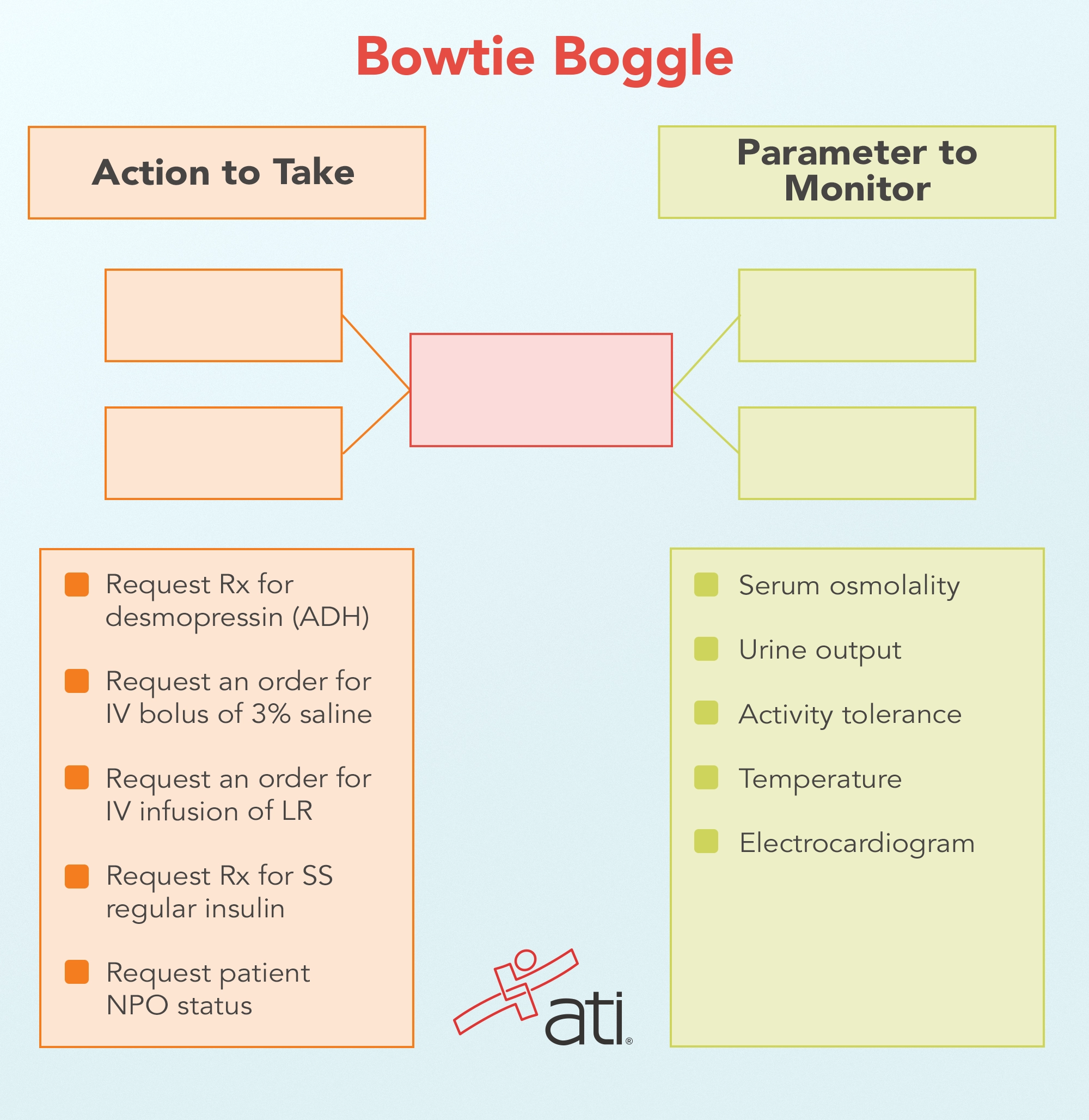
“Then they can explain their rationale, discuss it with other teams, and decide on the best options,” Dr. Williams said. “As with the actual bowtie questions on the NCLEX exam, this exercise uses all 6 functions of the clinical judgment model. And if they have become familiar with these in class, they are much less anxious when they see these question types on the exam.”
Try these case study approaches today:
- 2-sentence case studies: Present 2 brief descriptions (e.g., diabetes scenarios) and ask students to distinguish between them (e.g., Type 1 diabetes vs. Type 2 diabetes). Then ask students to identify priority cues, labs, complications, and other factors related to either diagnosis.
- Bowtie Boggle Lite: Using a simplified bowtie question template, ask students to place sticky notes or note cards to identify cues, actions and outcomes.
- Prediction rounds: Reveal small chunks of a scenario at a time and have students anticipate what comes next.
This micro approach to case studies activates all 4 cognitive science principles: retrieval practice, spacing, interleaving and metacognition.
4. Encourage Critical Thinking With Socratic Questioning
Socratic questioning is a powerful learning tool, but it should be delivered with sensitivity. This form of questioning should be challenging but not demeaning, Dr. Williams said.
In Socratic questioning, educators ask probing questions to facilitate connections and identify misconceptions. They can then analyze them at a deeper level and work to close gaps in understanding.
Try Socratic questioning today:
- Ask open-ended questions. Avoid closed questions that prompt only a “yes” or “no” answer.
- Ask students to reflect on their answers: “What makes you think that?”
- Allow time for students to reflect. Don’t rush.
- Provide a “phone a friend” option to get help.
- Leave space for students to look up answers (a “Google timeout”).
This approach encourages critical thinking without fear of failure, Dr. Williams said. “Even when they answer correctly, the process helps them retrieve information and explain their rationale. This builds stronger neural connections.”
5. Activate Learning with Movement
Station activities are one of the quickest ways to ignite curiosity. For this activity, Dr. Williams recommends starting class by having students rotate through 5 stations, spending less than 5 minutes at each.
The stations should require them to engage in somewhat difficult activities, such as writing their name with their nondominant hand or communicating without speaking to illustrate patients with stroke sequela. They can feel what it may be like to accomplish those tasks.
“As a result of these 20 minutes, they are now intrigued,” she said. “This really forces them to pull from what they know and predict what they don't. Afterward, debrief as a class.”
Another variation would be to have students work at a couple of stations before working on a skill, Dr. Williams said. “For example, have students draft a checklist for how they will perform the skill. Or, draft a list of supplies they might need,” she explained. “They can also identify common errors, by thinking about what could go wrong.”
This strategy also incorporates all 4 cognitive science principles, with emphasis on reflection for meaning.
“Reflection is how students make conscious connections between their actions and the results that they lead to,” Dr. Williams said. “Without that conscious awareness of distinct roles of individual and collective actions, there is no meaning. This ties back to the all-important metacognition phase of the learning process.”
Try station rotations today:
- Write with the nondominant hand.
- Communicate without speaking.
- Conduct a quick cranial nerve assessment.
- Reflect on a symptom pattern or emotional response.
Each station blends retrieval, prediction and emotional connection — key ingredients for knowledge retention.
6. End Class with Meaningful Reflection
Reflection is a vital element of learning. An important point to remember is that reflection isn’t just journaling. It’s metacognition.
“Reflection for meaning helps students make conscious connections between their actions and the results,” Dr. Williams said. “Students should really be reflecting on everything. But first, you might need to help them guide their reflecting. It needs to be meaningful, not simply saying that it went well.”
When students are provided with an organizational structure for new knowledge, they learn more effectively and efficiently. Use the clinical judgment model for reflecting or pose specific questions to guide reflecting, Dr. Williams said.
Try these reflection activities today:
- Ask: “What was the right thing to do in this scenario? Why?”
- Instruct students to submit a 1‑minute care plan.
- Use the clinical judgment model as the framework for reflection.
“Reflection transforms experience into lasting competence,” Dr. Williams said.
Choosing the Right Active Learning Strategy for Your Class
These 6 strategies set a strong foundation for active learning, but successful implementation requires thoughtful planning. When determining the right strategy for your class, Dr. Williams recommends adhering to a few principles:
- Organize your activity in advance. “Students will respond more positively when they feel like their time isn't wasted,” she said. Determine how much time is needed for the activity and content.
- The activity should address what's hard, not what’s easy.
- Consider the environment (classroom, tiered auditorium, a flat lab space?). It all influences which types of activities are realistic.
- Consider your students. Is the group large or small? Quiet or vocal? New students or ready to graduate? Try breaking large groups into groups of 2 to 4 students.
And perhaps most importantly, “Students really need to understand the purpose of the activity,” she said. “Be transparent. Let them know when it's the first time you're trying something, and tell them why. Clarify your expectations for participation.”
For classroom assessment, informal evaluation tools can be used prior to, throughout, and at the end of any class period. All of these provide opportunities for retrieval, reflection and retention.
“Small shifts can create powerful learning moments,” Dr. Williams said. “Try just one of these strategies in your next class.”
Remember, active learning doesn't require a complete course overhaul. Start with one strategy, observe the results, and build from there. Small, intentional changes in how you structure class time can influence and improve student engagement, knowledge retention, and clinical judgment development — ultimately preparing your students for both exam success and real-world nursing practice.
References
- Brown PC, Roediger HL, McDaniel MA. Make It Stick. The Science of Successful Learning. 2014. The Belknap Press of Harvard University Press. https://www.makeitstick.com/
- Liu W. Development of Clinical Decision-Making Among Undergraduate Nursing Students: the Effect of Unfolding Case-Based Learning. International Journal of Nursing Education Scholarship. 2024;21(1):2023115. https://doi.org/10.1515/ijnes-2023-0115
- Watkins M, Fruin BW, Brett A. Using Active Learning to Develop Clinical Judgment in Nursing Students. Teaching and Learning in Nursing. 2025;20(4):e1170-e1175. https://doi.org/10.1016/j.teln.2025.06.005
About the author: Michelle Perron is a healthcare writer and editor who develops evidence-based content for ATI Nursing Education. With more than 20 years of experience in healthcare publishing, journal development, medical editing, and editorial management, she helps connect nursing research and education best practices to today's faculty needs.